Implants don’t come with an expiration date — but the FDA is clear that they’re not lifetime devices. The 10-year mark is when most surgeons start the conversation about replacement, though many implants run 15–20 years without issue. What actually drives the decision isn’t a calendar; it’s specific complications and how your body changes.
Here’s what the data says — and what it costs to plan ahead.
What the FDA Actually Says
The FDA’s guidance on breast implants states explicitly that they’re not considered lifetime devices and that patients should plan for the possibility of revision surgery at some point. The agency’s long-term studies tracked implant survival and found:
- Saline implants: rupture rates of about 3–5% at 3 years, increasing over time
- Silicone gel implants: rupture is typically “silent” — no obvious symptoms — which is why the FDA recommends MRI screening starting 5–6 years after placement, then every 2–3 years
The ASPS 2023 statistics report that breast augmentation remains the most performed cosmetic surgery in the United States, with over 300,000 procedures annually — meaning hundreds of thousands of patients are cycling through the 10–20 year replacement window every year.
What Actually Causes Replacement
Patients don’t replace implants at 10 years by default. Most replacements happen because of one of these triggers:
| Reason for Revision | How Common | Typical Timing |
|---|---|---|
| Capsular contracture (scar hardening) | Most common complication | 3–10 years post-op |
| Implant rupture | ~1–2% annual rate after year 5 | 7–20 years |
| Desire to change size or style | Patient preference | Any time |
| Rippling or visible edges | More common with saline | 5–15 years |
| BIA-ALCL (rare lymphoma) | Very rare; textured implants | Variable |
| Natural body changes (pregnancy, weight) | Varies | Any time |
| Bottoming out or malposition | Technical/healing related | 1–10 years |
Capsular contracture — where scar tissue tightens around the implant — is the most common reason for early revision. It happens in roughly 10–15% of augmentation patients over 10 years, and it can cause firmness, discomfort, and distortion of shape that makes revision necessary before any implant failure.
The 10–20 Year Window: Planning for Costs
If you’re getting implants in your late 20s or 30s, assume you’ll likely have at least one revision procedure over your lifetime. Here’s what to budget:
| Procedure | Typical Cost Range | Notes |
|---|---|---|
| Implant exchange (size/style change) | $4,000–$9,000 | Simpler if no capsule work |
| Capsular contracture repair | $5,000–$12,000 | Includes capsulectomy |
| Breast implant removal only | $3,000–$7,000 | En bloc if requested |
| Removal + replacement | $6,500–$15,000 | All-in |
| Removal + lift (explant + mastopexy) | $9,000–$18,000 | Common after long-term use |
The lift question is one most patients don’t anticipate at the time of their original augmentation. After 15–20 years — especially with pregnancies or significant weight changes — the breast tissue has often changed enough that implant exchange alone doesn’t restore the original look. Many patients in their 40s and 50s end up combining breast implant removal with a breast lift, which adds to the total cost.
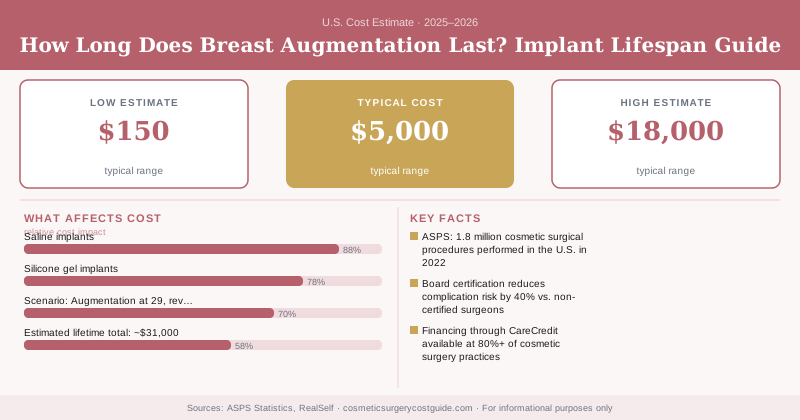
Scenario: Augmentation at 29, revision at 47, final explant/lift at 61
- Initial augmentation: $8,000
- Implant exchange + capsule work at year 18: $9,000
- Explant + mastopexy at year 32: $14,000
- Estimated lifetime total: ~$31,000
Spread over 32 years, that’s under $1,000/year — but it means the “cost” of breast augmentation isn’t the single upfront payment. Planning ahead financially makes each revision less stressful.
Does Insurance Cover Revision?
Rarely. Most revisions for capsular contracture, rupture, or size change are considered elective and not covered. The exception: if rupture causes documented pain or there’s a medically necessary basis (such as infection or BIA-ALCL diagnosis), some policies may partially cover removal.
Breast implant removal for BIA-ALCL — the rare lymphoma linked to textured implants — is generally considered reconstructive and more likely to receive coverage.
The MRI Monitoring Cost
If you have silicone implants, the FDA recommends periodic MRI to screen for silent rupture. That’s typically $500–$1,000 per scan depending on location and insurance. Over a 20-year period with scans at years 5, 8, 11, 14, and 17, you’re looking at $2,500–$5,000 in monitoring costs alone — worth factoring into your total picture.
Some surgeons offer ultrasound as a lower-cost alternative (around $150–$300/scan), though MRI is the gold standard.
Implants placed through a breast crease (inframammary) incision are easiest to revise. Implants placed through an armpit (transaxillary) or belly button (TUBA) require more surgical complexity at revision and sometimes mandate a new incision approach entirely. If longevity and revision ease matter to you, ask your surgeon about this when choosing your incision location.
How to Extend Implant Lifespan
There’s no guarantee, but these factors consistently correlate with longer implant life:
- Maintaining a stable weight (prevents tissue stress on implants)
- Wearing a supportive bra, especially during high-impact activity
- Following up with your surgeon at signs of firmness or shape change — early capsular contracture intervention is less invasive than late-stage repair
- Choosing a board-certified plastic surgeon with high-volume augmentation experience (lower complication rates on published data)
Bottom Line
Plan for one revision in your lifetime — probably somewhere between year 10 and year 20. The exact timing depends on your body, your implant type, and whether you have complications. Budget an additional $5,000–$15,000 for that future procedure when you’re making your original decision. The total lifetime cost is manageable, but it’s not the single number on your surgeon’s initial quote.
Frequently Asked Questions
Breast implant revision typically costs $8,000–$15,000, though prices vary by surgeon experience, geographic location, and whether complications like capsular contracture require additional work. Revision is generally more expensive than primary augmentation ($5,000–$12,000) because it involves removing scar tissue and repositioning existing implants or placing new ones.
Most health insurance plans do not cover cosmetic breast implant replacement since the original augmentation was elective. However, if revision is medically necessary due to rupture, infection, or severe capsular contracture, some plans may cover part of the surgical costs—you'll need pre-authorization and documentation from your surgeon. Out-of-pocket costs typically range from $5,000–$15,000 depending on the reason for revision.
The FDA recommends discussing replacement at the 10-year mark, though many implants safely last 15–20 years without problems. Your surgeon will recommend earlier replacement if you experience rupture, visible changes in shape, pain, or significant sagging—not based on a set timeline alone. Plan for revision costs in your long-term budget if you want to maintain your results beyond 15 years.