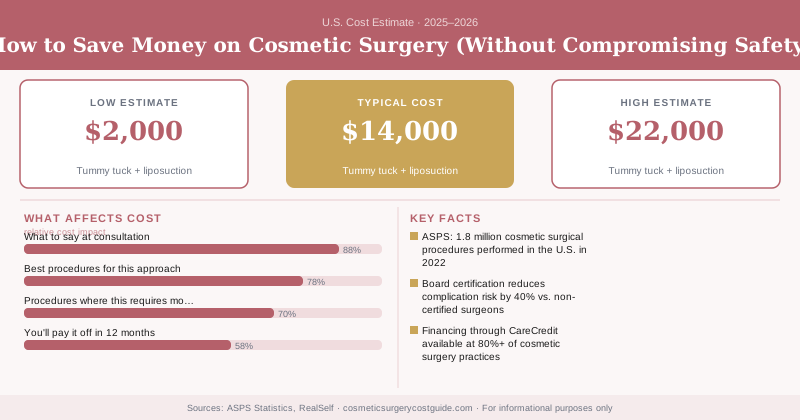
Cosmetic surgery is priced to be negotiable — more than most patients realize. Surgeons manage operating room schedules, anesthesiologist blocks, and facility bookings. Off-peak slots get discounted. Combining procedures shares fixed costs. Resident training programs offer substantially reduced fees. None of these strategies compromise safety when used correctly.
Here’s how to actually lower your total cost.
1. Off-Peak Scheduling: 10–20% Discount
Most cosmetic surgery practices have seasonally slow periods — January through March is typically the slowest quarter. Practices often offer incentives to fill OR time during these months: procedure discounts of 10–20%, waived consultation fees, or complimentary add-ons.
Summer can also be slower in some markets (patients traveling, school-age children home). Ask your surgeon’s office directly: “Are there times of year when pricing is more flexible, or when you have OR time available at a lower rate?” It’s a normal question. Many practices answer yes.
What to say at consultation: “I’m very interested in proceeding, but I have some flexibility on timing. If there are slots available where pricing might be more accessible, I’d love to know about those.”
This signals you’re a serious patient with price flexibility — not someone looking for a cheap surgeon. Most practices will offer a specific date or timeframe if one exists.
2. Combo Procedures: Share Fixed Costs
Every surgical case has a fixed overhead: OR time setup, anesthesiologist block (often minimum 2 hours), surgical team, and recovery room. When you combine two procedures into one surgical session, those fixed costs are shared.
A tummy tuck alone might have $2,000 in facility fees. Adding liposuction to the abdomen during the same case might add $1,500–$2,000 in surgeon time — but saves you the full facility and anesthesia overhead of a second operation. Net savings: often $2,500–$4,500.
| Combination | Individual Total | Combined Pricing | Typical Savings |
|---|---|---|---|
| Tummy tuck + liposuction | $14,000–$22,000 | $11,000–$18,000 | $2,000–$4,000 |
| Breast augmentation + lift | $13,000–$22,000 | $10,000–$18,000 | $2,000–$5,000 |
| Mommy makeover (aug + lift + tummy tuck) | $20,000–$38,000 | $15,000–$28,000 | $5,000–$10,000 |
| Facelift + blepharoplasty | $14,000–$28,000 | $11,000–$22,000 | $2,500–$6,000 |
| Rhinoplasty + chin augmentation | $12,000–$22,000 | $10,000–$18,000 | $2,000–$4,000 |
The recovery consideration: combined procedures have longer recovery than single procedures. A mommy makeover typically requires 3–4 weeks before returning to work vs. 2 weeks for any individual component. Make sure the recovery timeline works before optimizing on cost.
3. Resident Surgeons at Academic Centers
Board-certified plastic surgeons didn’t start board-certified — they completed 5–7 years of surgical residency first, operating under attending supervision. Academic medical centers with plastic surgery residency programs offer procedures at reduced rates performed by residents under attending oversight.
The ASPS notes that accredited training programs maintain rigorous supervision standards. For straightforward procedures, this is a legitimate cost reduction strategy.
Typical savings: 30–50% vs. private practice pricing.
Best procedures for this approach:
- Breast augmentation (well-standardized technique)
- Liposuction
- Blepharoplasty
- Breast reduction
Procedures where this requires more caution:
- Rhinoplasty (high complexity; verify attending involvement in the actual operation, not just supervision)
- Facelifts (complex anatomy; ask about attending role explicitly)
How to find these programs: search “[your city] academic plastic surgery residency” or contact major university medical centers directly.
4. Financing: What Actually Saves Money
Most cosmetic surgery practices offer financing through CareCredit or Alphaeon Credit. Used correctly, promotional financing can be a legitimate tool. Used incorrectly, it costs significantly more than the procedure.
| Option | Typical Terms | Real Cost |
|---|---|---|
| CareCredit 0% promo (24 months) | 0% if paid in full by end; 26.99% deferred interest otherwise | $0 extra if paid off; significant if not |
| Alphaeon Credit 0% promo | Similar structure to CareCredit | Same risk structure |
| Personal loan (good credit) | 8–15% APR, fixed | Predictable; often cheaper than deferred interest |
| Personal loan (fair credit) | 18–29% APR | Can get expensive for long terms |
| Home equity loan | 6–9% APR | Lowest rate; secured against home |
| Payment plan through practice | Varies; often 0% short-term | Best if available |
The most important thing to understand about CareCredit: it’s deferred interest, not truly 0%. If you don’t pay the full balance by the end of the promotional period, you’re charged all the interest that accumulated from day one at the full 26.99% rate — not just on the remaining balance. This is a significant trap.
If you know you can’t pay it off in the promotional period, a standard personal loan with fixed monthly payments is usually cheaper.
You’ll pay it off in 12 months: Use CareCredit 0% promo, pay it off on time = $0 interest
You’ll need 24–36 months: Get a fixed-rate personal loan from a credit union (typically 9–15% for good credit) = predictable, no surprise charges
You have home equity and excellent credit: HELOC at 6–8% is cheapest available option
You have limited credit history: Ask the practice about in-house payment plans first; some offer 0% for 6 months with a deposit
5. Multiple Consultations: Use Price Transparency
Prices vary substantially between practices for identical procedures in the same market — sometimes by $3,000–$5,000 for the same operation. Three consultations let you understand the range and give you leverage.
This doesn’t mean choosing the cheapest surgeon. It means knowing the market well enough to recognize when a quote is fair, when it’s inflated, and when it’s suspiciously low.
6. Bundled Packages vs. Itemized Quotes
When comparing prices, always ask for itemized quotes: surgeon fee, anesthesia fee, facility fee separately. “All-in packages” sometimes include extras you don’t need or exclude things you’ll definitely incur (compression garments, post-op medications, follow-up visits).
Itemized quotes let you compare surgeons on the surgeon fee specifically and see where you’re actually being charged more.
7. What Not to Compromise On
The areas where cutting costs creates real risk:
- Board certification: Never choose an unaccredited surgeon to save money. ASPS or ABPS certification matters.
- Facility accreditation: Procedures should be done in accredited facilities (AAAHC, JCAHO, or ASPS-approved). Unaccredited facilities are where complications cluster.
- Anesthesia credentials: General anesthesia should be administered by a board-certified anesthesiologist or certified CRNA, not substituted for lesser credentials to reduce cost.
- Skipping follow-up: Post-op visits are where complications get caught early. Never skip them to save a co-pay.
Bottom Line
Real cost savings in cosmetic surgery come from timing, combination strategy, academic programs, and smart financing — not from choosing unqualified providers or cutting corners on safety infrastructure. A patient who schedules in January, combines two procedures, uses a 0% financing option they’ll pay off on time, and gets three competitive quotes can realistically pay 25–40% less than the same procedures booked impulsively with a single surgeon at full private-practice pricing.
Frequently Asked Questions
Off-peak scheduling typically saves 10–20% on total surgery costs by filling slower operating room blocks. For example, a rhinoplasty costing $8,000 during peak season might drop to $6,400–$7,200 if scheduled on a Friday afternoon or during slower months like January or September. This discount applies to surgeon fees and facility costs, with no reduction in safety or surgeon experience.
Most health insurance plans exclude purely cosmetic procedures, meaning you'll pay 100% out-of-pocket for elective surgeries like breast augmentation or liposuction. However, if surgery addresses a medical condition (like rhinoplasty for breathing problems), insurance may cover 50–80% of costs after meeting your deductible, typically $1,500–$5,000. Check your specific policy, as coverage varies significantly by plan and insurer.
Yes—combining procedures can save 15–30% on total costs because fixed expenses like anesthesia, facility fees, and surgeon time are split across multiple surgeries. For instance, combining liposuction with a tummy tuck might cost $12,000 together versus $7,500 and $5,500 separately ($13,000 total), saving roughly $1,000. Recovery typically takes slightly longer (2–4 weeks combined versus staggered), but most patients find the savings and convenience worthwhile.