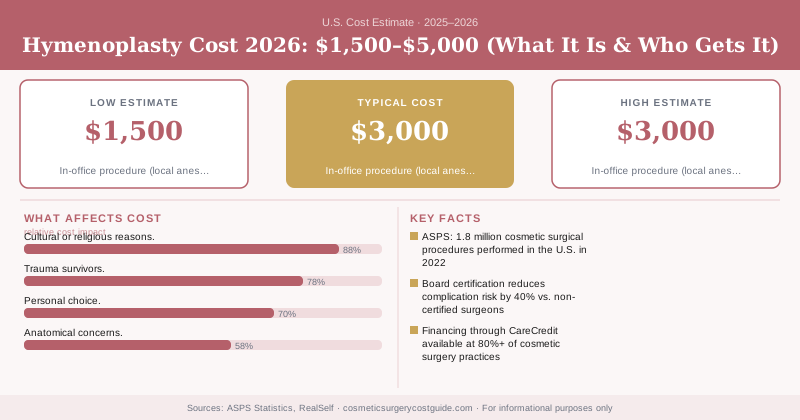
42% of OB-GYN practices in a 2021 survey reported receiving at least one inquiry about hymenoplasty annually — yet it remains one of the least openly discussed gynecological procedures in American medicine. The gap between demand and discussion creates a lot of confusion about what the procedure actually involves, who performs it, what it costs, and what patients realistically experience.
This guide covers all of it, clinically and directly.
What Hymenoplasty Is
The hymen is a thin membrane of tissue that partially covers the vaginal opening. It varies enormously in anatomy between individuals — some people are born with a minimal hymen, some with a more complete one, and its state after sexual activity also varies based on anatomy rather than following a single predictable pattern.
Hymenoplasty (also called hymen reconstruction or hymenorrhaphy) is a surgical procedure that repairs or reconstructs this membrane. The procedure typically involves:
- Removing the remnants of existing hymenal tissue
- Suturing the tissue edges together to reconstitute the membrane
- In some cases, using a small flap of nearby vaginal tissue when original hymenal remnants are insufficient
The procedure takes 30–60 minutes, is performed in an outpatient setting, and uses absorbable sutures that don’t require removal.
Cost Breakdown by Setting
| Setting / Component | Cost Range |
|---|---|
| In-office procedure (local anesthesia) | $1,500–$3,000 |
| Outpatient surgery center (local anesthesia) | $2,000–$4,000 |
| Outpatient surgery center (IV sedation) | $3,000–$5,000 |
| Surgeon fee | $1,000–$2,500 |
| Facility fee (if applicable) | $500–$1,500 |
| Local anesthesia | Included in surgeon fee |
| IV sedation / general anesthesia add-on | $800–$1,800 |
| Consultation fee | $100–$300 |
Who Seeks Hymenoplasty
People pursue this procedure for a range of personal, cultural, and psychological reasons. The most common include:
Cultural or religious reasons. In some communities, the hymen is considered significant in the context of marriage, and a patient may seek reconstruction in advance of marriage. This is the most commonly cited reason globally and reflects a patient’s personal and cultural context rather than a medical necessity.
Trauma survivors. Some survivors of sexual assault seek hymenoplasty as part of their physical and psychological recovery. The procedure offers a form of reclaiming bodily autonomy that some patients find meaningful.
Personal choice. Some patients simply want the procedure for personal reasons that they don’t owe to anyone to explain. Bodily autonomy as a principle means patients make decisions about their own anatomy — a surgeon’s job is to ensure the procedure is safe and performed well.
Anatomical concerns. Less commonly, patients with hymenal remnants causing discomfort or recurrent irritation may seek surgical correction for functional reasons, which may have more insurance coverage potential.
Hymenoplasty can be performed by:
- Board-certified OB-GYNs with experience in gynecological procedures
- Board-certified plastic surgeons who perform female genital surgery
- Urogynecologists
- Certified nurse midwives are NOT the right provider for surgical procedures
Verify board certification through the American Board of Medical Specialties (abms.org). Ask specifically about their experience with this procedure — how many they perform, and what their complication rate is. A provider who seems uncomfortable discussing it directly is a red flag.
Anesthesia Options
Most hymenoplasties are performed under local anesthesia in a physician’s office or minor surgical suite. The injection involves a small amount of lidocaine at the surgical site — similar to what a dentist uses. Discomfort during the procedure is minimal to none.
IV sedation (twilight anesthesia) is available for patients who are anxious about the procedure or prefer to be less aware. It adds $800–$1,500 to the total cost and requires a certified anesthesia provider at the facility.
General anesthesia is rarely necessary for a straightforward hymenoplasty but may be used if the procedure is combined with other gynecological surgery. It adds $1,200–$1,800 and requires a hospital or fully-licensed outpatient surgical center.
For most patients, local anesthesia in a physician’s office is the most cost-effective and clinically appropriate choice.
Realistic Expectations
Hymenoplasty reconstructs the appearance and superficial structure of the hymen. It’s not a guaranteed restoration of any specific pre-surgical state, and results vary based on individual anatomy and healing.
What the procedure can do:
- Reconstruct the membrane from available tissue
- Create a cosmetically and structurally repaired result in most patients
- Heal completely in 4–6 weeks with proper care
What the procedure cannot guarantee:
- Identical appearance to a specific prior state
- A specific sensory outcome during future sexual activity
- Any outcome that depends on highly individual biological variation
Most patients who undergo the procedure with realistic expectations and a qualified surgeon report a technically successful outcome. Complications are uncommon but include infection (rare, treatable with antibiotics), incomplete healing, or tissue breakdown requiring revision — particularly in patients with poor wound healing history.
Privacy and Confidentiality
This is a procedure many patients seek with specific privacy needs. A few practical notes:
- Physician-patient confidentiality applies fully. Your provider cannot disclose your procedure to a third party (including family members) without your written consent.
- Medical records can be restricted — ask your provider about their records access policy and who in the practice can view your chart.
- If you’re using insurance (in the unlikely case of coverage), the procedure code will appear on an Explanation of Benefits (EOB) sent to the policyholder. If that’s a concern, discuss self-pay options with the practice.
Be cautious of providers advertising hymenoplasty at unusually low prices ($500–$1,000) without a clear facility and credentials. This procedure involves surgical tissue manipulation near sensitive structures. An inadequately trained provider or non-sterile setting introduces risk of infection and poor healing that no cost savings justify. Always verify board certification and ask to see the surgical facility credentials.
Financing
Since insurance coverage is almost never available, most patients pay out-of-pocket. Options to consider:
- CareCredit or Alphaeon Credit: 0% promotional periods for 6–18 months, widely accepted at gynecological and plastic surgery practices
- FSA/HSA funds: Hymenoplasty for a functional concern (not purely cosmetic) may be FSA/HSA eligible — ask your provider for documentation. Purely elective cosmetic procedures typically aren’t eligible, but this varies by account administrator.
- Practice payment plans: Many providers offering this procedure understand the privacy motivations and offer discreet in-house financing
The Bottom Line
Hymenoplasty is a straightforward, low-complication procedure when performed by a qualified surgeon in an appropriate setting. At $1,500–$5,000, it’s one of the more accessible gynecological elective procedures. The most important steps are finding a board-certified, experienced provider, understanding realistic outcomes, and ensuring you’re making the decision for your own reasons — with complete clinical information.
Frequently Asked Questions
Hymenoplasty typically costs between $1,500 and $5,000 total, with most procedures falling in the $2,000–$3,500 range when performed in a physician's office or outpatient surgery center under local anesthesia. Adding IV sedation or general anesthesia increases the cost by $800–$1,800. Surgeon fees, facility fees, and anesthesia are the three main cost components — ask for an itemized estimate at your consultation.
Hymenoplasty is almost never covered by health insurance. It's classified as an elective cosmetic/gynecological procedure regardless of the reason it's sought. There are rare exceptions in cases with documented trauma-related reconstructive need, but even then coverage is inconsistent. Most patients pay entirely out-of-pocket, and many practices that perform this procedure offer financing through CareCredit or similar medical lending programs.
Recovery is typically 2–4 weeks for full healing, though most patients return to daily activities (desk work, light movement) within 3–5 days. You'll be advised to avoid sexual activity, tampons, swimming, and strenuous lower-body exercise for 4–6 weeks minimum. Discomfort is mild to moderate for the first week and managed with over-the-counter pain relief in most cases. Follow-up is usually at 2–4 weeks post-procedure to confirm healing.