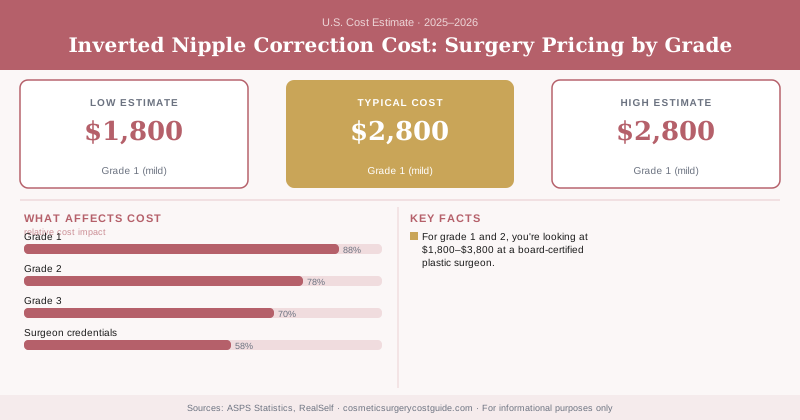
42% of women have some degree of nipple inversion — that’s not a rare anomaly, it’s a normal anatomical variation that a lot of women just quietly live with. If you’ve been self-conscious about it, or if inversion has made breastfeeding difficult or skin hygiene a constant issue, correction is genuinely simple for most grades.
Here’s the honest breakdown on what it costs and what the three grades actually mean for your procedure.
Inverted Nipple Correction Cost by Grade
| Grade | Description | Cost Range | Technique |
|---|---|---|---|
| Grade 1 (mild) | Nipple protrudes with stimulation | $1,800–$2,800 | Suture-only, no duct division |
| Grade 2 (moderate) | Nipple retracts quickly, limited protrusion | $2,500–$3,800 | Suture + partial duct release |
| Grade 3 (severe) | Permanently inverted, won’t protrude | $3,200–$4,500 | Full duct division required |
| Combined with areola reduction | Any grade + areola reshaping | $3,500–$5,500 | Combined procedure |
What’s Included in That Price
Most quotes you’ll receive from a board-certified plastic surgeon bundle the following:
- Surgeon’s fee: $1,200–$2,800 (the bulk of the total)
- Anesthesia: $400–$800 (local anesthesia is standard for grades 1–2; grade 3 may use IV sedation)
- Facility fee: $300–$700 if done in an outpatient surgical center vs. an in-office procedure room
Grade 1 and mild grade 2 corrections can often be done in-office under local anesthesia in 30–45 minutes. You’d be surprised how quick it is — you’re awake, there’s minimal pain, and you’re home within the hour.
Why Grade Matters So Much
The grading system determines whether milk ducts need to be divided — and that single factor changes the procedure, the recovery, and the permanence of results.
Grade 1: Short, fibrous bands are releasing the nipple. A surgeon places a small purse-string suture at the base of the nipple that holds it in the corrected position. Milk ducts are untouched. Breastfeeding capacity is preserved. Results are highly durable.
Grade 2: Slightly more tethered. The surgeon releases some, but not all, of the ductal connections. Most patients retain breastfeeding ability after grade 2 correction, but it’s worth discussing candidly with your surgeon before committing.
Grade 3: The nipple is retracted by tight, shortened milk ducts that have to be fully divided to release it. After grade 3 correction, breastfeeding isn’t possible from that breast. This is a significant consideration for anyone who hasn’t yet completed their family.
If you’re planning a breast augmentation or breast lift, your surgeon may recommend correcting inverted nipples at the same time. Combined procedures save on anesthesia and facility fees — you’re already in the OR — and the overall cost increase for adding nipple correction to an existing breast procedure is typically only $800–$1,500, versus $1,800–$4,500 as a standalone. Ask your surgeon about combining if you’re already planning breast work.
What Drives Price Variation
Surgeon credentials: A board-certified plastic surgeon (ABPS-certified) with a breast subspecialty typically charges 20–40% more than a general cosmetic surgeon performing the same procedure. For a short, in-office procedure, the premium is smaller in absolute terms — but the skill margin matters for getting the projection height right and avoiding re-inversion.
Geographic market: A New York or Beverly Hills surgeon will quote $3,500–$4,500 for a grade 2 correction. A Nashville or Phoenix surgeon performing the same procedure may quote $2,200–$3,000. The surgical outcome isn’t necessarily better in a higher-cost market — this is one procedure where regional variation is purely cost-of-practice.
Bilateral vs. unilateral: Both nipples inverted? Surgeon fees don’t double — most surgeons charge 1.3–1.5x the unilateral fee for bilateral work. Facility and anesthesia fees may increase modestly. Budget an additional $800–$1,500 to address both sides.
In-office vs. ASC: If your surgeon has an in-office procedure room, you’ll save the facility fee entirely for grade 1 and mild grade 2 corrections. Ask during your consultation whether your grade can be done in-office.
Is It Permanent?
For grades 1 and 2 where a suture technique is used without full duct division: results are durable in most patients but re-inversion can occur, particularly with significant weight fluctuation, pregnancy, or over time as sutures loosen. The re-inversion rate for suture-only techniques is approximately 10–15% over a 5-year period, per published outcomes data.
For grade 3 with full duct division: results are permanent. There’s nothing left to pull the nipple inward.
Revision procedures (re-correction after re-inversion) typically run $1,200–$2,500 and are often simpler than the original correction.
You’ve probably seen Niplette-style suction devices marketed for grade 1 inversions. For grade 1 inversions with very mild tethering, these can work — particularly when used consistently over several months during pregnancy or postpartum. They don’t work for grade 2 or 3. They’re worth trying before committing to surgery for a true grade 1, but don’t delay surgery if you have a moderate or severe inversion hoping a device will fix it.
Recovery Timeline
Nipple correction recovery is among the simplest of any cosmetic procedure. For grades 1–2:
- Day of: Light dressing, minimal pain, home the same morning
- Days 1–3: Mild soreness; most patients take no prescription pain medication
- Week 1: Small sutures remain in place; avoid submerging in water
- Week 2: Sutures removed; normal activity resumed
- Week 4–6: Final appearance established; slight swelling resolves
Grade 3 patients will have slightly more discomfort and a 2–3 week healing window, but it’s still a brief recovery compared to most cosmetic procedures.
Any new nipple inversion that develops in adulthood — particularly unilateral (one-sided) inversion that wasn’t present before — should be evaluated by a physician before scheduling cosmetic correction. New, unilateral nipple inversion can be a sign of underlying breast tissue changes and warrants a breast exam and imaging first. Congenital bilateral inversion (present since puberty or earlier) doesn’t carry this concern, but don’t assume. If it’s new and one-sided, see your doctor first.
The Bottom Line
Inverted nipple correction is one of the more straightforward cosmetic procedures available — short operative time, local anesthesia for most grades, quick recovery, and durable results. For grade 1 and 2, you’re looking at $1,800–$3,800 at a board-certified plastic surgeon. Grade 3 runs $3,200–$4,500. If you’re combining it with other breast work, you’ll likely pay only $800–$1,500 more than your base procedure.
Get at least two consultations, confirm your grade with each surgeon, and ask explicitly about breastfeeding implications if that’s relevant to you.
Frequently Asked Questions
Inverted nipple correction typically costs between $1,800 and $4,500, with pricing largely dependent on the severity grade of the inversion and whether one or both nipples are being corrected. Grade 1 (mild) inversions generally fall on the lower end around $1,800–$2,500 per nipple, while Grade 3 (severe) cases can reach $3,500–$4,500 due to increased surgical complexity.
Insurance typically does not cover inverted nipple correction when performed for cosmetic reasons, leaving most patients responsible for the full cost out-of-pocket. However, if the inversion is causing documented medical issues such as recurrent infections, severe hygiene problems, or breastfeeding inability, some insurers may cover part or all of the procedure—though you'll need pre-authorization and medical documentation from your surgeon.
Most patients can return to light daily activities within 3–5 days, though full recovery typically takes 2–4 weeks depending on the grade treated and your body's healing response. You should avoid strenuous exercise, heavy lifting, and direct nipple contact for at least 2–3 weeks to prevent complications and allow proper tissue remodeling.