Here’s a number that surprises people: financing a $10,000 procedure at a typical 15% rate over three years quietly adds about $2,500 in interest. That’s not a scam — it’s just how borrowing works. Financing plastic surgery can absolutely be a smart move, or it can turn a clean $10,000 bill into a $13,000 headache. The difference comes down to which option you pick and how disciplined you are about paying it back.
When Financing Actually Makes Sense
Borrowing is reasonable when three things are true: the expense is planned, your income comfortably covers the monthly payment, and you can realistically clear a 0% promotional balance before it expires. In that case, financing just smooths a big one-time cost across a few paychecks. No harm done.
It becomes a bad idea the moment you’re financing because you can’t afford the procedure — not because you’d rather not drain savings. Elective surgery isn’t an emergency. If the only way to afford it is a payment you’ll struggle with, the smartest financial move is usually to wait and save.
The Real Cost of Each Option
| Financing Option | Typical APR | Watch Out For |
|---|---|---|
| Medical credit card (promo) | 0% for 6–24 mo | Deferred interest of 26–30% if not paid in full on time |
| Medical credit card (standard) | 26–30% | Very expensive once promo ends |
| Personal loan | 7–20% | Rate depends heavily on credit score |
| Surgeon in-house plan | 0–12% | Often needs a larger down payment |
| HELOC | 7–10% | Your home is collateral for elective surgery |
| 401(k) loan | ~ prime + 1% | Stalls retirement growth; due fast if you quit |
The most popular route is a medical credit card. Used right, a true 0% promo is the cheapest financing there is. Used wrong, it’s the most expensive — see our breakdowns of CareCredit and Alphaeon Credit for how the deferred-interest math really plays out.
Deferred interest is the single biggest trap in cosmetic surgery financing. With most medical credit cards, if you don’t pay the entire balance before the promo period ends, you’re charged interest on the original full amount — retroactively, back to day one. Miss the deadline on a $10,000 charge by one month and you could owe $1,500+ in interest you thought you’d avoided. Set a payoff reminder a full month before the deadline.
Run the Numbers Before You Sign
Say you finance a $12,000 mommy makeover at 15% APR over 36 months.
Monthly payment: ~$416 Total interest: ~$2,980 Total repaid: ~$14,980
Now the same $12,000 on a 0% 18-month card, paid off on schedule: $0 interest, $667/month.
The cheaper option demands a higher monthly payment. If you can swing $667 for 18 months, you save nearly $3,000. If you can’t, the longer loan costs more but keeps you out of deferred-interest territory. Pick honestly.
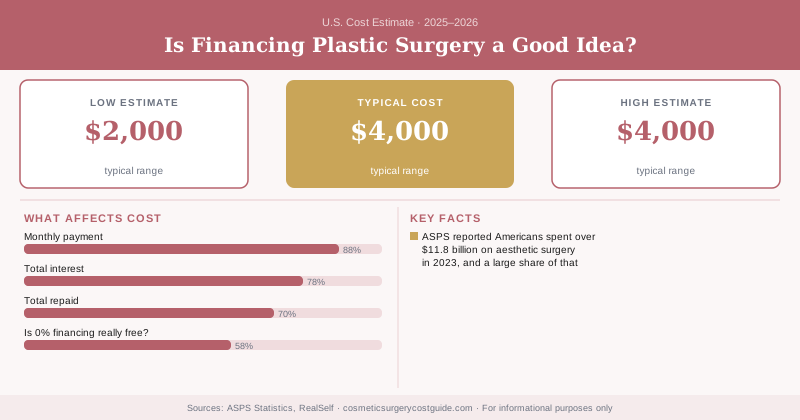
ASPS reported Americans spent over $11.8 billion on aesthetic surgery in 2023, and a large share of that was financed. The industry is built around it — which means there’s always a payment plan ready to make a $20,000 procedure feel like “just $400 a month.” That framing is designed to lower your resistance, not your total cost.
Common Questions, Answered
Is 0% financing really free? Only if you pay it off before the promo ends. Otherwise the deferred interest claws back everything you thought you saved.
Should I drain my emergency fund instead of financing? No. Keep 3–6 months of expenses untouched. If paying cash wipes out your safety net, financing a portion at a low rate may be the more responsible choice.
Can I negotiate the price down if I pay cash? Often, yes. Many surgeons offer a cash discount of 5–10% because they avoid card processing fees and financing-company cuts. Always ask — it’s covered in more depth in our financing guide.
What if my credit score is in the 600s? You’ll likely still qualify for a medical credit card, just at a higher standard rate and lower limit. Shop personal loans too — a co-signer can drop your rate meaningfully.
Bottom Line
Financing plastic surgery is a good idea when it’s a planned expense you can comfortably repay — ideally inside a true 0% window you’ll clear on time. It’s a bad idea when it’s the only way to afford a procedure you can’t actually pay for. Run the real interest math, never miss a deferred-interest deadline, and ask about a cash discount before you borrow a dollar.
Frequently Asked Questions
It can be — if you snag a true 0% promotional period and pay the balance off before it ends. Outside that window, medical credit cards like CareCredit can charge 26–30% deferred interest retroactively, turning a $10,000 procedure into $13,000+. Financing is reasonable for a planned, stable expense; it's a trap if you're stretching a budget you can't actually carry.
It varies widely. Medical credit cards advertise 0% for 6–24 months, then jump to 26–30% APR. Personal loans for cosmetic surgery typically run 7–20% APR depending on your credit score. Some surgeon in-house plans offer lower rates but require larger down payments.
Almost always, unless you complete a 0% promo on time. On a $10,000 procedure at 15% APR over 36 months, you'd pay roughly $2,500 in interest. A deferred-interest plan you miss can add even more, since the interest is charged retroactively from day one.
Medical credit cards like CareCredit often approve scores in the mid-600s, sometimes lower with a smaller limit. The best personal-loan rates (7–12% APR) generally require a 700+ score. A lower score doesn't mean no, but it usually means a higher rate.
If you don't pay the full balance before the promo period ends, the lender charges interest on the entire original amount retroactively — not just the leftover balance. Miss the deadline on a $10,000 charge and you could owe interest going back to month one.
A HELOC often has a lower rate but puts your home on the line for an elective expense — a serious risk. A 401(k) loan avoids a credit check but stalls your retirement growth and comes due fast if you leave your job. Both can beat a 28% medical card on rate, but neither is risk-free for cosmetic surgery.