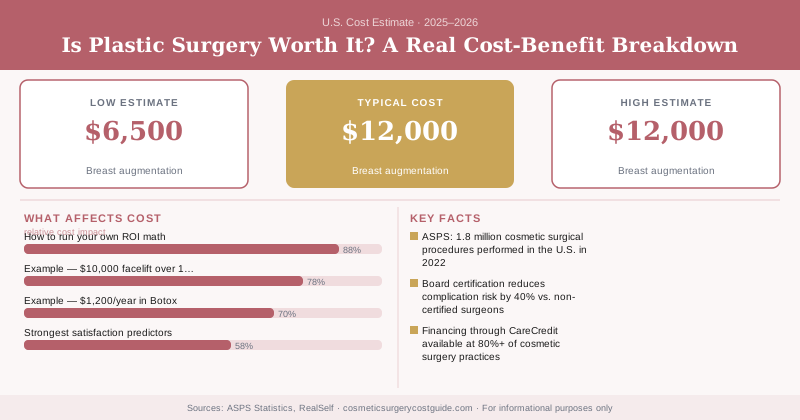
97% of breast augmentation patients said it was worth it. 95% for tummy tucks. 92% for facelifts. Those RealSelf 2024 figures get quoted everywhere — but worth it to whom, and at what cost? That’s the question nobody walks you through clearly.
Let’s do that now. If you’re weighing $8,000 to $15,000 or more and wondering whether you’ll regret it, here’s a framework grounded in patient data and honest math.
The Satisfaction Numbers Are Real — With a Caveat
RealSelf’s “Worth It” ratings, drawn from over 3 million patient reviews, genuinely correlate with published clinical research. A 2021 systematic review published in Aesthetic Surgery Journal found sustained body image improvements at 12-month follow-up across multiple procedure types — not just the immediate post-op honeymoon.
But the numbers have a built-in skew: patients who write reviews tend to be those who engaged enough to document the process. Still, the consistency across both clinical studies and self-reported data tells you something real.
| Procedure | Average Cost | RealSelf Worth It (2024) | Longevity |
|---|---|---|---|
| Breast augmentation | $6,500–$12,000 | 97% | 10–20 years |
| Breast reduction | $7,000–$12,000 | 97% | Long-term |
| Tummy tuck | $8,000–$15,000 | 95% | Long-term |
| Eyelid surgery | $3,000–$8,000 | 96% | 10–15 years |
| Facelift | $10,000–$25,000 | 92% | 7–12 years |
| Rhinoplasty | $8,000–$18,000 | 90% | Permanent |
| Liposuction | $4,000–$10,000 | 81% | Permanent (fat cells) |
| BBL | $8,000–$15,000 | 85% | 5–10 years |
A Simple ROI Framework
“Return on investment” in cosmetic surgery isn’t financial — it’s psychological. But you can still run the math.
Take a rhinoplasty at $12,000 with a permanent result. Spread over 20 years, that’s $600/year or $50/month. Most people spend more than $50/month on things they don’t think twice about.
Take a facelift at $15,000 with a 10-year result. That’s $1,500/year, or $4.11/day. Compare that to what daily happiness costs you in other categories — gym, travel, clothing, dining.
This isn’t a rationalization. It’s a reframe that helps people think clearly about a decision that can feel overwhelming when viewed as a single large number.
How to run your own ROI math:
- Get your all-in quote (surgeon fee + anesthesia + facility)
- Estimate realistic longevity (use the table above)
- Divide: cost ÷ (years × 365)
Example — $10,000 facelift over 10 years: $10,000 ÷ 3,650 days = $2.74/day
Example — $1,200/year in Botox: $1,200 ÷ 365 = $3.29/day
The surgical option, over time, often costs less per day than maintenance injectables — which is a useful data point if you’re comparing the two paths.
Who Gets the Best ROI
The ASPS 2023 procedural satisfaction data points to a consistent pattern: patients who do best have a specific goal, realistic expectations, and do it for themselves — not a partner, not a job, not social media.
Strongest satisfaction predictors:
- Procedure addresses a physical feature that’s bothered you for years (not months)
- You’re in stable emotional and financial circumstances
- Your surgeon explicitly reviewed your expectations during consultation
- You’re not expecting surgery to change relationships or career outcomes
Weakest outcomes cluster around:
- Doing it because someone else suggested it
- Vague goals (“I just want to look better overall”)
- Pre-existing body dysmorphic disorder — ASPS data consistently shows surgery doesn’t help and can worsen BDD
- Financial strain that adds stress to the recovery period
The Procedures With the Strongest Case
Breast reduction consistently shows the highest satisfaction of any procedure — 94–98% across published studies. The combination of physical symptom relief (back and neck pain, posture problems, difficulty exercising) plus aesthetic outcome creates a dual return that’s hard to argue against.
Functional eyelid surgery that restores peripheral vision has a measurable objective benefit on top of the cosmetic one. You can verify the result with a visual field test.
Rhinoplasty with a functional component — breathing improvement, deviated septum — builds in a satisfaction floor even if the cosmetic refinement takes months to fully appreciate.
The Honest Downsides
Not every procedure delivers what patients expected. Liposuction has the lowest worth-it rating in the table above (81%) — largely because patients who don’t maintain their weight see the remaining fat redistribute to untreated areas. The procedure worked; expectations didn’t account for that dynamic.
Revision rates also matter. Rhinoplasty has a published revision rate of 5–15%, meaning 1 in 7 to 1 in 20 patients will want another procedure. Each revision adds cost, recovery time, and complexity.
If you’re considering a procedure primarily because you’re unhappy with your appearance in general — rather than because one specific physical feature has bothered you for a long time — that’s a meaningful flag. Surgery changes your appearance; it doesn’t change the baseline relationship you have with how you look. That distinction is worth sitting with before writing a check.
Bottom Line
The data supports cosmetic surgery as genuinely worth it — for the right patient, at the right time, with the right motivation. High satisfaction rates aren’t marketing spin; they reflect real outcomes for well-selected patients. But “worth it” requires honest self-assessment before the procedure, not just confidence in the surgeon. Run your ROI math, check your motivations, and get at least one consultation where the surgeon asks hard questions about your expectations. That combination is what produces the 92–97% outcomes — not the surgery itself.
Frequently Asked Questions
Breast augmentation typically ranges from $8,000 to $15,000, with an average around $10,500 according to ASPS data. The final cost depends on surgeon experience, geographic location (coastal cities run 20-30% higher), implant type (saline vs. silicone), and facility fees. Additional costs like anesthesia and pre-op testing can add $1,500 to $3,000.
Most health insurance plans exclude cosmetic procedures entirely, treating them as elective rather than medically necessary. However, reconstructive surgery after injury, accident, or certain medical conditions may qualify for partial or full coverage—you'll need pre-authorization from your insurer. Out-of-pocket costs are typically 100% for purely cosmetic work, though some surgeons offer financing plans with 0% APR for 12-24 months.
Most facelift patients can return to light activities and work within 2-3 weeks, though full recovery takes 6-8 weeks before swelling and bruising fully resolve. You'll need to avoid strenuous exercise and heavy lifting for at least 4-6 weeks to prevent complications. Plan for 7-10 days of significant downtime if your job involves client-facing or public interaction.