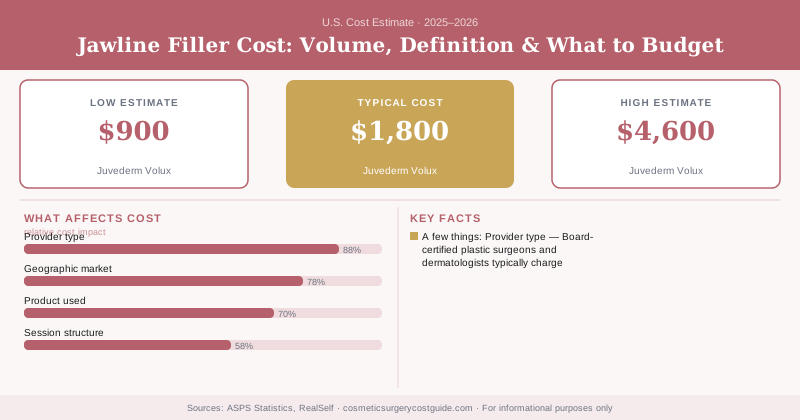
Most women walk into a consultation asking for “more definition” — but what they actually mean varies a lot. A sharper jaw angle. A longer, more balanced lower face. A jawline that photographs the way it used to. Jawline filler can address all of these things, but the product, placement, and volume are completely different depending on your goal. That’s also why the cost range is so wide.
Here’s a realistic breakdown of what you’ll spend, what to expect, and whether the investment is worth it.
Jawline Filler Cost in 2025–2026
| Product | Cost Per Syringe | Typical Volume | Total Estimate | Duration |
|---|---|---|---|---|
| Juvederm Volux | $900–$1,150 | 2–4 syringes | $1,800–$4,600 | 18–24 months |
| Juvederm Voluma | $850–$1,100 | 2–3 syringes | $1,700–$3,300 | 18–24 months |
| Restylane Defyne | $750–$1,000 | 2–4 syringes | $1,500–$4,000 | 12–18 months |
| Radiesse | $750–$1,100 | 2–3 syringes | $1,500–$3,300 | 18–24 months |
| Sculptra (per vial) | $800–$1,100 | 3–4 vials | $2,400–$4,400 | 2+ years |
Why So Many Syringes?
The jawline is a long structure. Unlike lips (1 syringe is often plenty) or under-eyes (0.5–1 syringe total), defining the jaw from the chin to the angle on both sides requires meaningful volume. Most injectors plan for 2–4 syringes depending on your anatomy — someone with a naturally strong jaw who just wants sharpening needs less; someone rebuilding lost definition in their 40s or 50s may need more.
According to ASPS data, non-surgical soft tissue filler procedures have grown more than 40% over the past decade, with the jawline emerging as one of the highest-demand treatment zones in patients under 45.
Juvederm Volux: Purpose-Built for the Jaw
Volux launched in the US specifically for jawline and chin definition — it’s the densest, most structural filler in the Juvederm family. It holds its shape better than Voluma in high-movement zones and shows up on the jaw angle more cleanly. Most experienced injectors reach for it first when the goal is actual architectural definition rather than subtle softening.
Budget $1,800–$3,000 for a full Volux treatment (2–3 syringes). That’s a real-world starting point for good results, not the low end you’ll see advertised.
If you’re spending money on jawline filler, consider pairing it with a small amount of chin projection — even 0.5 syringes. The chin is the anchor of the lower face, and a slightly underprojected chin makes even a well-defined jawline look less balanced. Most practices offer combo pricing, and adding chin treatment usually costs $500–$750 more. The visual improvement per dollar is hard to beat.
What Makes Injector Pricing Vary So Much?
A few things:
Provider type — Board-certified plastic surgeons and dermatologists typically charge 20–30% more than nurse practitioners or aestheticians. For structural jawline work, the anatomy knowledge of a physician matters more than it does for, say, lip filler.
Geographic market — NYC and LA practices run $950–$1,150 per syringe. Midwest and Southeast markets typically run $750–$950.
Product used — Volux costs more wholesale than older HA products, and that cost passes through.
Session structure — Some injectors do a conservative first session and a touch-up at 4 weeks. Others do the full volume in one visit. Neither is wrong, but two appointments add time, not necessarily cost.
How Long Do Results Last?
Juvederm Volux is FDA-cleared for up to 24 months, and real-world patients typically see results lasting 18–24 months before they want a touch-up. Radiesse can last a similar amount of time and costs slightly less per syringe, though it’s not reversible with hyaluronidase.
The ASAPS 2023 statistics report notes that hyaluronic acid fillers remain the most popular non-surgical cosmetic procedure in the US for the 10th consecutive year — and jawline filler is one of the fastest-growing subcategories within that.
Jawline filler placed too superficially or in the wrong anatomic plane can create a lumpy, uneven appearance — and it’s visible in photographs. Always ask your injector specifically about their jawline filler experience (not just general filler experience), and request before-and-after photos of jawline cases specifically. This is a technique-sensitive area. Cheaper injectors with less experience in jaw anatomy are a false economy here.
Is It Worth It?
That depends on what you’re comparing it to. A surgical jawline implant runs $4,000–$8,000 all-in and lasts permanently — but requires downtime, carries surgical risks, and is a bigger commitment. Filler is reversible, adjustable, requires no recovery, and can be a smart way to “try on” a stronger jawline before committing to implants.
For most women looking for meaningful lower-face definition without surgery, 2–3 syringes of a structural filler like Volux or Radiesse is the go-to. Budget $2,000–$3,500 for a result you’ll actually notice — and choose your injector based on jaw-specific before-and-afters, not price.
Frequently Asked Questions
Jawline filler typically costs $1,200–$3,600 per treatment session, depending on the filler brand, number of syringes needed, and your surgeon's experience level. Most patients require 1–3 syringes to achieve noticeable definition or volume, with premium fillers like Radiesse or Sculptra at the higher end of the range.
No, jawline filler is considered a cosmetic procedure and is not covered by health insurance plans. You will pay the full cost out-of-pocket, though some practices offer payment plans or financing options to spread the expense over several months.
Results typically last 6–12 months depending on the filler type: standard hyaluronic acid fillers (Juvederm, Restylane) last 6–9 months, while thicker, longer-lasting options like Radiesse last 12–18 months. Most patients schedule touch-up appointments annually to maintain their desired jawline definition.