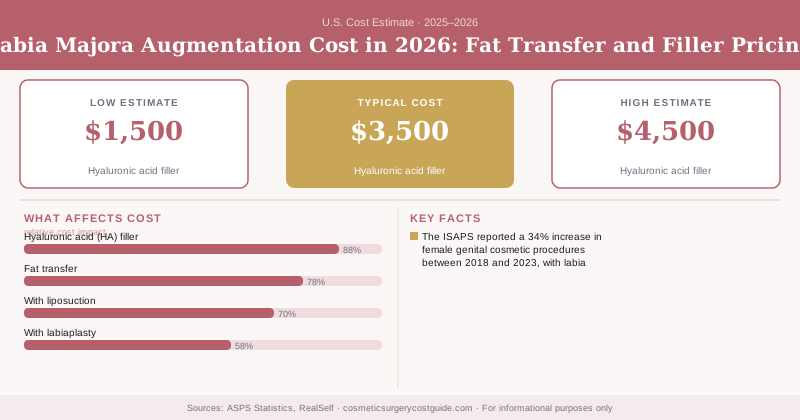
Labia majora augmentation is one of the lesser-known intimate rejuvenation procedures — and one that’s often sought after weight loss, hormonal changes, or aging cause the outer labia to appear deflated, flat, or loose. Volume loss in this area is normal and common: estrogen decline after menopause accelerates it, significant weight loss can cause it at any age, and some women simply notice it after pregnancy. The ISAPS reported a 34% increase in female genital cosmetic procedures between 2018 and 2023, with labia majora procedures representing a growing share of that growth.
Labia Majora Augmentation Cost Breakdown
| Approach | Surgeon Fee | All-In Cost |
|---|---|---|
| Hyaluronic acid filler | $1,500–$3,500 | $2,000–$4,500 |
| Fat transfer (small-volume) | $3,000–$5,500 | $4,500–$8,000 |
| Fat transfer (combined with labiaplasty) | $2,000–$4,000 add-on | $6,500–$12,000 combined |
| PRF/PRP with filler | $2,000–$4,000 | $2,500–$5,500 |
Filler is less expensive and requires no harvest procedure, but results last 12–18 months. Fat transfer is more involved (requires liposuction for harvest) but produces longer-lasting results for patients with adequate donor fat.
What Actually Causes Labia Majora Volume Loss
Three main drivers: age-related fat atrophy (the same process that causes volume loss in the face), hormonal changes (estrogen supports tissue fullness; declining estrogen with menopause causes progressive deflation), and weight loss. Significant weight reduction often disproportionately affects the vulvar area, leaving tissue that was previously full appearing flat or with excess skin relative to reduced volume.
The appearance concerns most commonly described: flatness visible through athletic wear, a “deflated” look that feels inconsistent with the patient’s overall appearance, or skin wrinkling that developed after fat loss.
Filler vs. Fat Transfer: Making the Right Choice
Hyaluronic acid (HA) filler is the non-surgical option. The same filler used in facial rejuvenation is injected into the labia majora to restore fullness. The procedure takes 15–20 minutes in-office, requires minimal numbing, and has essentially no downtime. Results are visible immediately and last 12–18 months. It’s reversible with hyaluronidase.
Good candidates: women who want to try the result before committing to surgery, those with minimal volume loss, or those who prefer avoiding a harvest procedure.
Fat transfer harvests fat via liposuction from a donor site (typically the inner thighs, abdomen, or flanks), processes it, and injects it into the labia majora. It’s a surgical procedure requiring local anesthesia with sedation. Recovery is 1–2 weeks. Results last longer — typically 60–80% of transferred fat survives permanently — but there’s an initial phase of volume fluctuation as transfer fat settles over 3–6 months.
Good candidates: women with adequate donor fat, those seeking a permanent solution, or those who are already having liposuction elsewhere and want to add this at the same session (which is the most cost-effective approach — the harvest and anesthesia are shared).
Labia majora augmentation is most cost-effective when combined with other procedures:
- With liposuction: Fat is already being harvested — augmentation adds relatively little to the overall cost ($800–$1,500 more)
- With labiaplasty: Both procedures address vulvar appearance and are complementary — reduction of the labia minora with augmentation of the labia majora produces a balanced result
- With vaginal tightening: Some women pursuing comprehensive intimate rejuvenation address multiple concerns in one OR session
When combined, you save on anesthesia and facility fees versus scheduling separately.
Who Performs This Procedure?
Both gynecologists with cosmetic training and board-certified plastic surgeons perform labia majora augmentation. For filler approaches, a gynecologist or physician with specific intimate injection training may perform it in an office setting. For fat transfer, a board-certified plastic surgeon performing the harvest and injection is appropriate.
What to verify:
- Medical degree (MD or DO) — not nurse or aesthetician
- Specific training and experience in intimate area procedures
- Accredited facility for any surgical procedure
- Willingness to show before/after photos and discuss realistic outcomes
Recovery and What to Expect
Filler: minimal downtime. Some swelling and tenderness for 3–5 days. Avoid sexual activity for 2 weeks. Results visible immediately; final appearance stable at 4–6 weeks.
Fat transfer: 1–2 weeks of swelling and tenderness. Similar activity restrictions. Initial overcorrection is intentional — the fat volume settles over 6–12 weeks as non-surviving cells are reabsorbed. Final result is visible at 3–6 months.
Both approaches are generally well-tolerated. Most patients report minimal pain, manageable with over-the-counter analgesics.
Permanent fillers (silicone, PMMA) should be avoided in intimate areas — they cannot be removed if complications arise and have caused severe chronic inflammation and disfigurement. Only biocompatible, reversible HA fillers should be used for non-surgical augmentation. For any procedure in the genital area, confirm that your provider is a licensed physician, the procedure is performed in a clinical setting, and you receive thorough information on risks and realistic expectations before proceeding.
Insurance and Financing
Labia majora augmentation for cosmetic purposes is not covered by insurance. For patients whose volume loss is related to documented hormonal deficiency (post-menopausal atrophy), some functional concerns may overlap with covered treatments — discuss with your gynecologist.
Most plastic surgery practices and some gynecological cosmetic practices offer financing. A $5,000 fat transfer on a 12-month 0% plan is about $417/month. Filler at $2,500–$3,500 is often manageable without financing for most patients.
Frequently Asked Questions
Labia majora augmentation typically costs between $2,500 and $7,000, depending on the technique used and surgeon experience. Fat transfer procedures generally range from $3,500–$7,000, while injectable filler options tend to fall on the lower end at $2,500–$4,500 per treatment.
No, labia majora augmentation is considered an elective cosmetic procedure and is not covered by standard health insurance plans. You can expect to pay the full cost out-of-pocket, though some surgeons offer financing options or payment plans to help make the procedure more affordable.
Fat transfer results are typically permanent since the grafted fat integrates into the tissue, though some volume loss of 20–30% may occur in the first 6–12 months. Injectable filler results last 12–18 months on average, requiring repeat treatments to maintain volume, making fat transfer a more cost-effective long-term option despite higher upfront costs.