Labia minora reduction — the most common type of labiaplasty — has seen a 73% increase in procedure volume over the past decade, according to the American Society of Plastic Surgeons (ASPS). That growth reflects two things: improved awareness that the procedure exists, and a significant reduction in the stigma around seeking it. Women seek labia minora reduction for a mix of functional and aesthetic reasons: discomfort during exercise, irritation with certain clothing, pain during intercourse, or simply wanting a different appearance.
What’s the realistic all-in cost? Here’s the breakdown.
Labia Minora Reduction Cost in 2025–2026
| Component | Cost Range | Notes |
|---|---|---|
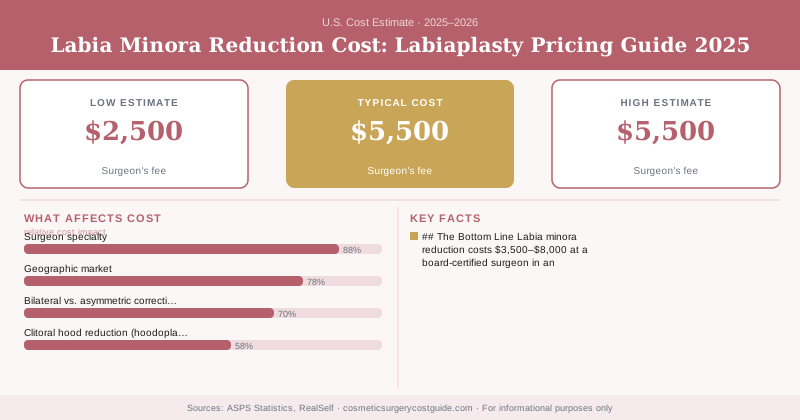
| Surgeon’s fee | $2,500–$5,500 | The dominant cost driver |
| Anesthesia | $700–$1,500 | IV sedation standard; local for minor cases |
| Facility fee | $800–$1,500 | Accredited outpatient surgical center |
| Total all-in | $3,500–$8,000 | Most patients pay $4,500–$6,500 |
Trim Technique vs. Wedge Resection: Does Technique Change the Price?
Yes, slightly. The two main surgical approaches have different complexity levels:
Trim labiaplasty removes a linear strip of tissue from the free edge of the labia minora. It’s the older, more commonly performed technique. Shorter operative time, technically more straightforward, and preserves less natural edge texture. Typically runs on the lower end of the surgeon fee range ($2,500–$4,000).
Wedge labiaplasty (V-wedge or central wedge) removes a V-shaped wedge of tissue from the middle portion of the labia, then closes the edges to preserve the natural darkened edge of the labial tissue. More technically demanding, produces a more natural-appearing result, and takes longer to perform. Surgeon fees typically run $3,500–$5,500 for this technique.
Most experienced surgeons prefer the wedge technique for aesthetic reasons when anatomy permits. The price premium for wedge is roughly $500–$1,500 over a trim at the same facility.
“Labiaplasty” is a broad term covering multiple structures. Labia minora reduction specifically addresses the inner lips. Some patients also need or want labia majora work — reduction of prominent outer lips or augmentation of deflated outer lips. Labia majora augmentation is a separate procedure priced separately. Patients addressing both inner and outer labia in a single session typically pay $5,500–$10,000 combined. A vaginoplasty (vaginal tightening) is a different procedure entirely and should not be confused with labiaplasty.
Is It Ever Covered by Insurance?
Purely aesthetic labia minora reduction is not covered by insurance. However, some cases do have a functional component that may support a coverage argument:
- Chronic labial irritation or recurrent skin breakdown documented by a gynecologist or dermatologist
- Labial hypertrophy causing documented discomfort during exercise, cycling, or intercourse
- Recurrent infections attributed to labial tissue trapping moisture
Getting insurance to cover labiaplasty requires thorough documentation from a treating physician, usually over multiple visits, and is far from guaranteed. Most patients self-pay. If you have genuine functional symptoms, it’s worth a conversation with your OB-GYN before assuming you’ll pay out-of-pocket — but manage your expectations.
What Drives Variation in Surgeon Fees
Surgeon specialty: Gynecologists, urogynecologists, and plastic surgeons all perform labia minora reduction. Fees vary significantly by specialty. Fellowship-trained plastic surgeons or female genital plastic surgery specialists typically charge the most; some OB-GYNs with significant labiaplasty volume may charge $2,500–$4,000 for a straightforward trim. Neither specialty is inherently superior — what matters is documented case volume and outcome photos.
Geographic market: Miami and Los Angeles are the highest-cost markets, with all-in prices routinely $6,500–$9,000 at well-known practices. Chicago, Dallas, Atlanta, and Phoenix-area markets run $4,500–$6,500. Smaller regional markets often quote $3,500–$5,000.
Bilateral vs. asymmetric correction: When one side requires significantly more reduction than the other — or when clitoral hood reduction is added — complexity increases and pricing adjusts accordingly.
Clitoral hood reduction (hoodoplasty): Many patients considering labia minora reduction also ask about reducing prominent clitoral hood tissue. Adding hoodoplasty typically adds $800–$1,500 to the total cost when done concurrently.
The Clitoral Hood Question
Clitoral hood reduction is commonly requested alongside labia minora reduction. The hood is often reduced proportionally when labial tissue is removed — it can look disproportionately prominent after labia minora reduction alone. Most surgeons will discuss this during consultation and factor it into a single quote rather than pricing it entirely separately.
If you have concerns about clitoral hood prominence, raise it explicitly during your consultation. Don’t assume it’s included unless confirmed.
Recovery Timeline
Labia minora reduction recovery is approximately 6 weeks to full activity:
- Days 1–5: Swelling and bruising significant; cold packs, prescribed pain medication, limited mobility
- Week 1–2: Walking comfortable; return to sedentary work by day 7–10
- Week 2–3: Most external sutures dissolved; external swelling reducing
- Week 4–6: Cleared for light activity and exercise
- Week 6–8: Sexual activity permitted after surgeon clearance; final shape establishing
- Month 3: Final result apparent as all residual swelling resolves
Avoid tight underwear, exercise, bicycle riding, and sexual activity during the healing window. These are the most common causes of suboptimal healing outcomes.
Labia minora reduction outcomes are highly predictable when performed by an experienced surgeon. Patient satisfaction rates in published outcome studies consistently exceed 90%. The most commonly reported regret is asymmetry — one side healing differently than the other — which occurs in a small percentage of cases and may require minor revision. Revisions are typically office-based under local anesthesia and cost $500–$1,500. More significant revisions after major technique errors are rare but occur — which reinforces the importance of selecting a surgeon with meaningful labiaplasty-specific volume.
Be cautious of very low-price labiaplasty quotes. A $1,500–$2,500 all-in quote typically means local anesthesia only (no IV sedation) in a non-accredited setting, often performed by a practitioner with limited labiaplasty volume. Labia minora reduction performed poorly leaves difficult-to-revise scars and can remove too much tissue, creating functional problems worse than the original. Price-shop within the qualified range — but don’t chase the lowest quote for a procedure this sensitive to surgical skill.
The Bottom Line
Labia minora reduction costs $3,500–$8,000 at a board-certified surgeon in an accredited facility. Most patients pay $4,500–$6,500 for a bilateral wedge or trim labiaplasty with IV sedation. Adding clitoral hood reduction brings the total to $5,000–$7,500. Insurance rarely covers it; most patients self-pay.
Choose a surgeon with substantial labiaplasty-specific case volume, review their outcome photos, and verify the facility is accredited. This is a procedure where experience directly predicts outcome quality.
Frequently Asked Questions
Labia minora reduction typically costs between $3,500 and $8,000, with the final price depending on surgeon experience, geographic location, and whether you choose the trim or wedge technique. Board-certified plastic surgeons in major metropolitan areas often charge toward the higher end of this range, while less urban areas may offer procedures at the lower end. Additional fees for anesthesia and facility use usually add $500–$1,500 to the base surgical cost.
Most insurance plans classify labia minora reduction as cosmetic surgery and do not cover it, leaving patients responsible for the full $3,500–$8,000 cost out-of-pocket. However, if the procedure is deemed medically necessary to address functional issues like chronic pain or physical discomfort during activity, some insurers may cover a portion; you'll need pre-authorization and documentation from your surgeon. It's essential to contact your insurance provider directly, as coverage policies vary significantly by plan and state.
The trim technique removes tissue from the edge of the labia minora and typically costs $3,500–$5,500, while the wedge technique removes a central section and usually ranges from $4,500–$8,000 due to increased complexity and surgical time. Wedge is often preferred by surgeons for better aesthetic outcomes and lower complication rates, though trim may be recommended for certain anatomies. Recovery time is similar for both techniques at 2–3 weeks, with full healing in 6–8 weeks.