42% of women report that lip products are the cosmetic they apply most frequently — and for many, a lip blush tattoo has become the permanent answer to that daily routine. It’s not a lip filler. It doesn’t add volume. But for women who spend 10 minutes every morning recreating the same lip color and border, it eliminates the routine entirely for 2–5 years. Here’s what it costs, what it actually looks like healed, and how to avoid the most common mistakes.
What Is a Lip Blush Tattoo?
Lip blush is a form of cosmetic tattooing where a skilled artist deposits semi-permanent pigment across the entire lip surface using a machine. Unlike traditional lip tattoos that create bold, saturated color, lip blush uses a soft, watercolor-like technique that mimics a natural flush — hence the name. The result looks like your lips naturally, but more defined, more symmetrical, and more colorful.
It’s distinct from:
- Lip liner tattoo: Just the border, no fill
- Lip filler: Volume enhancement via hyaluronic acid injection
- Lip tint: Topical product, not permanent
The procedure takes 2–3 hours for the initial session, plus a mandatory touch-up at 6–8 weeks once the skin heals. That touch-up is where the final color and shape get refined — it’s not optional.
What Does Lip Blush Cost?
| Service | Low | Typical | High |
|---|---|---|---|
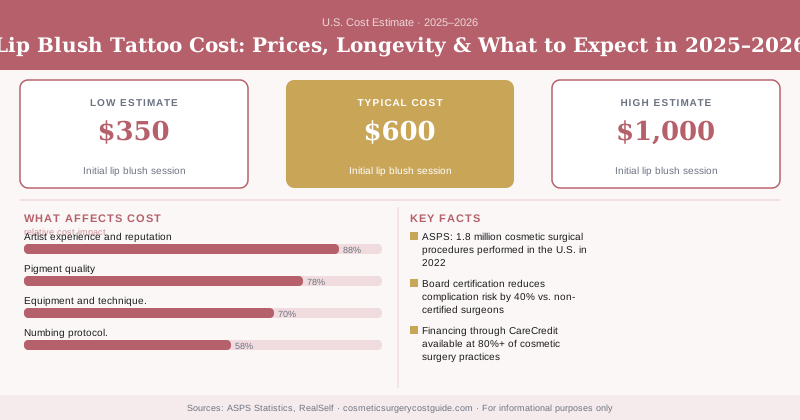
| Initial lip blush session | $350 | $600 | $1,000 |
| Touch-up (6–8 weeks) | $100 | $175 | $300 |
| Color refresh (2–3 years later) | $200 | $350 | $600 |
| Full package (session + touch-up) | $450 | $750 | $1,200 |
In competitive markets like NYC and LA, premium artists charge $900–$1,500 for the initial session alone. In mid-sized cities and suburban markets, $450–$700 all-in is common for a qualified artist. The touch-up is non-negotiable — factor it into your budget from the start.
What Drives the Price?
Artist experience and reputation are the primary cost drivers. The best lip blush artists have dedicated portfolios of 200–500+ healed results across different skin tones and lip shapes. They understand how pigment heals on different lip tissue and can compensate for asymmetry, thin borders, and uneven natural pigmentation.
Pigment quality varies significantly. High-quality, organic-based pigments deposit more evenly, heal truer to color, and fade gracefully without turning gray, orange, or blue. Cheap pigments are one of the biggest variables in why some people’s lip blush looks amazing and others looks muddy within a year.
Equipment and technique. Rotary machines with fine needle groupings produce different results than cartridge machines. The artist’s technique for the blush vs. the border vs. the center fill are all distinct skills.
Numbing protocol. Good lip blush artists use proper topical numbing (EMLA or similar), usually applied for 30–45 minutes, which significantly affects patient comfort. Some budget providers skip this step.
Days 1–2: Lips look intensely pigmented, swollen, and possibly bruised. Color looks dramatically darker than the intended result. This is normal.
Days 3–5: Peeling begins. The outer layer of skin flakes off, taking some pigment with it. Lips may look patchy, blotchy, or alarmingly faded. Do NOT pick at peeling skin.
Days 6–10: Most peeling is complete. Color looks very faded and uneven — this is the “ghosting” phase.
Weeks 2–4: Color gradually returns as the deeper layers reveal. Still uneven.
Weeks 5–8: True healed color emerges. This is what you’ll look like at your touch-up appointment.
Months 2–5: Color settles and softens further. The final, long-term result.
How Long Does Lip Blush Last?
Most lip blush results last 2–5 years, with significant variation based on:
- Skin type: Oily skin fades faster; dry skin retains color longer
- Sun exposure: UV breaks down pigment; always use SPF on lips
- Skincare ingredients: Retinol, AHA/BHA accelerate fading; avoid on lips
- Natural lip pigmentation: Women with naturally darker lips may see the result fade unevenly as natural pigment competes
- Lifestyle: Smokers and frequent coffee/tea drinkers fade faster
Most artists recommend a color refresh at 2–3 years — not a full new treatment, but a color boost at a lower cost ($200–$500).
Is It Safe? Who Should Avoid It?
Lip blush is a low-risk procedure when performed by a licensed, trained artist in a clean environment. The most significant risk is:
Cold sore risk is real and serious. If you have any history of oral herpes simplex (HSV-1), trauma to the lips — including tattooing — can trigger an outbreak. You MUST take antiviral prophylaxis before your appointment. Talk to your doctor about prescribing Valtrex (valacyclovir) or acyclovir, typically starting 3 days before the procedure. Skipping this can result in an outbreak during healing that damages results and causes prolonged discomfort. Disclose your HSV status to your artist regardless.
Other contraindications:
- Active lip infection or cold sore at time of appointment
- Allergy to topical anesthetics (patch test available on request)
- Pregnancy or nursing (not advised)
- Recent lip filler (wait at least 4 weeks — ideally 8)
- History of keloid scarring (rare on lips, but worth discussing)
- Blood thinners or certain medications (disclose all medications)
How to Find a Good Lip Blush Artist
The most important step is evaluating healed results, not fresh ones. Fresh lip blush always looks vivid and dramatic — healed results reveal the artist’s true skill. When reviewing portfolios:
- Look for healed photos taken at 6+ weeks post-procedure
- Look at diverse skin tones and lip shapes
- Look at color consistency: does the blush fade evenly and naturally?
- Look at border definition: is the cupid’s bow sharp and symmetrical?
Ask specifically: “Can you show me healed results on someone with thin lips?” or “Can you show me how this heals on darker skin tones?” A confident artist will have exactly what you’re asking for.
Lip Blush vs. Lip Filler: Which Is Right for You?
These solve different problems:
Choose lip blush if you want: More color, better definition, improved symmetry, elimination of daily lip product routine. Your natural lip size is fine; you just want more color and shape.
Choose lip filler if you want: More volume, physically larger lips, plumper cupid’s bow. Results are immediate, reversible, and last 6–12 months.
Consider both if: You want volume AND color. Many women get filler first (to establish the shape they want), then lip blush 4–8 weeks later to add color. The two work well together.
At $450–$900 for lip blush versus $500–$1,200 for filler, the cost is comparable. The key difference is durability — lip blush outlasts filler 3–5x in terms of longevity.
Frequently Asked Questions
Lip blush tattoos typically cost between $400 and $900 in the US, depending on the artist's experience level, geographic location, and studio reputation. Touch-up appointments are usually $100–$300 and are often needed 4–6 weeks after the initial procedure, then every 2–5 years to maintain color vibrancy.
No, lip blush tattoos are considered cosmetic procedures and are not covered by any major US health insurance plans. You will pay the full cost out-of-pocket, with no option for insurance reimbursement or HSA/FSA coverage.
The initial appointment typically takes 2–3 hours from consultation through application. Full healing and final color appearance takes 2–4 weeks as swelling reduces and the pigment settles, so you should plan for time off work if you prefer minimal appearance changes during the healing phase.