She’d been getting lip filler every 9 months for six years. The math caught up with her: $850 per session, six sessions, over $5,000 spent. A lip implant would have cost $3,200 once. That calculation — not dissatisfaction with filler results, just pure financial logic — is what’s driving renewed interest in permanent lip augmentation options.
Lip implants aren’t new. PermaLip silicone implants have been available since FDA approval in 2016. Fat grafting to the lips offers a natural alternative with variable retention. For the right patient, permanent lip augmentation delivers the volume they want without the recurring cost and quarterly appointments. But “right patient” is specific — and the risks are different from filler.
Lip Implant Cost Breakdown
| Procedure Type | Cost Range |
|---|---|
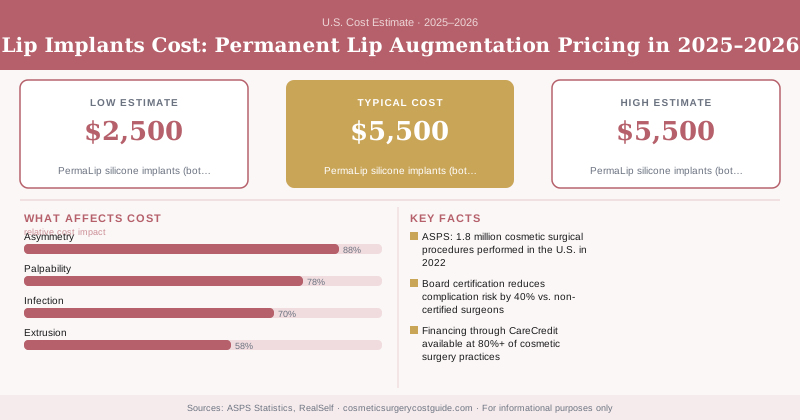
| PermaLip silicone implants (both lips) | $2,500–$5,500 |
| PermaLip (upper lip only) | $1,500–$3,000 |
| Fat transfer to lips (fat grafting) | $2,500–$5,000 |
| Lip lift surgery (separate procedure) | $2,500–$5,000 |
| Implant removal (if revision needed) | $1,500–$3,500 |
Cost includes surgeon fee, facility/OR, and anesthesia (local with sedation or IV sedation). Unlike filler, lip implants are an outpatient surgical procedure — brief but real surgery with real recovery.
PermaLip Silicone Implants: What They Are
PermaLip implants are tapered, smooth silicone cylinders inserted through small incisions at the corners of the mouth. They’re available in five sizes (3–5mm diameter) and create consistent, predictable volume that doesn’t dissolve or migrate over time.
The procedure takes 30–45 minutes under local anesthesia with optional oral or IV sedation. Recovery involves swelling and firmness for 2–4 weeks. Most patients say the implants soften and feel more natural at 6–8 weeks. Unlike breast implants, lip implants don’t require periodic replacement — they’re meant to be permanent.
Who Does the Procedure
PermaLip is technically simple but has a meaningful learning curve for natural-looking results. Board-certified facial plastic surgeons and plastic surgeons with lip augmentation experience are the preferred providers. General plastic surgeons who focus primarily on body work may have less refinement in lip-specific technique.
The American Society of Plastic Surgeons (ASPS) reported that lip augmentation (all types) grew 48% in demand from 2019 to 2023, driven heavily by the social media selfie era and the “Gen Z lip” aesthetic. Soft tissue fillers accounted for over 3.4 million procedures in 2023, with lip augmentation representing the fastest-growing subset. Against this backdrop, surgical alternatives like PermaLip have attracted patients seeking to reduce the recurring cost and time commitment of filler maintenance — particularly among patients who’ve been consistent filler users for 3+ years.
Fat Grafting to the Lips
Fat transfer is the other permanent option: fat is harvested from the abdomen, inner thighs, or flanks via mini-liposuction, processed, and injected into the lips. It’s natural (your own tissue), doesn’t involve a foreign implant, and integrates fully with lip tissue.
The catch: fat retention is variable. Expect 40–70% of injected fat volume to remain permanently. Experienced surgeons who specialize in fat grafting can improve this, but it’s never fully predictable. Some patients need a second session ($1,500–$2,500) to address volume loss.
Total fat grafting to lips: $2,500–$5,000 for the first session, potentially more for a touch-up. More expensive than PermaLip but preferred by patients who want an entirely natural result.
Lip Implants vs. Filler: The Long-Term Math
Annual filler maintenance cost: $700–$1,200/year (one to two sessions)
Over 5 years: $3,500–$6,000
PermaLip all-in: $2,500–$5,500 (one time)
Over 5 years: $2,500–$5,500
The break-even point is roughly 3–4 years of filler maintenance. Beyond that, implants are cost-positive. But this only holds if:
- The implant result aligns with what you want aesthetically
- No complications require revision or removal
- You don’t change your mind about lip volume preferences
Lip preferences change. Trends shift. Filler’s reversibility is a feature, not just a limitation.
Risks of Lip Implants
Filler is reversible with hyaluronidase; implants are not (without another procedure). Understand these risks before committing:
- Asymmetry: Can occur if implants shift slightly post-insertion. Revision requires reoperation.
- Palpability: Silicone implants can sometimes be felt through the lip tissue, especially in patients with thin lips.
- Infection: Rare (less than 1%), but the mouth’s bacterial environment creates some risk. Pre-op antibiotics are standard.
- Extrusion: In rare cases, the body pushes the implant toward the surface. Removal is required.
- Firmness: Some patients find the feel less natural than filler, particularly in the early months.
Removal is possible and straightforward — same small corner incisions, 20-minute procedure — but adds $1,500–$3,500 to your total cost if you change your mind.
Think carefully before choosing permanent lip augmentation if you’ve only been using filler for a short time or if your lip preferences have changed over the years. Filler’s ability to be dissolved or adjusted is a real advantage for lips specifically — trends in lip aesthetics shift, and what looks ideal at 30 may not feel right at 45. If you’ve been consistently happy with the same filler volume for 3+ years and want to eliminate the maintenance commitment, implants are worth serious consideration. If you’re still experimenting with volume, stay with filler.
Finding the Right Provider
Not all plastic surgeons perform lip implants. Ask specifically:
- How many PermaLip cases have you performed?
- Can I see before/after photos of your lip implant patients at 12+ months?
- What’s your revision and removal rate?
- Do you have experience with fat grafting as an alternative?
A surgeon who can discuss both options honestly — including which one is right for your anatomy — is far preferable to one who only offers one approach.
The Bottom Line
Lip implants make financial sense if you’re a longtime filler user satisfied with a consistent volume and want to eliminate recurring treatments. Budget $2,500–$5,500 all-in for PermaLip silicone implants, or $2,500–$5,000 for fat grafting. The investment pays off at roughly the 4-year mark versus annual filler maintenance.
The decision should be driven by your satisfaction with a specific filler volume held consistently over multiple sessions — not by a single appointment where you tried something new. Permanence in aesthetics demands certainty.
Frequently Asked Questions
Lip implants typically cost $2,000–$5,500 for a one-time permanent procedure, depending on the implant type, surgeon expertise, and geographic location. This contrasts with lip fillers, which cost $600–$1,000 per session and require touch-ups every 9–12 months, making implants more cost-effective long-term.
Lip implants are considered cosmetic procedures and are not covered by health insurance plans like Medicare or private insurers. Patients should expect to pay the full surgical cost out-of-pocket, though some surgeons offer financing plans or payment arrangements to spread costs over several months.
Most patients experience swelling and bruising for 1–2 weeks after lip implant surgery, with final results visible after 4–6 weeks. You can typically return to light activities within 3–5 days, though strenuous exercise and contact sports should be avoided for 2–3 weeks to prevent implant displacement.