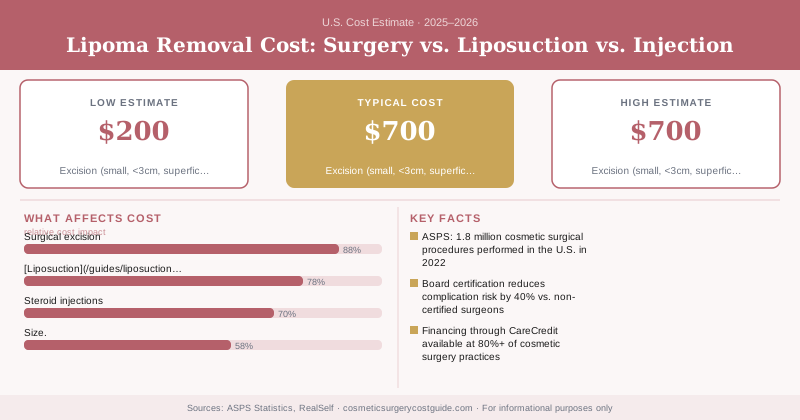
Most patients assume a lipoma — that soft, movable lump of fat under the skin — is a quick $200 fix. Then they get the quote. What actually determines whether it’s $200 or $2,500? Mostly size, depth, and location. Here’s how to read the numbers before you walk into that consultation.
What Is a Lipoma, and When Does It Need to Come Out?
Lipomas are benign fatty tumors. They’re the most common soft-tissue tumor in adults — the American Academy of Orthopaedic Surgeons estimates that about 1 in 100 people will develop one, and most adults who have one have multiple. They’re soft, moveable under the skin, and almost never cancerous.
Removal is elective in the vast majority of cases. The reasons people choose removal: the lipoma is cosmetically bothersome, it’s growing, it presses on a nerve (causing pain or tingling), or it’s in an area that causes functional discomfort. There’s no medical urgency unless the growth changes rapidly or looks unusual on imaging.
Cost by Removal Method
| Method | Typical Cost Range |
|---|---|
| Excision (small, <3cm, superficial) | $200 – $700 |
| Excision (medium, 3–5cm) | $500 – $1,200 |
| Excision (large or deep, >5cm) | $1,000 – $3,000+ |
| Liposuction-assisted removal | $1,500 – $4,000 |
| Steroid injection (size reduction only) | $50 – $200 per injection |
| Multiple lipomas (batch removal) | $800 – $3,500 |
Surgical excision is the gold standard. Under local anesthesia, the surgeon makes an incision over the lipoma, removes the entire capsule, and closes. Complete removal prevents recurrence.
Liposuction-assisted removal uses a small cannula to aspirate the fatty tissue through a tiny incision. It leaves a much smaller scar but has a higher recurrence rate because the fibrous capsule may not be fully removed. Best for larger, superficial lipomas in visible areas where scar length matters.
Steroid injections (usually triamcinolone) shrink lipomas by 30–75% in some cases but rarely eliminate them entirely. Best for patients who want size reduction without surgery. Requires repeat injections every few months.
What Pushes the Price Up
Size. A 1 cm lipoma on the forearm takes 15 minutes. A 7 cm lipoma on the back may take an hour and require deep dissection — that’s a completely different procedure.
Depth and location. Superficial lipomas just beneath the skin are easiest. Intramuscular lipomas — those embedded within muscle — are significantly more complex and expensive. A lipoma near a nerve bundle requires more careful dissection.
Provider. A dermatologist handles small, superficial lipomas and charges $200–$600. A plastic surgeon or general surgeon charges more ($500–$2,000+) but brings more complex closure skill. For lipomas in sensitive locations or over 3 cm, a surgeon is the right choice.
Facility. Most lipoma removals happen in-office under local anesthesia — no facility fee. Large or deep lipomas may require an outpatient surgery center, which adds $500–$2,000 in facility costs.
Sometimes. If the lipoma is causing documented pain, nerve compression, or functional limitation, many insurers will cover removal as medically necessary. The key is documentation: your provider needs to chart the symptoms, not just the cosmetic concern. Purely elective removal for appearance is cash-pay. CPT codes typically used: 21930–21935 (trunk/extremity) or 21552 (soft tissue tumor excision). Always get a pre-authorization if submitting to insurance.
Multiple Lipomas: Batch Pricing
If you have several lipomas — which is common — many surgeons offer reduced per-unit pricing when removing multiple in a single session. Removing three small lipomas might cost $600–$1,200 total, compared to $300–$500 each if done separately. Ask explicitly about bundled pricing.
The American Academy of Dermatology notes that people with familial multiple lipomatosis (an inherited condition) may develop dozens of lipomas and often benefit significantly from batch removal planning.
Avoid any provider who offers “lipoma removal” without imaging for large or deep lumps. A lipoma that feels unusual, grows rapidly, is fixed (doesn’t move), or is hard rather than soft needs imaging first — usually ultrasound — to rule out liposarcoma. This is rare, but a legitimate surgeon always evaluates atypical findings before excising.
Recovery and What to Expect
Small lipoma excisions have minimal downtime. Local anesthetic, a small incision, dissolvable or removable sutures, and you’re driving yourself home. Most patients return to full activity in 2–5 days.
Large lipoma removal may cause bruising, swelling, and a temporary seroma (fluid pocket) under the skin. Full healing takes 2–4 weeks.
Bottom Line
Simple lipoma removal — small, superficial, no insurance — costs $200–$700 at a dermatologist. Larger or deeper lipomas, surgery center, or plastic surgeon work pushes that to $1,000–$3,000+. If symptoms are documented, insurance may cover most or all of the cost. Get at least two quotes and confirm whether the facility fee (if any) is included in the estimate.
Frequently Asked Questions
Lipoma removal typically costs $200–$3,000, with small superficial lipomas at the lower end ($200–$500) and larger or deeply positioned lipomas at the higher end ($1,500–$3,000). The final cost depends heavily on size, depth, location, and whether the procedure is performed in an office setting versus an operating room.
Most insurance plans do not cover lipoma removal if it is purely cosmetic or asymptomatic. However, if the lipoma is causing pain, functional impairment, or cosmetic disfigurement that affects quality of life, some insurers may cover 50–80% of surgical costs; you should expect $500–$1,500 out-of-pocket even with coverage.
A typical lipoma removal procedure takes 30–60 minutes depending on size and method, with local anesthesia used for small lipomas and general anesthesia for larger ones. Most patients can return to light activities within 3–7 days, though full recovery and strenuous exercise may take 2–4 weeks.