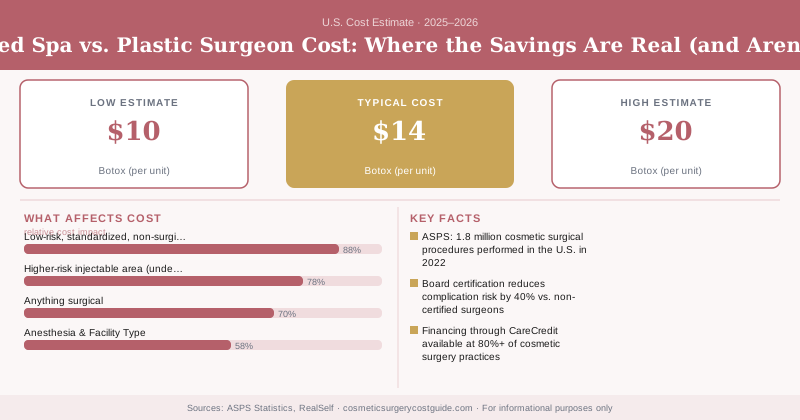
Same Botox unit, same brand, two different prices: $12 at the med spa, $18 at the plastic surgeon’s office. Is one of them ripping you off? Not necessarily — but the reasons behind that price gap matter more than the gap itself.
Understanding where med spa savings are legitimate and where they can signal a real safety tradeoff will save you both money and risk.
Typical price comparison
| Treatment | Med Spa (avg) | Plastic Surgeon Office (avg) |
|---|---|---|
| Botox (per unit) | $10–$14 | $14–$20 |
| Dermal filler (per syringe) | $500–$700 | $650–$900 |
| Laser hair removal (session) | $75–$200 | $150–$300 |
| Chemical peel | $100–$300 | $200–$500 |
| Microneedling | $200–$400 | $300–$600 |
Why med spas can charge less
Med spas generally operate with lower overhead than a full plastic surgery practice — no surgical suite, no anesthesia team, often smaller support staff. Many employ registered nurses, nurse practitioners, or physician assistants as the primary injectors rather than the physician personally performing every treatment, which reduces per-treatment labor cost. Higher patient volume, since injectables and laser treatments take less time per appointment than surgical consultations, also helps med spas spread fixed costs across more visits.
None of this inherently makes med spa treatment unsafe — a well-run med spa with properly trained, appropriately supervised injectors can deliver comparable quality to a surgeon’s office for the right treatments. The savings become risky when oversight is thin or absent.
Where the savings are genuinely safe
For well-established, lower-risk, non-surgical treatments — Botox, standard dermal filler in low-risk areas, laser hair removal, basic chemical peels — a reputable med spa with verified physician oversight and properly licensed injectors is a legitimate, lower-cost option. The treatments themselves are standardized enough, and the risk profile low enough, that the specific provider’s base credentials (RN, NP, PA with adequate specific training) matter more than whether they work at a med spa versus a surgical practice.
Ask directly: who is the medical director, and are they actually on-site or reachable during treatments (not just a name on a certificate)? Who specifically will perform your treatment, and what is their license type and specific training in that treatment? How does the practice handle complications if something goes wrong? A med spa that answers these questions clearly and confidently is a meaningfully different risk profile than one that’s vague or defensive about them.
Where the savings gap becomes a real risk
Higher-risk injectable areas — under-eye filler, nasal filler (liquid rhinoplasty), and any treatment near major blood vessels — carry a real risk of vascular complications if performed by an inadequately trained or supervised injector. This is where the lower med spa price can reflect a genuinely thinner safety margin, not just lower overhead. For these specific higher-risk treatments, verifying the individual injector’s specific experience (not just the facility’s general reputation) matters more than usual.
And for anything surgical — facelifts, breast augmentation, tummy tucks, liposuction, rhinoplasty — a med spa is simply the wrong facility type entirely. These require an accredited surgical facility and a board-certified surgeon; no legitimate med spa performs true surgical procedures, and any that claims to should be treated as a serious red flag.
A practical framework for choosing
Low-risk, standardized, non-surgical treatment + verified proper oversight → med spa savings are reasonable to take.
Higher-risk injectable area (under-eye, nose) or any treatment requiring nuanced judgment → prioritize a specific injector’s individual experience over the facility type or price.
Anything surgical → board-certified surgeon, accredited surgical facility, full stop — not a price-comparison decision at all. See our guide on the board-certified surgeon cost premium for more on why that premium is worth paying for actual surgery.
Some med spas operate with minimal or effectively absent physician oversight despite state regulations requiring it — sometimes called “cash-only” or “franchise” med spas where the named medical director rarely or never sets foot on-site. This arrangement, sometimes legally gray depending on your state, meaningfully increases risk regardless of the individual injector’s skill. Ask specifically whether the medical director is regularly present, not just nominally listed.
Bottom line
Med spas can genuinely save you 20-40% on standard non-surgical treatments like Botox and filler, and that savings is safe to take when the facility has real, verifiable physician oversight and properly trained injectors. For higher-risk injectable areas or anything surgical, the price gap stops being the relevant factor — provider qualification and facility accreditation should be your only real filter.
Frequently Asked Questions
Med spas typically have lower overhead costs, often employ nurse injectors or aestheticians rather than physicians performing the treatments directly, and operate on higher patient volume — all of which allow them to charge 20-40% less than a plastic surgeon's office for comparable injectable or laser treatments. The physician's direct involvement and typically smaller patient volume at a surgical practice are the main drivers of the higher price there.
It can be safe if the med spa is run under appropriate physician oversight with properly trained and licensed injectors, but oversight quality varies enormously between med spas, and some operate with minimal physician involvement despite state requirements. Always verify who is actually administering your injection, their specific credentials, and the level of physician supervision before booking, regardless of the facility's price point.
Any surgical procedure — facelifts, breast augmentation, tummy tucks, liposuction, rhinoplasty — should only be performed by a board-certified surgeon in an accredited surgical facility, never at a med spa, which is not equipped or licensed for surgical procedures. Med spas are appropriate only for non-surgical treatments like Botox, filler, laser treatments, and skin treatments performed by properly trained and supervised staff.