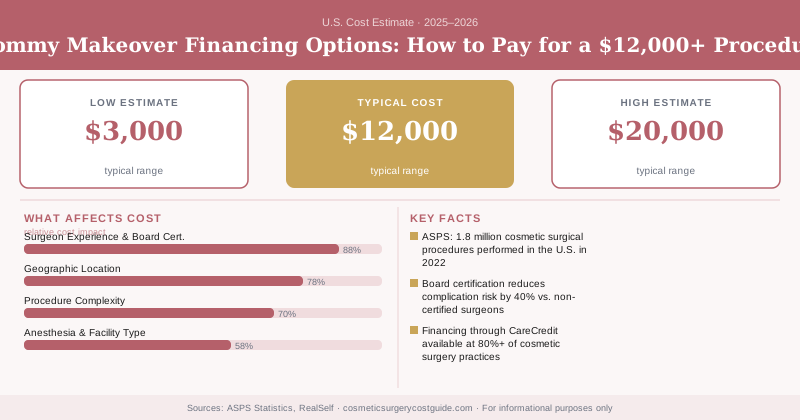
A mommy makeover routinely runs $12,000–$18,000 for the combined package — tummy tuck, breast work, and often liposuction in one surgery. That’s a number most families don’t have sitting in a checking account, which is exactly why financing conversations dominate so many consultation appointments.
Here’s a practical breakdown of every major financing route, what it actually costs, and how to choose between them based on your specific financial situation.
Financing options compared
| Option | Interest Structure | Best For |
|---|---|---|
| CareCredit / Alphaeon Credit | 0% promo, then 26.99–29.99% | Paying off within 12–24 months |
| Prosper Healthcare Lending | Fixed rate, ~7–36% APR | Longer terms, predictable payments |
| United Medical Credit | Fixed rate, marketplace-based | Fair/poor credit applicants |
| Personal loan (bank/credit union) | Fixed rate, ~6–15% for good credit | Best overall rate if credit qualifies |
| In-house payment plan | Varies by practice | No credit check, larger deposit needed |
Start with the real total cost
Before comparing financing products, get an accurate total. A mommy makeover typically combines a tummy tuck, breast augmentation or lift, and often liposuction — bundled together, this commonly runs $9,000–$20,000 depending on which procedures you’re combining and your geographic market. Financing $18,000 requires a very different plan than financing $10,000, so get your surgeon’s itemized quote locked in first.
Matching the financing product to your timeline
If you can realistically pay off your balance within 12-24 months, a medical credit card’s 0% promotional period is usually the cheapest option — genuinely interest-free if you hit the deadline. Run the math: an $15,000 balance over 18 months means a required payment around $835/month. If that’s comfortably within your budget, a promotional card makes sense.
If 18-24 months isn’t realistic — say you need 36-60 months to comfortably manage payments alongside other family expenses — a fixed-rate personal loan through Prosper, your bank, or a credit union avoids the deferred interest trap entirely and gives you a predictable, unchanging monthly payment for the life of the loan.
You don’t have to finance the entire cost through one product. A common approach: put a portion down in cash or savings (reducing the financed amount), then finance the remainder through whichever product best matches your timeline. Financing $10,000 instead of $15,000 dramatically lowers both your monthly payment and total interest paid, even at the same rate — and it reduces how tight your promotional-period deadline math needs to be.
If your credit isn’t strong
Patients with fair or poor credit shouldn’t assume financing is off the table. United Medical Credit’s lender marketplace specifically serves this group, though expect meaningfully higher rates than what good-credit applicants see elsewhere. Some practices also offer in-house payment plans requiring a larger deposit (often 30-50% upfront) with the remainder paid over a shorter period directly to the practice, bypassing a credit check entirely — worth asking about directly.
Combining procedures lowers your financing burden
One underappreciated way to reduce your total financed amount: combining procedures into a single mommy makeover surgery rather than spacing them out as separate operations. Shared anesthesia and facility fees across combined procedures commonly save $3,000–$8,000 versus doing a tummy tuck, then a breast procedure, then liposuction as three separate surgeries months apart — each with its own full facility and anesthesia charge.
Don’t forget the recovery-period budget
Financing conversations often focus entirely on the surgical bill and skip an important related cost: 2-4 weeks of reduced work capacity during recovery, especially relevant for mothers managing childcare. Factor in help at home, meal delivery, or reduced work hours when calculating your total financial picture — not just the procedure invoice itself.
Whatever financing route you choose, avoid financing 100% of the cost if you can help it. A larger upfront cash contribution, even 10-20% of the total, meaningfully reduces your monthly payment, your total interest paid, and your risk if your promotional period financing isn’t paid off on schedule.
Bottom line
Mommy makeover financing isn’t one-size-fits-all — match the product to your realistic payoff timeline, consider combining a cash down payment with financing to shrink the amount owed, and don’t overlook practice-specific payment plans if your credit is a limiting factor. The $12,000-$18,000 price tag is manageable with the right financing structure; it’s unmanageable only if you pick a product that doesn’t match how quickly you can actually pay it off.
Frequently Asked Questions
The best financing option depends on your credit and repayment timeline: medical credit cards like CareCredit or Alphaeon work well if you can pay off the balance within 12-24 months to avoid deferred interest, while a personal loan through Prosper Healthcare Lending or a bank offers a fixed rate better suited to longer repayment periods. Many patients also combine a smaller cash payment with financing for the remainder to reduce total interest paid.
Yes, options like United Medical Credit's lender marketplace serve patients with fair or poor credit, though rates for lower credit scores can be significantly higher than standard medical credit card promotional rates. Some plastic surgery practices also offer in-house payment plans that don't require a credit check, though these are less common and typically require a larger upfront deposit.
Yes — combining procedures like a tummy tuck, breast augmentation, and liposuction into one mommy makeover surgery typically saves $3,000–$8,000 compared to doing them as separate surgeries, since anesthesia and facility fees are shared across the combined procedure. This makes financing math more favorable since you're financing one lower total rather than several separate procedure costs plus repeated facility fees.