What does $3,000 buy you in non-surgical skin tightening? Depends entirely on what you pick. Standard RF microneedling devices — Vivace, Sylfirm X, Secret RF — cost $300–$800 per session and treat the dermis at 1.5–3.5mm depth. Morpheus8 penetrates 4–8mm, reaching the subdermal fat layer. That’s not a marginal upgrade; it’s a fundamentally different procedure. And at $800–$1,500 per facial session (and up to $2,500 for body areas), the price reflects that difference.
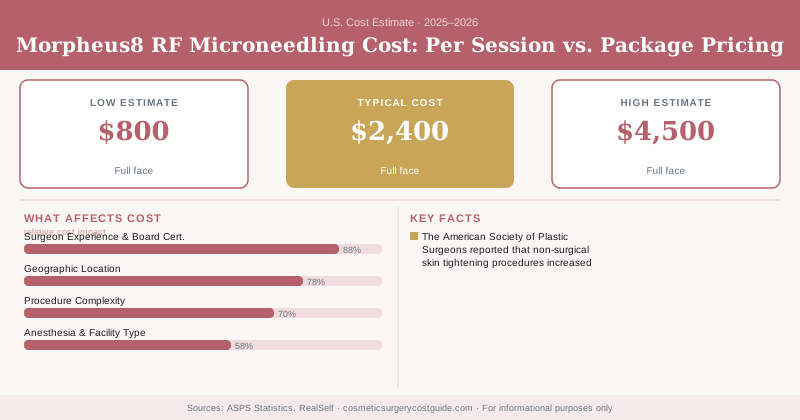
The American Society of Plastic Surgeons reported that non-surgical skin tightening procedures increased 23% between 2020 and 2023. Morpheus8, manufactured by InMode, has been one of the primary drivers of that growth — especially for patients who want more than surface-level results but aren’t ready for surgical correction.
Morpheus8 Pricing by Treatment Area
| Treatment Area | Cost Per Session | Sessions Typically Needed | Package Total |
|---|---|---|---|
| Full face | $800–$1,500 | 3 | $2,400–$4,500 |
| Neck | $600–$1,200 | 3 | $1,800–$3,600 |
| Face + neck combined | $1,200–$2,200 | 3 | $3,600–$6,600 |
| Jawline / jowl (targeted) | $600–$1,000 | 2–3 | $1,200–$3,000 |
| Abdomen | $1,000–$2,500 | 3 | $3,000–$7,500 |
| Upper arms | $800–$1,800 | 3 | $2,400–$5,400 |
| Inner thighs | $1,000–$2,000 | 3 | $3,000–$6,000 |
Packages (3 sessions booked upfront) typically save 10–20% over per-session pricing. Most practices offer promotional bundles — worth asking about at consultation, particularly for face + neck combinations.
What makes Morpheus8 different from standard RF microneedling
Standard RF microneedling delivers radiofrequency energy through needles that penetrate 1.5–3.5mm — effectively treating the superficial dermis. That’s genuinely useful for texture improvement, pore minimization, and fine lines.
Morpheus8 uses 24-pin bipolar RF needles that penetrate to 4–8mm, past the dermis and into the subdermal fat layer. At that depth, RF energy does two things: it triggers collagen remodeling in the deep reticular dermis, and it induces partial lipolysis (fat cell disruption) in the superficial fat. The result is dual-action skin tightening and mild contouring — something surface-level devices cannot replicate.
InMode’s Morpheus8 holds FDA clearance specifically for “subdermal adipose remodeling.” A 2021 study in Lasers in Surgery and Medicine documented statistically significant improvement in skin laxity scores at 3-month follow-up, with minimal downtime. That’s meaningful clinical validation, not just marketing language.
Who’s the right candidate
Morpheus8 performs best when there’s something to tighten — not just texture issues. Ideal candidates have:
- Mild to moderate skin laxity with early jowling
- Loose skin on the abdomen, arms, or thighs after weight loss or pregnancy
- Atrophic acne scarring (rolling, boxcar scars respond well)
- Fitzpatrick skin types I–VI: unlike ablative lasers, Morpheus8 bypasses the epidermis and is safe for darker skin tones
It’s not appropriate for severe laxity requiring excision, active acne in the treatment zone, or patients expecting surgical-level results.
All three target skin laxity through different energy modalities. Ultherapy ($2,000–$5,000 full face) uses focused ultrasound to heat the SMAS layer — excellent for significant lift but more discomfort and longer recovery than Morpheus8. Thermage ($1,500–$4,500 per session) uses monopolar RF without needles — less downtime but less depth, considered less effective for significant laxity. Morpheus8 wins on versatility (safe for darker skin tones, body areas), downtime management, and evidence base for subdermal remodeling. Choose Ultherapy for maximum facial lifting; Morpheus8 for dual skin tightening and mild contouring with less discomfort.
What the treatment feels like
Most providers apply topical numbing cream 30–45 minutes before treatment. The procedure itself involves controlled needle penetrations across the treatment area — most patients describe it as a combination of pressure and heat, not sharp pain. Body treatments are typically less comfortable than facial ones due to thicker tissue. Plan for 60–90 minutes from arrival to walking out.
Downtime: 3–5 days of redness, swelling, and pinpoint bruising. You’ll look like a moderate sunburn for 48 hours, followed by mild peeling. Most patients return to social activity by day 5. Full results develop over 3–6 months as collagen remodeling continues.
Geographic pricing differences
In Los Angeles, Miami, and New York, expect to pay at the upper end of published ranges. Smaller markets and practice-owned med spas typically run 20–30% lower. Board-certified plastic surgeons and dermatologists charge more than nurse practitioners at standalone med spas — not always because outcomes differ, but because clinical infrastructure costs more.
Always confirm the device being used is authentic InMode-manufactured Morpheus8. Counterfeit RF microneedling devices sold under generic names are circulating in less-regulated med spa markets. Verify the device model directly with the provider.
Morpheus8 and sun exposure don’t mix well — before or after. Avoid significant sun exposure for 2 weeks pre-treatment, and commit to SPF 30+ for at least 4 weeks post-treatment. Even though Morpheus8 is safer for darker skin tones than ablative lasers, tanned skin at the time of treatment raises the risk of post-inflammatory hyperpigmentation. If a provider doesn’t ask about your recent sun history, that’s worth noting before you book.
Is the cost justified?
For early jowling, loose post-pregnancy abdominal skin, and acne scarring that needs subdermal correction — yes, Morpheus8’s premium over standard RF microneedling is defensible. The evidence is there, the FDA clearance is specific to the claimed mechanism, and patients with appropriate expectations generally report high satisfaction.
For pure texture and fine lines without laxity concerns, standard RF microneedling at $300–$800 per session gets the job done. The $500+ premium per session isn’t justified if you’re not targeting the deeper tissue.
Bottom Line
Budget $2,400–$4,500 for a three-session facial package with a reputable provider. Get at least two quotes, verify board-certified providers over solo med spa practitioners, ask to see before-and-afters from patients with similar skin type and concerns, and confirm you’re looking at authentic InMode Morpheus8 equipment. Results take 3–6 months to mature — don’t judge the investment in the first 60 days.
Frequently Asked Questions
Morpheus8 RF microneedling costs $800–$2,500 per session, depending on treatment area and provider location. Most patients require 3 sessions spaced 4–6 weeks apart, bringing the total treatment cost to $2,400–$7,500 for a complete course.
No, Morpheus8 is considered a cosmetic procedure and is not covered by health insurance plans. You will pay the full out-of-pocket cost, though some clinics offer financing options or package discounts for multiple sessions paid upfront.
Morpheus8 penetrates 4–8mm into the subdermal fat layer, while standard RF devices like Vivace and Secret RF penetrate only 1.5–3.5mm into the dermis. This deeper penetration makes Morpheus8 more effective for skin tightening and lifting, justifying its higher cost of $800–$2,500 per session versus $300–$800 for standard RF microneedling.