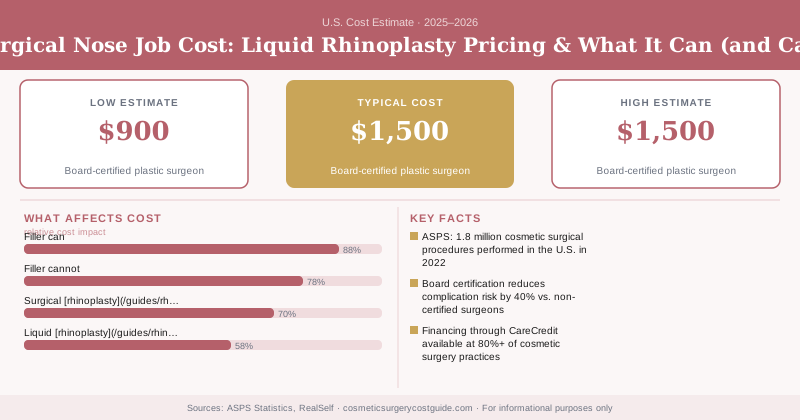
What if your nose looked different, no surgery required? For specific concerns — a dorsal hump, a slightly drooping tip, asymmetry from a past injury — liquid rhinoplasty with hyaluronic acid filler can produce visible improvement in 15 minutes. The cost: $600–$1,500 per session. The limitations: it adds volume, it doesn’t remove it. And in the wrong hands, it’s one of the riskier filler injections on the face.
According to RealSelf data, the non-surgical nose job has maintained a “Worth It” rating above 80% for several consecutive years — but the same data shows a wider range of satisfaction than almost any other filler treatment, driven almost entirely by provider selection and patient expectations. The people who love their results understood exactly what filler could and couldn’t do. The ones who didn’t? Often found themselves with noses that looked larger, not smaller.
Non-Surgical Nose Job Cost Breakdown
| Provider Type | Cost Per Session | Filler Amount Used | Results Duration |
|---|---|---|---|
| Board-certified plastic surgeon | $900–$1,500 | 0.5–1.5 mL | 9–18 months |
| Board-certified dermatologist | $800–$1,400 | 0.5–1.5 mL | 9–18 months |
| Cosmetic surgeon / aesthetic MD | $700–$1,200 | 0.5–1.5 mL | 9–18 months |
| Med spa (NP/PA with experience) | $600–$1,000 | 0.5–1.5 mL | 9–18 months |
| Touch-up or asymmetry correction | $300–$700 | 0.1–0.5 mL | — |
Filler type affects both cost and duration. Hyaluronic acid fillers (Juvederm Voluma, Restylane Lyft) are reversible with hyaluronidase — a critical safety feature for nasal work — and last 9–18 months. Permanent fillers (silicone, PMMA) should never be used on the nose due to irreversibility of complications.
What liquid rhinoplasty can actually do
This is the most important section to read before booking a consultation.
Filler can:
- Smooth a dorsal hump by filling the area above and below it, creating a straighter profile
- Lift a drooping nasal tip (temporarily) by injecting beneath the tip
- Correct minor asymmetry from prior surgery or injury
- Define the supratip break (the subtle dip above the tip) for a more refined profile
- Camouflage a shallow radix (nose-bridge) by building projection at the root
Filler cannot:
- Make the nose smaller — filler adds volume by definition
- Address a truly enlarged nose or wide alar base
- Fix breathing problems (septal deviation, valve dysfunction)
- Replicate the structural reshaping of surgical rhinoplasty
- Narrow nostrils
The single most common disappointment: patients who want their nose smaller leaving with a nose that looks larger because filler was added without correcting the optical illusion that makes a hump appear to dominate the nose. This does work — a straight profile can make the nose appear slimmer — but only when patients understand they’re not reducing tissue, they’re redirecting visual attention.
The nose has a dense, interconnected vascular supply. The dorsal nasal artery, lateral nasal artery, and angular artery are all in close proximity to common injection points. Accidental intra-arterial injection — where filler enters a blood vessel — can cause vascular occlusion, skin necrosis, and in rare cases, vision loss (via retrograde flow to the ophthalmic artery). This isn’t theoretical: the nose and glabella are the two highest-risk filler injection zones on the face. A 2019 review in Plastic and Reconstructive Surgery identified the nasal area as a primary site of serious filler complications. Your injector must have immediate access to hyaluronidase (for HA filler reversal), know the anatomy cold, and use a slow, careful injection technique with aspiration. This is not a procedure to book based on price alone.
How it compares to surgical rhinoplasty
The cost gap is significant: surgical rhinoplasty averages $7,400–$12,000+ all-in; liquid rhinoplasty runs $600–$1,500 per session. But they’re fundamentally different procedures with different capabilities.
- Surgical rhinoplasty: Can reduce, reshape, refine, and correct structural issues. Permanent. One-time cost amortized over decades. Downtime 1–2 weeks, full results at 12 months.
- Liquid rhinoplasty: Can camouflage, add volume, and correct perception. Temporary (9–18 months). Requires repeat treatments. No downtime. But limited to what addition of volume can accomplish.
The right patient for liquid rhinoplasty isn’t the patient who can’t afford surgery — it’s the patient whose specific concerns are genuinely addressable by adding volume in strategic locations. A patient with a subtle dorsal hump and good overall nasal proportion may be an ideal candidate. A patient wanting a smaller nose or corrected breathing is not.
What to expect during treatment
Topical numbing cream is applied 20–30 minutes before the procedure. The actual injection takes 10–20 minutes using either a needle or cannula (a blunt-tipped device that reduces bruising risk and vascular trauma). Results are immediately visible — though some initial swelling adds temporary volume that resolves in 24–48 hours.
Post-treatment: don’t blow your nose forcefully for 24 hours, avoid glasses that press on the bridge for 2–3 days, and skip strenuous exercise for 24–48 hours.
Never book non-surgical rhinoplasty with a provider who doesn’t have hyaluronidase physically present during the procedure. Hyaluronidase dissolves HA filler and is the emergency treatment for vascular occlusion — if blood supply to nasal skin is cut off, you have minutes to act before tissue necrosis begins. Any practice offering nasal filler without on-site hyaluronidase is taking an unacceptable risk with your safety. Ask specifically: “Do you have hyaluronidase here right now?” The answer should be yes, without hesitation.
Dissolving and reversibility
One of HA filler’s most valuable properties: it’s reversible. Hyaluronidase dissolves HA filler in 24–48 hours. Dissolution costs $200–$500 and can be performed if you’re unhappy with results, develop a complication, or simply want to return to baseline before trying again.
This is the primary reason permanent or semi-permanent fillers should never be used in the nose. Complication management with non-reversible products is significantly more complex and less reliable.
Bottom Line
A non-surgical nose job costs $600–$1,500 per session and lasts 9–18 months. It’s appropriate for specific, well-defined concerns — dorsal hump camouflage, drooping tip, minor asymmetry — and works only when the patient understands that volume is being added, not removed. The procedure carries real vascular risk and demands a highly experienced injector with on-site hyaluronidase. Don’t price-shop this one. The $300 difference between a budget med spa and an experienced facial surgeon or dermatologist is irrelevant compared to the risk of a vascular complication. Get two consultations, ask about provider volume and emergency protocols, and be honest with yourself about whether filler can actually accomplish what you want.
Frequently Asked Questions
A liquid rhinoplasty typically costs $600–$1,500 per session using hyaluronic acid filler. Most patients require 1–2 sessions initially, with touch-ups needed every 12–18 months as the filler gradually breaks down.
No, liquid rhinoplasty is considered a cosmetic procedure and is not covered by health insurance plans. You will pay the full cost out-of-pocket, though some practices offer payment plans to spread the expense over several months.
The injection procedure takes about 15 minutes. Liquid rhinoplasty works best for adding volume to smooth a dorsal hump, lift a drooping tip, or correct minor asymmetry—but it cannot remove bone or cartilage, so it is not suitable for patients who need to reduce nose size.