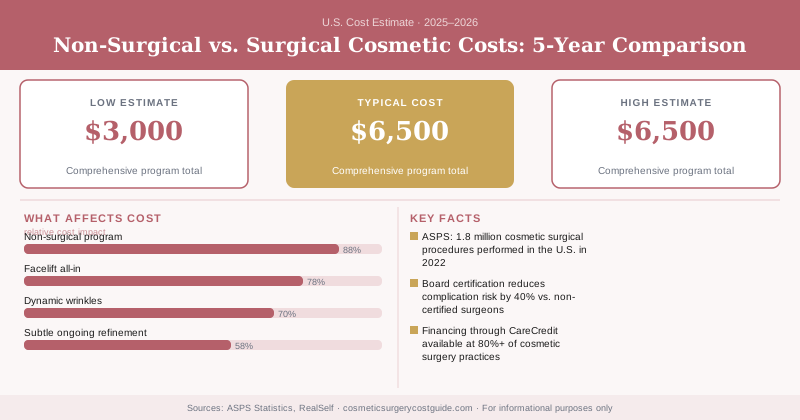
Here’s a comparison that almost no one runs before they start Botox at 40: over five years, a full non-surgical maintenance program costs more than many one-time surgical procedures. That doesn’t automatically make surgery the right choice — but it changes the financial framing entirely.
What a Full Non-Surgical Maintenance Program Costs
The ASPS 2023 statistics show non-surgical cosmetic procedures outpacing surgical ones by volume: over 9 million Botox treatments and 4.4 million soft tissue filler treatments were performed in 2023 alone. Most patients underestimate what they’ll spend long-term.
| Non-Surgical Treatment | Frequency | Annual Cost |
|---|---|---|
| Botox (forehead + crow’s feet + glabella) | Every 3–4 months | $900–$1,800 |
| Cheek/midface filler | Every 12–18 months | $800–$1,600 |
| Lip filler | Every 6–12 months | $600–$1,200 |
| Under-eye filler | Every 12–18 months | $600–$1,200 |
| Jawline/chin filler | Every 12 months | $700–$1,400 |
| Skin booster (Sculptra/Radiesse) | Every 2 years | $500–$1,000 |
| Comprehensive program total | — | $3,000–$6,500/year |
A patient starting a comprehensive non-surgical program at 45 and maintaining it for 10 years will spend $30,000–$65,000. That’s real money — comparable to or exceeding the cost of a surgical intervention that might have addressed the underlying concern more definitively.
The 5-Year Cost Model: Face
| Strategy | Year 1 | Years 2–5 | 5-Year Total |
|---|---|---|---|
| Non-surgical only (full program) | $4,000 | $4,000/yr | $20,000 |
| Facelift (SMAS) + maintenance | $16,000 | $1,800/yr | $23,200 |
| Facelift (deep plane) + minimal maintenance | $22,000 | $1,200/yr | $26,800 |
| Non-surgical + Ultherapy every 2 years | $6,000 | $5,000/yr avg | $26,000 |
Over 5 years, a facelift with reduced maintenance maintenance costs about the same as a full non-surgical program. Over 10 years, surgery usually wins on total cost — especially for patients who start surgery at 55–60 and only need one procedure in their lifetime.
Non-surgical program: $4,500/year
Facelift all-in: $15,000
Break-even: $15,000 ÷ $4,500 = 3.3 years
By year 4, a surgical patient who reduces maintenance to $1,500/year starts coming out financially ahead. By year 7, the gap is $15,000–$20,000 in the surgical patient’s favor.
This assumes the surgery achieves the result adequately. If it doesn’t — or if revision is needed — the math reverses.
The 5-Year Cost Model: Breasts
| Strategy | Upfront Cost | Ongoing | 5-Year Total |
|---|---|---|---|
| Breast augmentation | $8,000–$12,000 | None typical | $8,000–$12,000 |
| Non-surgical breast enhancement (fat transfer) | $6,000–$10,000 | May need 2nd session | $10,000–$20,000 |
| Non-surgical only (no equivalent) | N/A | N/A | N/A |
For breast procedures specifically, there’s no meaningful non-surgical alternative for volume augmentation — fat transfer achieves some effect but typically requires 1–2 sessions and delivers modest results compared to implants. The surgical path is clearer here.
The 5-Year Cost Model: Body Contouring
| Strategy | Cost | Frequency | 5-Year Total |
|---|---|---|---|
| CoolSculpting (full abdomen) | $2,000–$4,000/session | 2–4 sessions | $8,000–$16,000 |
| Emsculpt Neo | $3,000–$6,000/series | Every 1–2 years | $9,000–$18,000 |
| Liposuction (abdomen + flanks) | $5,000–$9,000 | Once | $5,000–$9,000 |
Multiple CoolSculpting sessions chasing the same result as a single liposuction procedure is a common scenario. The ASPS notes that liposuction permanently removes fat cells from treated areas; non-surgical options reduce fat cells but less completely, often require retreatment, and have more modest effect sizes.
What Surgery Can’t Do That Non-Surgical Can
Cost comparison alone misses an important point: non-surgical treatments are genuinely better for some things.
Dynamic wrinkles: Botox addresses forehead lines and crow’s feet better than surgery. No surgery eliminates dynamic wrinkles — Botox is the mechanism.
Subtle ongoing refinement: A 40-year-old who isn’t ready for surgery yet — and doesn’t need it — can maintain a natural refreshed appearance with targeted injectables that would look over-operated if done surgically.
Volume replacement: Dermal fillers replace age-related volume loss in cheeks, temples, and lips in ways that don’t require surgery. This is the primary aesthetic use of fillers.
Zero downtime: Botox or lip filler has no recovery time. For someone who can’t take 2–4 weeks off work, non-surgical has a real quality-of-life advantage.
What Surgery Does Better
Structural laxity: Once skin has lost enough elasticity to create visible sagging — jowls, neck laxity, drooping upper eyelids — injectables can’t mechanically lift it. You can add volume to camouflage, but you can’t recreate the structural support that surgical repositioning provides. That’s not a sales pitch; it’s anatomy.
One-and-done for many patients: A 55-year-old who gets a facelift and uses modest maintenance injectables afterward spends less over 15 years than a patient who avoids surgery entirely and chases equivalent results non-surgically.
Body procedures with no non-surgical equivalent: A tummy tuck removes excess abdominal skin. Nothing non-surgical does that. Same for arm lift, thigh lift, and skin removal after significant weight loss.
“Non-surgical” doesn’t mean “consequence-free.” Repeated filler injections can cause volume distortion over time (overfilled cheeks, pillow face), migration, or granuloma formation. Botox overuse creates a frozen appearance. Non-surgical treatments are less invasive — but they have their own risk profile with long-term cumulative use that patients often don’t anticipate at year one of their program.
The Decision Framework
Choose non-surgical if:
- You’re in your late 30s or early 40s with early signs of aging
- You want to maintain results without surgery
- Your primary concerns are dynamic wrinkles or volume loss (not structural laxity)
- You can’t afford the time off for surgery recovery
- You want to test your tolerance for aesthetic procedures before committing to surgery
Consider surgery if:
- You have visible structural laxity that injectables can’t adequately address
- You’ve been running a full non-surgical program for 2+ years and feel you’ve hit a ceiling
- Your long-term cost analysis shows surgery is more economical for your specific goals
- The result you want requires physical tissue repositioning or removal
Bottom Line
The financial case for surgery strengthens significantly over 5–10 years. A full non-surgical maintenance program at $4,000–$6,000/year costs $20,000–$60,000 over a decade. The equivalent surgical procedure — facelift, liposuction, eyelid surgery — often costs less in total when you account for reduced maintenance. But cost isn’t everything: non-surgical options offer real advantages in downtime, flexibility, and reversibility that surgery doesn’t. Know what you’re actually comparing before you make the decision.
Frequently Asked Questions
A non-surgical maintenance program using Botox and fillers typically costs $3,000–$6,000 annually, totaling $15,000–$30,000 over five years. A surgical facelift costs $12,000–$20,000 as a one-time procedure, making it potentially more cost-effective over a five-year period despite the higher upfront expense.
Cosmetic procedures including Botox, fillers, and facelifts are considered elective and are not covered by health insurance, meaning you pay 100% out-of-pocket. Some surgical procedures may be covered if they serve a medical purpose (such as reconstructive surgery after injury), but purely cosmetic work requires full patient payment.
Botox results last 3–4 months and require repeat injections 3–4 times yearly to maintain the effect, while dermal fillers typically last 6–18 months depending on the product used. This ongoing maintenance schedule means non-surgical treatments require a long-term commitment with recurring costs, whereas a surgical facelift provides results lasting 7–10 years with no maintenance injections needed.