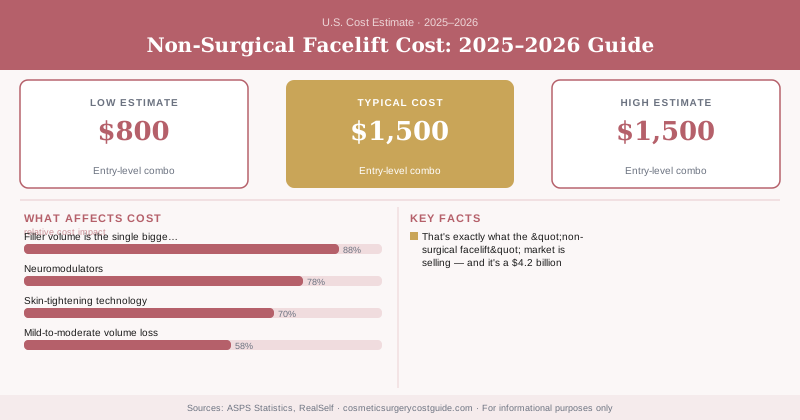
42% of women considering facial rejuvenation say they want surgical-level results without the recovery time. That’s exactly what the “non-surgical facelift” market is selling — and it’s a $4.2 billion category in the US alone, according to the American Society for Dermatologic Surgery. But what you actually get for your money depends enormously on what’s in the treatment package.
“Non-surgical facelift” isn’t one procedure. It’s a marketing term for a combination of treatments — usually some mix of neuromodulators (Botox/Dysport), dermal fillers, skin-tightening technology (RF, ultrasound), and possibly biostimulators like Sculptra. The best results come from thoughtful combination protocols. The worst come from generic spa packages that under-treat everything.
Non-surgical facelift cost by approach
| Treatment Combination | What’s Included | Typical Cost |
|---|---|---|
| Entry-level combo | Botox 3 areas + 1 syringe filler | $800–$1,500 |
| Standard “liquid facelift” | Botox + 2–3 syringes filler | $2,000–$4,000 |
| Comprehensive rejuvenation | Botox + filler + RF skin tightening | $3,500–$6,000 |
| Full-face protocol | Botox + 4–6 syringes + biostimulator | $5,000–$8,000 |
| Maintenance session (existing patient) | Touch-up Botox + 1 syringe filler | $600–$1,200 |
Prices vary sharply by location and injector. In Manhattan, LA, or Miami, a comprehensive protocol easily reaches $8,000–$12,000. In smaller markets, a well-designed treatment plan often runs $3,000–$5,000 for the same clinical outcome.
What drives the price
Filler volume is the single biggest cost driver. Meaningful volumization of the midface, temples, jawline, and chin requires 3–6 syringes of hyaluronic acid filler. At $600–$1,200 per syringe, that alone is $1,800–$7,200 before any Botox or technology treatments.
Neuromodulators (Botox, Dysport, Xeomin) run $300–$800 for a full upper-face treatment. They address dynamic wrinkles and can create a subtle brow lift, but they don’t replace lost volume.
Skin-tightening technology (Ultherapy, Thermage, RF microneedling) adds $1,000–$4,000 depending on treatment area and number of sessions. These work on skin laxity and collagen production, which fillers don’t address.
How to read “combination package” pricing
Many practices offer bundled package prices that appear to be discounts. Scrutinize what’s actually included:
- How many units of Botox? (Meaningful treatment = 40+ units for full face)
- How many syringes of filler? (Meaningful midface volume = 2+ syringes)
- What brand of filler? (Juvederm Voluma vs. a cheaper HA filler = very different results)
- What technology treatment? (A 30-minute RF facial ≠ a full Thermage treatment)
A “$1,200 non-surgical facelift” that includes 20 units of Botox and half a syringe of filler is not going to produce a meaningful rejuvenation result.
Most experienced injectors agree the baseline for visible, natural-looking results is:
- 40–60 units of neuromodulator (full upper and mid-face)
- 2–4 syringes of filler placed strategically across midface, temples, jawline, and under-eye
- At least one skin-tightening treatment if there’s significant laxity
That protocol realistically costs $3,000–$5,500 at a reputable practice. Budget packages that promise “facelift results” for under $1,500 are almost always over-promising.
How does it compare to surgical facelift cost?
A surgical facelift runs $8,000–$20,000 including facility and anesthesia fees. Non-surgical approaches cost less upfront — but they require ongoing maintenance. Fillers last 12–24 months. Botox lasts 3–4 months. If you’re maintaining a full non-surgical protocol annually, expect to spend $2,500–$5,000 per year indefinitely.
Surgical facelift results typically last 7–12 years. Over a 10-year horizon, a well-maintained non-surgical protocol can actually cost more than surgery. The tradeoff: no downtime, no surgical risk, adjustable results, and the ability to stop anytime.
Who gets the best results from non-surgical approaches
Non-surgical rejuvenation works best for:
- Mild-to-moderate volume loss — hollowed temples, flattened cheeks, thinning lips
- Dynamic wrinkles — forehead lines, crow’s feet, frown lines that are motion-related
- Early skin laxity — slight looseness in the lower face and neck that hasn’t progressed to excess skin
Non-surgical approaches can’t address:
- Significant skin excess — the jowling and neck skin that needs to be physically lifted and re-draped
- Deep structural descent — fat pad migration that creates prominent nasolabial folds
- SMAS layer changes — the deeper fascial layer that surgery tightens directly
Overfilling is a real risk with non-surgical approaches. Patients who repeatedly add filler without dissolving old product can develop a “pillow face” look — puffy, overfilled cheeks that read as unnatural. A good injector tracks your total filler history and recommends dissolving old product before adding new. If your injector never suggests Hyaluronidase for existing filler, consider that a yellow flag.
Maintenance costs year over year
Budget for ongoing care if you’re committed to a non-surgical approach:
- Botox touch-ups: 3–4 times per year at $300–$600 each = $900–$2,400/year
- Filler maintenance: 1–2 syringes annually = $700–$2,000/year
- Skin-tightening treatment: once every 1–2 years = $500–$2,000 amortized
Total annual maintenance: roughly $2,000–$5,000 depending on protocol intensity. Factor this into your decision between surgical and non-surgical options.
Frequently Asked Questions
A non-surgical facelift typically costs between $1,500 and $8,000, depending on the number of treatments and products used. Most patients spend $2,500 to $5,000 for a full-face approach combining dermal fillers ($600–$2,000 per syringe), Botox ($10–$15 per unit, averaging $300–$800 per session), and radiofrequency treatments ($1,500–$4,000 per session). Costs vary by geographic location, practitioner expertise, and brand selection.
No, health insurance does not cover non-surgical facelift procedures because they are considered cosmetic treatments rather than medically necessary. You should expect to pay 100% out-of-pocket, though some practices offer payment plans, financing through CareCredit or Affirm, or package discounts for multiple sessions. Some employers offer wellness stipends that may apply to dermatology visits, but these rarely cover cosmetic procedures.
Results typically last 3 to 6 months for Botox, 6 to 18 months for dermal fillers depending on the product, and 6 to 12 months for radiofrequency treatments. Most patients commit to maintenance appointments every 3 to 6 months to sustain results, meaning annual costs of $3,000 to $15,000 depending on the intensity of your regimen. If you want permanent surgical-level changes without ongoing treatments, a traditional surgical facelift ($7,500–$20,000) may be more cost-effective over 10+ years.