Most people assume “nose job” only comes in one form: surgery, general anesthesia, weeks of recovery, a bill north of $8,000. That’s true for surgical rhinoplasty — but there’s a non-surgical version that costs a fraction of that and takes 15 minutes in a chair.
Non-surgical nose reshaping, often called “liquid rhinoplasty,” uses injectable dermal filler to smooth bumps, correct minor asymmetry, or add height to the bridge — without cutting anything. It’s not a replacement for surgery in every case, but for the right candidate, it’s a dramatically cheaper alternative.
What it costs
| Component | Cost |
|---|---|
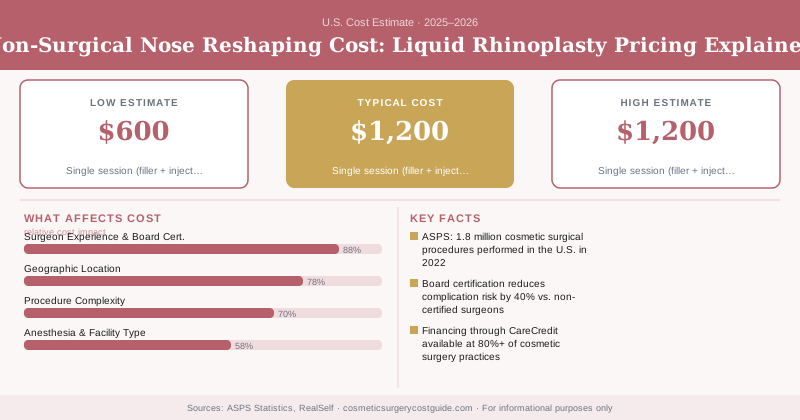
| Single session (filler + injection) | $600–$1,200 |
| Premium filler brands (Juvederm Voluma, Restylane) | $800–$2,000 |
| Touch-up session | $400–$800 |
| Annual maintenance (1–2 sessions/year) | $1,200–$3,000 |
| Compare: surgical rhinoplasty | $5,000–$15,000 |
What it can fix — and what it can’t
This is the part patients most often misunderstand: non-surgical rhinoplasty adds volume. It cannot remove volume. That single fact determines whether you’re a good candidate.
It works well for:
- A small dorsal hump — filler placed above and below the bump can create the visual illusion of a straighter profile
- Minor asymmetry between the two sides of the nose
- A low or flat bridge that needs more height/projection
- Smoothing minor irregularities left after a previous surgical rhinoplasty
It cannot help with:
- A nose that’s too large or wide overall
- A bulbous or droopy tip that needs cartilage reshaping
- Breathing problems from a deviated septum
- Any case where the actual goal is to make the nose smaller
If your main complaint is size, only surgical rhinoplasty can deliver that. Injecting filler into a nose that’s already too big only makes it bigger.
Surgeons who perform liquid rhinoplasty are candid that it works through optical illusion, not structural change. By adding filler above and below a dorsal hump, the nose appears straighter in profile even though the bump itself is still there — it’s just visually flanked by added volume. This is a completely different mechanism than surgical rhinoplasty, which physically removes or reshapes bone and cartilage. Understanding this distinction is the key to realistic expectations.
Why it’s so much cheaper than surgery
Surgical rhinoplasty requires an operating room, anesthesia (general or heavy sedation), a surgeon’s OR time of 1.5–3 hours, and weeks of recovery with splints and swelling. Non-surgical reshaping needs none of that — it’s an in-office injection using topical numbing cream, done in 15–30 minutes, with patients returning to normal activities the same day. Every one of those differences strips cost out of the procedure.
But that lower cost is recurring, not one-time. Filler dissolves gradually over 6–18 months, so you’re paying $1,200–$3,000 a year indefinitely to maintain the result — versus a single upfront surgical cost that, aside from rare revisions, is permanent.
Doing the long-term math
Over a 5-year period, non-surgical nose reshaping at roughly $1,500/year in maintenance costs around $7,500 — comparable to or even more than a single surgical rhinoplasty at $5,000–$15,000. The math favors surgery for anyone planning to maintain results for many years; it favors filler for anyone wanting a temporary trial run or a smaller, more affordable correction.
Who should choose the non-surgical route
Good candidates are patients with a small, specific concern (a bump, minor asymmetry) who want to avoid downtime and surgery, or who want a “preview” of how a straighter profile might look before committing to permanent surgical change.
Filler injected into the nose carries a rare but serious risk: vascular occlusion, where filler blocks blood flow to the skin or, in extremely rare cases, the eye. This is one of the highest-risk areas in the body for filler injection. Only go to an injector with specific, extensive experience in nasal filler — not a general injector who occasionally does noses. Ask directly how many nasal filler cases they’ve done and what their protocol is if a vascular event occurs.
Bottom line
Non-surgical nose reshaping costs $600–$2,000 per session — a fraction of surgical rhinoplasty’s $5,000–$15,000 price tag — but it only adds volume and needs repeating every 6–18 months. For small corrections and patients avoiding downtime, it’s a legitimate, budget-conscious option. For anyone wanting a smaller nose or a permanent fix, surgery remains the only real path.
Frequently Asked Questions
Non-surgical nose reshaping using dermal filler typically costs $600–$2,000 per session, with most patients needing touch-ups every 12–18 months since the filler is not permanent. Total annual cost for maintaining results usually falls between $1,200–$3,000 depending on the filler used and how often you need refinement.
No — non-surgical rhinoplasty using filler can only add volume to camouflage bumps, asymmetry, or depressions; it cannot reduce the size of your nose or remove cartilage or bone. If your goal is a smaller or narrower nose, only surgical rhinoplasty can achieve that result.
Results from non-surgical nose reshaping typically last 6–18 months depending on the filler type used, with thicker hyaluronic acid fillers lasting longer than thinner ones. Most patients return for maintenance injections once or twice a year to preserve the shape, making it an ongoing cost rather than a one-time expense.