Full ear surgery pricing overview? Our ear surgery otoplasty cost guide covers children vs. adult pricing, congenital coverage, and surgeon selection. This page focuses on ear pinning specifically.
That $3,200 quote from the first surgeon felt steep. Then the second surgeon quoted $6,800 — for what looked like the same procedure. Here’s the thing: both quotes can be completely reasonable, depending on what’s actually driving the ear otoplasty cost.
Otoplasty — or ear pinning surgery — reshapes protruding, asymmetrical, or abnormally formed ears. It’s one of the few cosmetic surgery procedures commonly performed on children, but adults make up a significant share of patients too. The American Society of Plastic Surgeons (ASPS) reports approximately 23,000 otoplasty procedures performed annually in the US, with an 84% patient satisfaction rate — one of the higher ratings in the field.
The variation in quotes reflects real differences in surgeon experience, technique complexity, and how much cartilage work is involved. Let’s break it down.
Ear Otoplasty Cost: What You’ll Actually Pay
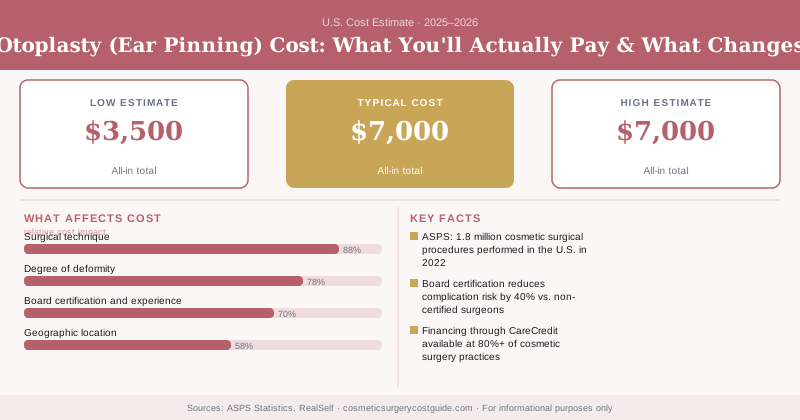
Ear otoplasty cost ranges from $3,500 to $7,000 all-in for most bilateral (both ear) cases. That figure covers the surgeon’s fee, anesthesia, surgical facility, and post-op supplies. It’s genuinely one of the more predictable cosmetic surgery costs — there’s less variability than procedures like rhinoplasty or facelift because otoplasty is a relatively contained operation with well-defined technique options.
Otoplasty Cost Breakdown
| Cost Component | Range |
|---|---|
| Surgeon’s fee | $2,500–$5,000 |
| Anesthesia fee | $500–$1,000 |
| Facility / operating room fee | $500–$1,200 |
| Pre-op labs and medical clearance | $100–$300 |
| Post-op supplies (bandages, headband) | $50–$100 |
| All-in total | $3,500–$7,000 |
Bilateral otoplasty — both ears — is the standard. Single-ear procedures are done when only one ear is affected, but asymmetry between ears is so common that most patients benefit from at least some correction on both sides. Bilateral work adds modest cost over unilateral but is often necessary for a balanced result.
What Drives Price Differences
Surgical technique: There are three main approaches to otoplasty — suture techniques (Mustardé sutures hold cartilage in a new position), cartilage scoring (weakening the cartilage so it bends to the desired shape), and cartilage removal (excising strips of cartilage). Scoring and removal are more technically demanding and take longer than suture-only techniques. Complex cases requiring all three approaches command higher surgeon fees.
Degree of deformity: A simple protrusion with normal ear anatomy is more straightforward than a constricted ear (lop ear), cupped ear, or Stahl’s ear deformity. The more complex the anatomy, the longer the operating time and the higher the fee.
Board certification and experience: A board-certified plastic surgeon or facial plastic surgeon with a high volume of otoplasty cases — especially pediatric cases — will price their fees accordingly. This is not a place to optimize for the lowest quote.
Geographic location: Expect 20–35% higher fees in major metros (New York, Los Angeles, Miami) versus mid-size cities.
Congenital ear deformities — conditions present from birth — are sometimes partially covered by insurance. Relevant scenarios include:
- Microtia: Underdeveloped or absent ear (requires reconstruction, not just pinning)
- Prominent ears caused by documented congenital absence of the antihelical fold
- Psychological or functional documentation: Some plans require evidence of psychological impact, particularly in children
If you’re pursuing insurance coverage, document everything before the consultation — photographs, pediatrician notes, any psychological evaluations. Your surgeon can provide the coding (ICD-10 Q17.5 for congenital ear malposition is a starting point). Most standard “my ears stick out” cases won’t qualify, but it’s worth making the call.
What the Procedure Actually Involves
Otoplasty is an outpatient procedure, typically 1–2 hours under general anesthesia for children and local anesthesia with sedation for adults. The incision is made behind the ear, in the natural crease where the ear meets the head — the scar is almost entirely hidden.
Recovery is more comfortable than most patients expect. The main constraint is protecting the ears from trauma during healing:
- Week 1: Bulky head bandage worn continuously; avoid sleeping on your side
- Weeks 2–4: Soft headband worn at night to protect sutures
- Month 1–2: Avoid contact sports, wrestling, anything that risks a blow to the ears
- Return to work/school: Typically 5–7 days for most adults and children
Results are visible immediately after bandage removal, though swelling takes 4–6 weeks to fully resolve. The final position of the ears is stable by 3 months.
Combining Otoplasty With Other Procedures
Adults sometimes combine otoplasty with rhinoplasty or facelift procedures — both address facial features and can be done in a single anesthesia session when operating time allows. The combination saves on facility and anesthesia fees. Children rarely have combinations; the ear correction is the singular focus.
Avoid surgeons who quote an unusually low fee ($1,500–$2,500 all-in) for otoplasty. At that price point, you’re likely looking at a surgeon with limited experience in the procedure, a facility that cuts corners on safety standards, or both. Otoplasty revision surgery — to correct asymmetry or recurrence — costs as much as the original procedure and is technically harder. The investment in doing it right the first time is worth it.
Finding the Right Surgeon
For otoplasty specifically, look for:
- Board certification by the American Board of Plastic Surgery (ABPS) or American Board of Facial Plastic and Reconstructive Surgery (ABFPRS)
- A surgeon who regularly performs pediatric otoplasty — they’ve seen a wide range of ear anatomy
- Before-and-after photos showing both the front view and the view from behind (where the scar lives)
- Natural-looking results — ears that look balanced, not overcorrected or pinned too flat
The ASPS member finder and the American Board of Cosmetic Surgery directory are reliable starting points. Your consultation should include a frank conversation about the specific technique the surgeon plans to use and why — that explanation reveals a lot about their depth of knowledge.
Financing Your Ear Surgery
Most cosmetic surgery practices accept CareCredit or Alphaeon Credit for otoplasty. For a $4,500–$5,500 procedure, 12–18 month interest-free promotional periods bring payments to $250–$460/month — workable for most budgets without stretching past the promotional window and triggering deferred interest. See our cosmetic surgery financing guide for how to compare options.
If you’re considering combining otoplasty with other facial procedures, review rhinoplasty cost and facelift cost to understand how combination pricing typically works — anesthesia and facility fees are shared, which usually reduces total cost compared to sequential surgeries. For a broader look at other ear-related procedures, the ear surgery cost guide covers earlobe repair and reconstruction options.
Frequently Asked Questions About Ear Otoplasty Cost
How much does ear otoplasty cost for adults vs. children? For adults under local sedation, expect $3,000–$6,500 all-in. For children requiring general anesthesia, add $400–$1,000 to the anesthesia line — so $4,000–$7,500. The surgeon’s fee itself is typically the same regardless of patient age; it’s the anesthesia type that drives the difference.
Does health insurance cover otoplasty? Standard cosmetic otoplasty for protruding ears — not covered. However, congenital deformities like microtia, lop ear, or constricted ear may qualify as reconstructive surgery under some plans. If your child has a documented congenital condition, ask your pediatrician for a reconstructive surgery referral (not a cosmetic one) before consulting practices. The ICD-10 code Q17.5 (congenital ear malposition) is a starting point for pre-authorization requests.
What’s the best age for otoplasty? Most surgeons recommend ages 5–7 for children — ear cartilage has reached 85–90% of adult size but remains pliable and easier to reshape. Earlier surgery also prevents years of social difficulty during school. Adults can have otoplasty at any age with equally good outcomes; the cartilage is firmer but the same techniques apply.
How long is otoplasty recovery? Most patients return to work or school within 5–7 days. A head bandage is worn for the first week; a protective headband at night for 4–6 weeks. Contact sports and activities that risk impact to the ears are restricted for 4–6 weeks minimum in adults, longer in children. The final ear position stabilizes by 3 months post-op.
Frequently Asked Questions
Most surgeons recommend waiting until the ears are fully developed — around age 5 to 6. The cartilage is still soft at that age, which makes reshaping easier and results more predictable. Adults can absolutely have otoplasty at any age with excellent results, but the cartilage is firmer and requires more precise technique. There's no upper age limit.
Occasionally. If the ear protrusion or deformity is congenital and causes documented psychological impact or functional impairment, some plans will cover at least partial costs. You'll typically need a letter of medical necessity and documentation of the congenital condition. Pure cosmetic otoplasty — where the ears are simply prominent but normally formed — is almost never covered. Call your insurer before your consultation and ask specifically about congenital ear deformity codes.
Yes, with one caveat: recurrence. If the sutures used to hold the ear cartilage in its new position loosen over time — which happens in roughly 5–10% of cases — the ear can partially drift back. Revision is less involved than the original procedure. The cartilage reshaping itself (where cartilage is scored or removed) is permanent. A qualified surgeon with solid technique and appropriate suture selection significantly reduces recurrence risk.