Most men who consider pectoral implants aren’t looking to skip the gym. They’ve been in the gym — often for years — and have hit an anatomical ceiling. Genetics dictates pectoral muscle shape, volume, and how visible that muscle is relative to body fat. No amount of bench pressing changes the underlying muscle anatomy. Pectoral implants do.
The American Society of Plastic Surgeons reported that male cosmetic procedures have grown significantly over the past decade, with body implant procedures for men increasing 22% between 2017 and 2022. Pectoral augmentation remains a niche but established procedure performed by board-certified plastic surgeons at a relatively small number of high-volume practices.
Pectoral Implant Cost Breakdown
| Component | Cost Range |
|---|---|
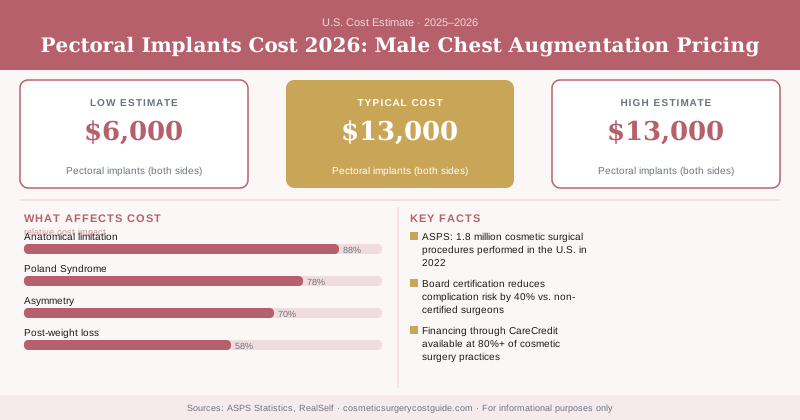
| Pectoral implants (both sides) | $6,000–$13,000 |
| Surgeon fee | $4,000–$8,000 |
| Implant cost (pair) | $1,500–$3,500 |
| Anesthesia fee | $1,000–$2,500 |
| Surgical facility fee | $800–$2,000 |
| Post-op garment | $80–$200 |
| Combined pec + abdominal etching | $12,000–$20,000 |
What Pectoral Implants Are — and Aren’t
Pectoral implants are solid or semi-solid silicone implants placed beneath the pectoral major muscle (submuscular plane) through a small incision in the axilla (armpit). They add volume and projection to the chest, creating a more defined, fuller chest contour.
They’re not breast implants. Pectoral implants are specifically shaped to mimic male chest anatomy — typically a wider, flatter profile designed to enhance the natural rectangular or oval pectoral shape rather than create a rounded feminine contour. Most are made of cohesive silicone gel or solid silicone that holds its shape under muscular compression.
This is a distinctly different procedure from gynecomastia surgery, which removes excess glandular tissue and fat from male breasts. Pectoral augmentation adds volume where the muscle is underdeveloped; gynecomastia surgery removes tissue where there’s excess.
Who Gets Pectoral Implants
The typical candidate falls into one of a few categories:
Anatomical limitation: Men who train consistently but have pectoral muscles that are naturally thin, narrow, or poorly shaped due to genetics. The muscle is functional but doesn’t produce the visual mass or definition they’re working toward.
Poland Syndrome: A congenital condition causing underdevelopment of the pectoral muscle on one or both sides. Pectoral implants are frequently used for reconstruction in these cases and may have partial insurance coverage — unlike purely cosmetic cases.
Asymmetry: Significant left-right pectoral asymmetry that training hasn’t corrected. Implants can be sized differently to balance the chest.
Post-weight loss: Men who’ve lost significant weight may have diminished chest volume and tissue that doesn’t respond to training the way it would at a younger age.
Pectoral implants add volume and improve chest contour. They work best in men who already have some pectoral development — the implant enhances what’s there rather than creating a chest from nothing. Men with very low body fat and good muscle definition will see the most dramatic visible result. Men with higher body fat or minimal training history should understand that implants sit beneath the muscle and fat layer — if that layer is thick, the definition created by the implant may not be visible at rest. Many patients combine pectoral implants with abdominal etching for a complete athletic physique result.
Pectoral Implants vs. Fat Transfer
Fat transfer chest augmentation is a less common alternative — harvesting fat via liposuction from elsewhere on the body and injecting it into the pectoral area. It avoids implants entirely, uses your own tissue, and adds modest volume.
The tradeoff: fat transfer to the pectoral area typically adds limited volume (fat survival in this high-motion area is variable), results are less predictable than implants, and meaningful augmentation usually requires multiple sessions. For men wanting significant, predictable, lasting chest improvement, implants remain the more reliable option.
The Surgery and Recovery
Pectoral implant surgery takes 1.5–2.5 hours under general anesthesia. The incision is placed in the natural crease of the axilla (armpit) — typically 3–4 cm, well hidden. The surgeon creates a pocket in the submuscular plane, positions the implant, and closes in layers.
Recovery is meaningful. The pectoral muscle moves constantly — breathing, reaching, any upper body activity. That motion affects healing.
- Days 1–3: Significant tightness, soreness with arm movement, rest required
- Week 1–2: Return to desk work, arm elevation limited, compression vest worn
- Week 3–4: Gradually increasing arm mobility, driving typically resumes
- Week 6: Light upper body exercise cautiously resumes
- Week 12: Full gym activity including chest training
Most surgeons restrict chest pressing movements (bench press, push-ups) for 8–12 weeks to allow the submuscular pocket to heal around the implant properly. Returning too early risks implant displacement.
Finding the Right Surgeon
Pectoral augmentation is a low-volume specialty — most plastic surgeons perform it infrequently. Seek out surgeons who specifically mention male body implants in their practice focus and who can show you an extensive before/after portfolio for pectoral procedures specifically.
Questions to ask:
- How many pectoral augmentations do you perform per year?
- What implant brands and shapes do you use?
- What’s your revision rate and policy?
- Do you place implants subpectoral (submuscular) — and why?
The ISAPS (International Society of Aesthetic Plastic Surgery) notes that body implant procedures require specific pocket dissection skills and anatomical knowledge of musculature that differ significantly from breast augmentation — confirming this as a genuinely specialized procedure rather than a simple variation on more common implant surgery.
Pectoral implant complications include infection, implant migration, asymmetry, and capsular contracture — hardening of the scar tissue around the implant that can distort its shape. Migration is a specific risk if the submuscular pocket is dissected too large or if high-impact upper body activity is resumed prematurely. Revision surgery for displaced or contracted pectoral implants costs $3,000–$7,000 and is not uncommon with less experienced surgeons. Prioritize surgeon experience heavily in this procedure.
The Bottom Line
Pectoral implants cost $6,000–$13,000 total in most U.S. markets, with higher costs in major metropolitan areas and at high-volume specialty practices. For men who’ve genuinely maximized their natural potential through training and want anatomical enhancement, they’re an effective and lasting solution. The niche nature of the procedure means surgeon selection is everything — find someone for whom this is a regular part of their practice, not an occasional case.
Frequently Asked Questions
Pectoral implant surgery typically costs between $6,000 and $13,000, with the final price depending on surgeon experience, implant material and size, facility fees, and geographic location. Surgeons in major metropolitan areas and those with extensive experience often charge toward the higher end of this range. Additional costs may apply if revision surgery or anesthesia add-ons are needed.
No, pectoral implants are considered cosmetic surgery and are not covered by standard health insurance plans, meaning you will pay the full cost out-of-pocket. Some surgeons offer financing options or payment plans to help manage the $6,000–$13,000 expense. Medical tourism or traveling to lower-cost regions may reduce expenses, though this should be weighed against quality and follow-up care considerations.
Most patients return to light daily activities within 1 to 2 weeks and can resume chest exercises and heavy lifting after 4 to 6 weeks, depending on how quickly healing progresses. Full results and optimal implant settling typically become visible after 2 to 3 months. Your surgeon will provide specific activity restrictions to avoid complications and ensure proper implant positioning.