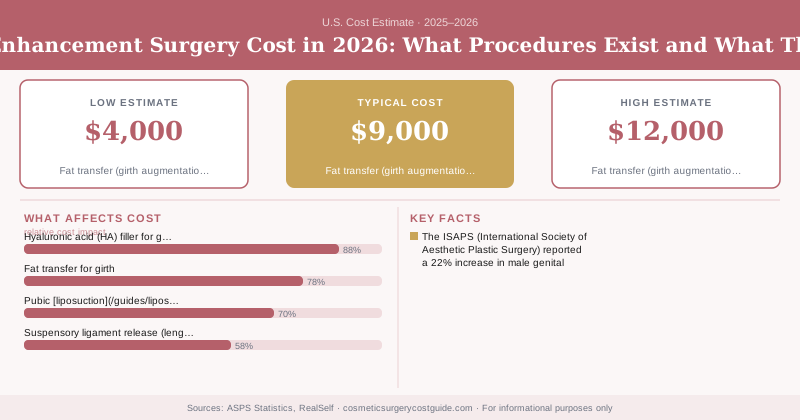
It’s one of the fastest-growing areas of male cosmetic surgery — and one of the most aggressively marketed. The American Urological Association states that most men who seek penile enlargement actually fall within normal size ranges, and that dissatisfaction is frequently psychological rather than anatomical. That context matters before talking money. But for men who have legitimate concerns — penile dysmorphia, micropenis (clinically defined as stretched penile length under 9.3 cm), or concerns from buried penis syndrome — real surgical options exist, and they come with real costs. The ISAPS (International Society of Aesthetic Plastic Surgery) reported a 22% increase in male genital cosmetic procedures globally between 2019 and 2023.
Penile Enhancement Procedures and Costs
| Procedure | Surgeon Fee | All-In Cost |
|---|---|---|
| Fat transfer (girth augmentation) | $4,000–$9,000 | $5,500–$12,000 |
| Dermal filler (non-surgical girth) | $2,000–$5,000 | $2,500–$6,500 |
| Penile lengthening (ligament release) | $5,000–$12,000 | $7,500–$18,000 |
| HA filler revision/dissolution | $500–$1,500 | $800–$2,500 |
| Scrotal enhancement (filler) | $1,500–$3,500 | $2,000–$5,000 |
| Pubic liposuction (visual lengthening) | $2,500–$5,000 | $3,500–$7,000 |
The most commonly performed procedures are non-surgical filler injections and fat transfer for girth. Surgical lengthening is performed but is the most controversial and carries the highest complication rate.
What the Procedures Actually Do
Hyaluronic acid (HA) filler for girth: The most common non-surgical approach. Injectable filler (the same type used in facial rejuvenation) is injected along the shaft to increase circumference. Results are immediate but temporary — HA filler lasts 12–18 months before reabsorption. The procedure is reversible with hyaluronidase. Done properly by experienced injectors, it’s generally safe. Done poorly, nodules, asymmetry, and irregular texture are common complications.
Fat transfer for girth: Fat is harvested via liposuction, processed, and injected around the shaft. Results are more durable than filler but unpredictable — significant reabsorption (40–60%) is common, and irregular lumps are a frequent complication. Some patients require multiple procedures to achieve the intended result.
Pubic liposuction: Removes suprapubic fat pad that can obscure penile length visually. This is the most straightforward and least risky procedure — it doesn’t alter penile anatomy, just removes a fat pad that was concealing existing length. For overweight patients with a prominent suprapubic fat pad, this may provide meaningful visual improvement without direct penile surgery.
Suspensory ligament release (lengthening): The most invasive and controversial procedure. Cutting the suspensory ligament allows more of the penile shaft to be visible externally. The gain is typically 1–2 cm at rest; the gain during erection is often minimal or absent. Major risks include destabilization of the erection angle (the erection may no longer be angled upward), scarring, and erectile dysfunction. Most urological societies caution against this procedure for cosmetic purposes.
- “What’s the realistic gain I can expect, and in what measurement specifically?”
- “What are your complication rates for this procedure?”
- “What happens if I’m unhappy with the result — can it be reversed?”
- “Do you have documented before/after photos of girth and length outcomes?”
- “Do you perform the AUA’s recommended psychological evaluation before surgery?”
A surgeon who overpromises specific measurements, dismisses questions about complications, or pushes for immediate booking without adequate consultation time is a red flag. This is a field with many predatory practitioners.
The Psychological Component — Not Optional
The American Urological Association and most reputable urological and plastic surgery organizations recommend psychological screening before penile enhancement surgery. Men with penile dysmorphic disorder (a body dysmorphic disorder focused on penile size despite normal anatomy) do not improve psychologically after surgery — dissatisfaction typically continues regardless of physical outcome.
A reputable surgeon for this procedure will conduct or require a psychological consultation. Surgeons who skip this step, particularly for cosmetic requests rather than documented medical conditions like micropenis, are prioritizing the surgical fee over your well-being. This isn’t a bureaucratic hurdle — it’s clinically appropriate practice.
Who Should Perform This Surgery
This is a specialized intersection of urology and plastic surgery. Look for:
- Urologists with fellowship training in sexual medicine and reconstructive urology, or board-certified plastic surgeons with documented penile surgery experience
- Surgeons who are transparent about outcomes data and realistic gains
- Practices that perform psychological screening as standard protocol
- Membership in legitimate professional societies (AUA, ASPS, ISAPS) — not self-created “specialty boards” that exist only to market their own members
Avoid: medical spas, aestheticians, or any non-physician provider offering penile enhancement. These procedures require physician-level training and proper surgical facilities.
The penile enhancement field has significant numbers of predatory practitioners who market aggressively to men with body image concerns and charge premium prices for procedures with limited evidence. Permanent fillers (silicone, PMMA) have caused permanent disfigurement and are not reversible — avoid any provider recommending permanent filler for penile augmentation. Hyaluronic acid fillers (reversible) or fat transfer performed by a legitimate urologist or plastic surgeon in an accredited facility are the only defensible options for most cosmetic requests. Always verify credentials and request outcome data before committing to any procedure.
Cost Drivers and Planning
Geographic market and surgeon specialty drive costs as much as procedure type. The same fat transfer procedure costs $5,000 in Charlotte and $10,000 in Miami. Credentials, volume, and facility accreditation should drive your choice more than geography.
Most patients pay out of pocket — insurance doesn’t cover cosmetic penile procedures. Medical indications (micropenis, buried penis causing hygiene issues, post-circumcision revision) may have partial coverage under some plans with physician documentation of medical necessity.
Frequently Asked Questions
Penile lengthening surgery typically costs $5,000–$9,000 in the US, depending on the technique used (ligament cutting, fat grafting, or dermal matrix placement) and surgeon expertise. Some high-demand specialists in major metropolitan areas may charge $12,000–$15,000 for combined lengthening and girth procedures.
No—penile enhancement surgery is considered cosmetic and is not covered by any major US health insurance plan, including Medicare and Medicaid. You will pay the full surgical cost out-of-pocket, though some surgeons offer payment plans or medical financing options through third-party lenders.
Recovery typically takes 2–4 weeks before returning to normal daily activities, with full healing and final results visible after 3–6 months. Sexual activity and strenuous exercise should be avoided for 4–6 weeks post-surgery to prevent complications like infection or graft failure.