Sarah, 41, was quoted $3,200 for upper eyelid surgery. Her friend sent her a link to “plasma pen” treatments for $350. Same result, right? Not exactly — and understanding the difference before you book could save you a genuinely bad outcome. Plasma fibroblast therapy is a legitimate treatment for the right candidates. It’s also one of the most misrepresented procedures in the med-spa market.
The American Society for Dermatologic Surgery notes that plasma-based treatments represent one of the newer device categories in aesthetic medicine, with growing adoption but also a higher-than-average rate of patient complaints related to inadequate provider training. The FDA has issued warnings about some plasma pen devices marketed without clearance. What you’re getting depends almost entirely on who’s operating the device and what device they’re actually using.
Plasma pen cost by treatment area
| Treatment Area | Sessions Typical | Cost Range |
|---|---|---|
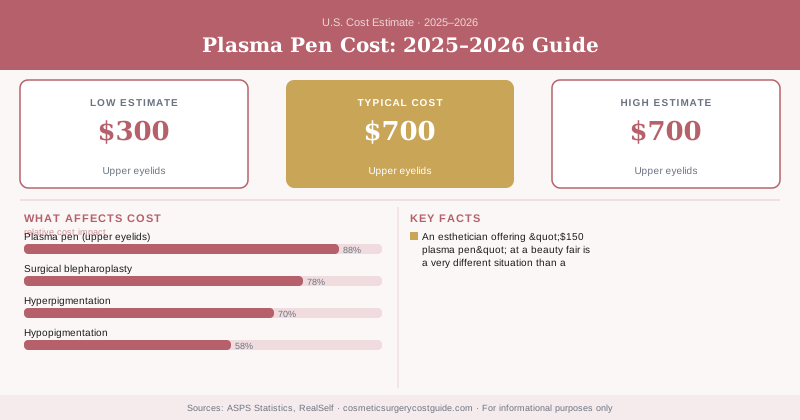
| Upper eyelids | 1–2 | $300–$700 |
| Lower eyelids | 1–2 | $250–$600 |
| Full eye area (upper + lower) | 1–2 | $500–$1,100 |
| Nasolabial folds (smile lines) | 1–2 | $300–$800 |
| Neck tightening | 1–3 | $400–$1,000 |
| Mouth area (lip lines) | 1–2 | $250–$600 |
| Forehead lines | 1–2 | $350–$800 |
| Full face | 1–3 | $900–$2,500 |
| Stretch marks (per area) | 2–3 | $300–$900 |
How plasma fibroblast therapy actually works
A plasma pen uses a handheld device to ionize atmospheric gas and create a small plasma arc. When held close to the skin surface, this creates controlled micro-injuries — tiny dots of thermal damage — that cause the skin to contract and crust. The underlying fibroblasts (skin cells that produce collagen) are stimulated to regenerate new tissue.
The result: skin contracts immediately (physical tightening from the thermal effect) and collagen production is stimulated over the following weeks. For small areas with early laxity — specifically the eyelid area — this can produce visible tightening without surgery.
The treatment is not laser. It’s not RF. It creates literal small carbon dots on the skin surface that crust over and flake off over 5–10 days. The downtime is real and visible.
What it works well for
Plasma pen produces its best results in areas where:
- The skin is thin and mobile
- Laxity is mild to moderate, not severe
- You can tolerate 7–14 days of social downtime (dotted crusting)
The eyelid area — specifically upper eyelid hooding — is the single best application. The tissue is thin, moves easily, and the contractile effect of plasma is most visible here. It won’t match surgical blepharoplasty results, but for early hooding it can produce meaningful improvement.
Secondary applications where results are more variable: perioral lines, mild nasolabial folds, early neck laxity.
Plasma pen (upper eyelids): $300–$700, 7–10 days downtime, results last 2–4 years, repeatable, appropriate for mild hooding.
Surgical blepharoplasty: $2,500–$5,000, 1–2 weeks downtime, results last 5–10+ years, permanent tissue removal, addresses moderate to severe hooding.
If you have mild early eyelid hooding and want to postpone surgery, plasma pen is a reasonable option. If you have true excess eyelid skin that impairs vision or creates heavy hooding, plasma pen won’t produce sufficient correction — surgery is the appropriate treatment.
Downtime and healing: what to expect
The plasma pen creates tiny carbonized dots on the skin surface. These dots:
- Appear immediately as small dark spots
- Form into small scabs or crusts by day 2–3
- Begin to flake and slough off around day 5–7
- Are fully resolved by day 10–14
During this period, you’ll look like you have dozens of tiny scabs on the treated area. This is not a “no downtime” procedure. Plan for at least 7 days of significant visible healing if treating the eyelid or face area.
Aftercare is critical: keep the area clean and dry, apply healing ointment as directed, do not pick or scratch the dots (this dramatically increases scarring risk), and avoid direct sun exposure for 6–8 weeks.
The risks: what can go wrong
Plasma pen has a higher complication rate than many comparable procedures when performed by inadequately trained providers. Documented risks include:
- Hyperpigmentation: Dark spots in the treated area, especially in darker skin tones. Can last months or be permanent.
- Hypopigmentation: Loss of pigment in treated areas, especially with aggressive treatment. Often permanent.
- Scarring: From too-aggressive settings or post-treatment picking.
- Burns: From device being held too close to the skin or used on inappropriate skin types.
Fitzpatrick skin types IV–VI (medium-brown to dark complexions) face significantly higher risk of hyperpigmentation and are generally not ideal candidates for plasma pen treatment.
The FDA has not cleared many plasma pen devices sold to estheticians and non-medical providers. Only FDA-cleared devices used by trained medical professionals have validated safety data. Ask specifically what device is being used, whether it’s FDA-cleared, and whether your provider has formal training documentation. An esthetician offering “$150 plasma pen” at a beauty fair is a very different situation than a board-certified dermatologist using a cleared device in a clinical setting. The price difference reflects the risk difference.
Finding a qualified provider
For plasma pen treatments, especially around the eyes, seek:
- A board-certified dermatologist or plastic surgeon — or a nurse practitioner or PA working directly under physician supervision
- Someone who performs plasma treatments regularly, with before/after photos
- A provider who will assess your Fitzpatrick skin type and advise you honestly if you’re not an ideal candidate
- A practice using a FDA-cleared device (ask for the specific device name and FDA registration number)
Avoid bargain providers on social media platforms offering plasma pen at deep discounts. The complication rate at these providers is substantially higher.
Is plasma pen worth it?
For the right candidate — mild upper eyelid hooding, fair skin, realistic expectations, and a qualified provider — plasma pen delivers visible results at a fraction of surgical costs. The 7–10 day downtime is the main barrier, and the 2–4 year longevity means it’s a bridge treatment rather than a permanent solution.
For anyone with darker skin, significant laxity, or access only to non-medical providers, the risk-benefit calculation tilts unfavorably. Be honest with yourself about your candidacy before booking.
Frequently Asked Questions
Plasma pen treatments typically cost between $200 and $1,500 per treatment area, depending on the size of the area treated and your provider's location and experience level. A single eyelid treatment may run $350–$600, while larger areas like the full face or neck can reach $1,200–$1,500 per session. Most patients require 1–3 sessions spaced 6–8 weeks apart for optimal results.
Plasma pen treatments are considered cosmetic and are not covered by insurance plans, making them an entirely out-of-pocket expense. Some practices offer payment plans or financing options through third-party lenders like CareCredit, which can help spread costs over 6–12 months with or without interest depending on promotion periods.
Plasma pen works best for mild to moderate skin tightening and is not equivalent to surgical eyelid lifts for severe drooping—a $3,200 blepharoplasty and a $350 plasma pen treatment address different levels of aging. Plasma pen is less invasive than surgery with minimal downtime (3–5 days of redness), but laser and surgical options produce more dramatic results for advanced aging; choose plasma pen if you have mild concerns and want to avoid surgery, but manage expectations accordingly.