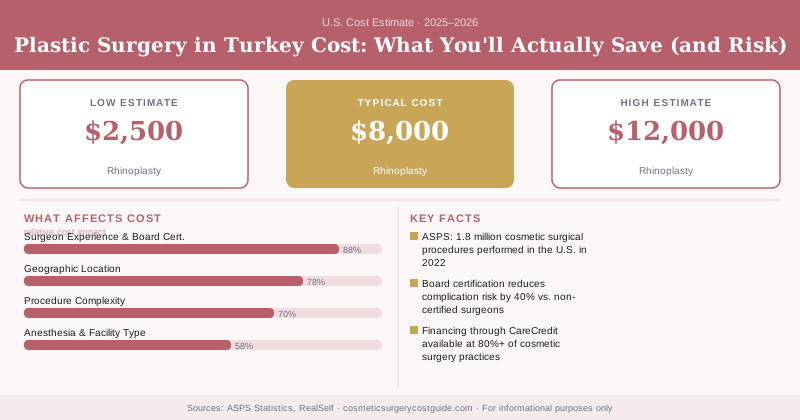
In 2015, medical tourism to Turkey for cosmetic surgery was a niche path mostly known through word of mouth. Today, Istanbul alone reportedly hosts hundreds of thousands of international patients a year for hair transplants, rhinoplasty, and body contouring — driven almost entirely by one number: the price gap between Turkey and the U.S. is often 50-70%.
That gap is real. So are the tradeoffs. Here’s the complete, honest cost picture.
Cost comparison: Turkey vs. U.S.
| Procedure | U.S. Cost | Turkey Cost (typical package) |
|---|---|---|
| Rhinoplasty | $8,000–$12,000 | $2,500–$4,500 |
| Breast augmentation | $6,000–$10,000 | $2,500–$4,500 |
| Tummy tuck | $8,000–$16,000 | $3,000–$6,000 |
| BBL | $6,000–$12,000 | $2,500–$5,000 |
| Hair transplant (FUE) | $8,000–$15,000 | $1,500–$3,000 |
Most Turkey packages bundle the surgery itself with hotel accommodations, airport transfers, and sometimes a translator or patient coordinator — part of why the all-inclusive price looks so favorable compared to the U.S., where none of those costs are included in a surgeon’s quoted fee.
Why the price gap is this large
Labor costs, facility overhead, and general cost of living in Turkey are substantially lower than in the U.S., and that difference cascades through every part of a surgical practice’s pricing — surgeon compensation, nursing staff, facility rent, anesthesia costs. Turkey has also deliberately built out a large medical tourism infrastructure, with government support and JCI-accredited hospital systems specifically competing for international patients, creating real economies of scale that help keep prices down without necessarily sacrificing facility quality at accredited institutions.
It’s important to separate two different things: facility/labor cost differences (largely legitimate and expected between countries with different economies) versus surgeon skill and safety oversight (where the picture is much more mixed and requires real due diligence on your part).
What the price gap doesn’t tell you
The most commonly cited risk with medical tourism isn’t necessarily lower in-room surgical skill — many Turkish surgeons are excellently trained. The bigger practical risk is what happens after you fly home: follow-up care becomes logistically difficult across time zones and distance, minor post-op issues that would normally get a quick in-person check become harder to monitor remotely, and if a complication requires urgent revision, you’re often paying full U.S. prices for that correction with a surgeon unfamiliar with the original procedure’s specifics. Some U.S. plastic surgeons report a meaningful share of their revision caseload consists of patients returning from medical tourism trips with results needing correction.
The flight-timing risk many patients overlook
Flying long-haul within days of surgery — common with international medical tourism packages built around short trip windows — increases deep vein thrombosis (blood clot) risk, since prolonged sitting combined with recent surgery are both independent risk factors. Reputable surgeons, wherever they practice, generally recommend waiting at least 1-2 weeks before long-haul flights following major surgery. Packages that schedule your return flight within days of the procedure should be a specific point of scrutiny, not just a convenience feature.
How to vet a surgeon in Turkey specifically
Verify certification through the Turkish Board of Plastic, Reconstructive and Aesthetic Surgery rather than relying solely on a medical tourism broker’s assurances — brokers often have financial incentives tied to booking volume rather than surgeon quality specifically. Confirm the hospital or clinic holds JCI (Joint Commission International) accreditation, request direct communication with the actual operating surgeon (not just a patient coordinator) before booking, and independently search for reviews and outcome reports beyond what the package company provides.
Financing considerations for medical tourism
Because international medical tourism packages are typically paid upfront or through the broker’s own financing arrangement, standard U.S. medical credit cards like CareCredit or Alphaeon generally don’t apply. Patients considering Turkey often pay via savings, a personal loan, or a payment plan arranged directly with the clinic — worth clarifying the specific payment structure and any currency exchange considerations well before travel.
Budget explicitly for the possibility of needing a revision once you’re home, and price that revision at full U.S. rates, not at the discounted price you paid abroad. If a complication arises, treat U.S. follow-up care costs as a real, separate line item in your overall financial planning for the trip — not an unlikely worst case you can ignore.
Bottom line
Plastic surgery in Turkey genuinely costs 50-70% less than the U.S., and that gap largely reflects legitimate differences in labor and facility costs rather than an automatic quality gap. The real risk sits in follow-up care access, revision logistics, and post-flight complications — not necessarily in the surgery itself. Do the same credential verification you’d do for a U.S. surgeon, and budget honestly for the possibility that any needed correction will cost full U.S. price.
Frequently Asked Questions
Plastic surgery in Turkey typically costs 50-70% less than the United States for comparable procedures — a rhinoplasty that runs $8,000-$12,000 in the U.S. might cost $2,500-$4,000 in Turkey, often including accommodations and transfers as part of an all-inclusive package. This price gap reflects lower labor, facility, and living costs in Turkey rather than necessarily lower surgical quality.
The biggest risks include difficulty accessing follow-up care once you've returned home, less consistent regulatory oversight and surgeon credentialing verification compared to U.S. board certification standards, limited legal recourse if complications occur, and the added physical risk of long-haul flights shortly after surgery, which can increase blood clot risk. Some U.S. surgeons report treating a meaningful share of revision cases from patients who had initial surgery performed abroad.
Look for surgeons certified by the Turkish Board of Plastic, Reconstructive and Aesthetic Surgery, verify their JCI (Joint Commission International) hospital accreditation status, and independently research reviews rather than relying solely on packages arranged through medical tourism brokers with financial incentives to book you regardless of surgeon quality. Requesting direct communication with the surgeon (not just a coordinator) before booking is also a meaningful screening step many patients skip.