Got denied for CareCredit and assumed plastic surgery was off the table? It isn’t. A score in the 500s makes financing harder and more expensive — but not impossible. The honest tradeoff: bad-credit approvals come with APRs of 25% to 36%, so an $8,000 procedure financed this way can balloon past $11,000. Knowing your real options keeps you from making an expensive mistake out of desperation.
Here’s what actually works when your credit is rough, and what to avoid.
Why Bad Credit Raises the Cost
Lenders price risk. A lower score signals higher default odds, so they charge more interest to compensate. The procedure price doesn’t change — your cost of borrowing does.
| Credit Tier | Typical APR | Cost to Finance $8,000 (36 mo) |
|---|---|---|
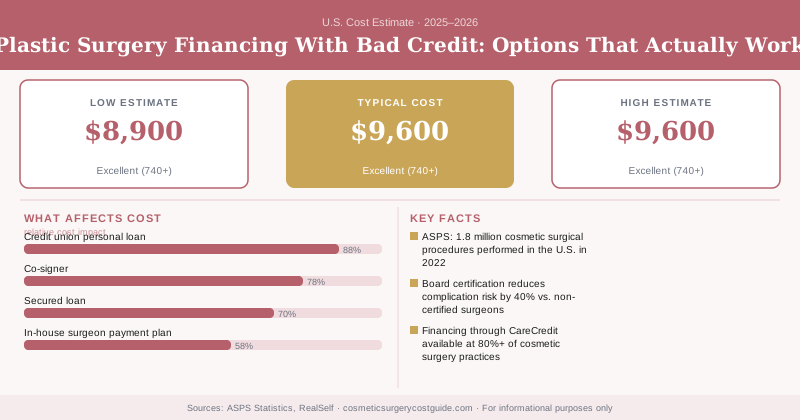
| Excellent (740+) | 7% – 12% | $8,900 – $9,600 |
| Good (670–739) | 13% – 18% | $9,700 – $10,400 |
| Fair (580–669) | 19% – 28% | $10,500 – $11,900 |
| Poor (below 580) | 29% – 36% | $12,000 – $13,400 |
Same surgery, but poor credit can add $4,000+ over the life of the loan. According to the Consumer Financial Protection Bureau, medical financing products marketed through provider offices often carry steep rates, and the agency has warned borrowers to compare carefully rather than accept the first office offer.
Bad credit doesn’t block plastic surgery financing — it just makes it expensive (25–36% APR). The smartest move is often to delay: spend three to six months raising your score 40–80 points, which can drop your APR a full tier and save thousands. Desperation financing at 36% is the most costly path.
Options That Work With Bad Credit
You’ve got several realistic routes, ranked roughly from best to last-resort:
- Credit union personal loan: Credit unions are often more flexible than banks and cap APRs lower than predatory lenders.
- Co-signer: A creditworthy co-signer can unlock a much lower rate — but they’re fully liable if you miss payments.
- Secured loan: Backing the loan with collateral (a CD, savings) lowers the rate.
- In-house surgeon payment plan: Some practices offer their own installment plans with lighter credit checks.
- Medical credit card with a co-applicant: Sometimes approves where solo applications fail.
Avoid payday loans, title loans, and any “guaranteed approval, no credit check” surgery financing. These carry effective APRs that can top 100% and trap you in a debt cycle. No cosmetic procedure is worth a predatory loan. If your only approval is at triple-digit APR, that’s a signal to wait and save instead.
The Delay-and-Repair Strategy
Frequently the cheapest financing is the one you don’t take yet. Pulling your score from 560 to 640 in a few months — paying down card balances, fixing report errors, never missing a payment — can move you a whole APR tier and save more than any deal a surgeon offers. Meanwhile, save part of the cost so you borrow less.
Reduce the amount you need to finance with tactics in how to save money on cosmetic surgery, and compare full financing options in cosmetic surgery financing. The most common office card is covered in our CareCredit cosmetic surgery guide — worth applying for even with fair credit, since approval thresholds vary.
Borrow Less by Spending Less
Bad-credit financing punishes large balances, so shrinking the bill matters more than ever. Choose a lower-cost market — plastic surgery cost by state shows the swings — and consider procedures with lower base prices. Even breast reduction cost, which may have insurance angles, can be far cheaper than you’d expect if part is covered.
The Bottom Line
Plastic surgery financing with bad credit is possible but pricey — APRs of 25% to 36% can add thousands to an $8,000 procedure. Skip payday and triple-digit-APR products entirely. Your best play is usually to spend a few months raising your score a tier and saving a down payment, then finance a smaller balance at a better rate. Credit unions and co-signers are your friends.
Frequently Asked Questions
An $8,000 procedure financed through bad-credit lenders typically costs $11,000 or more after interest, because APRs range from 25% to 36%. For example, a $5,000 procedure could cost $6,500 to $7,500 total depending on your loan term and exact rate. Always calculate the final cost before signing any financing agreement.
Most health insurance plans do not cover cosmetic procedures, meaning you pay the full surgical cost out-of-pocket with no insurance assistance. Reconstructive surgery after injury or birth defects may be partially covered, but cosmetic financing is entirely your responsibility. Check your policy directly, as coverage varies by plan and procedure type.
You can apply to alternative lenders (Prosper, LendingClub, or medical-specific options) immediately after a CareCredit denial without waiting, though multiple applications within 14 days count as one inquiry. However, space out applications by at least 1 week to avoid looking desperate to lenders and to allow time to improve your financial profile if possible. Bad-credit lenders will still approve you, but waiting gives you leverage to negotiate better terms.