Here’s the number that surprises most people: if you carry a balance past a CareCredit promotional period, the deferred interest gets applied retroactively to the entire original amount — not just what’s left. On an $10,000 tummy tuck, that can mean owing hundreds or thousands more than you expected, all because a $200 balance was left unpaid one month past the deadline.
What financing a tummy tuck typically costs
| Financing Option | Typical Terms | Best For |
|---|---|---|
| CareCredit | 0% for 6–18 months (deferred interest after), then 17–27% APR | Patients confident they’ll pay in full within the promo period |
| Prosper Healthcare Lending | Fixed APR 6–36%, 24–84 month terms | Larger amounts, predictable fixed payments |
| Alphaeon Credit | 0% for 12–24 months on approved amounts | Patients wanting a longer interest-free window |
| In-house practice payment plan | Varies; often 0–10% APR, 6–24 months | Patients who prefer dealing directly with the surgical practice |
| Personal loan (bank/credit union) | Fixed APR 7–20% based on credit | Patients with strong credit wanting no deferred-interest risk |
The deferred interest trap, explained clearly
Medical credit cards like CareCredit market their promotional periods as “0% interest,” which is true only if you pay the full balance by the deadline. If even a small balance remains after the promotional period ends, the card issuer charges interest retroactively on the entire original financed amount, calculated from the original purchase date — not from whatever the remaining balance happens to be.
On a $10,000 tummy tuck financed at 0% for 12 months with a deferred APR of 26.99%, missing the deadline by even one payment cycle with a small remaining balance can trigger over $1,000 in retroactive interest charges. Set a firm personal deadline several weeks before the promotional period actually ends, and consider autopay specifically to avoid this scenario.
Fixed-rate medical loans as an alternative
Companies like Prosper Healthcare Lending offer fixed-rate installment loans specifically for medical and cosmetic procedures, with no deferred-interest structure — you know your exact monthly payment and total repayment amount from day one. Rates vary significantly based on credit score, from around 6% APR for excellent credit up to 36% for lower credit scores, so it’s worth getting pre-qualified (usually a soft credit check with no score impact) before committing to any single option.
A lower monthly payment over a longer term can end up costing significantly more in total interest than a higher monthly payment over a shorter term. Before choosing a plan, ask each lender for the total repayment amount — principal plus all interest — over the life of the loan, and compare that single number across your options rather than just comparing monthly payments.
In-house payment plans: what to ask
Some surgical practices offer their own payment plans, collecting a deposit upfront (typically 20–50%) with the remainder paid in installments before or shortly after surgery. These plans sometimes carry lower or no interest compared to third-party financing, but terms vary enormously by practice — always get the full payment schedule and any late fee policy in writing before your first payment.
Personal loans deserve a serious look
Patients with good to excellent credit sometimes overlook personal loans from their own bank or credit union in favor of medical-specific financing, assuming medical lenders automatically offer the best terms. That’s not always true — a credit union personal loan can carry a lower fixed APR than a medical credit card’s post-promotional rate, with no deferred-interest risk at all. It’s worth getting a quote from your own bank before assuming medical financing is your only or best option.
Never finance a tummy tuck through a plan you don’t fully understand the terms of — specifically ask whether interest is deferred (charged retroactively if not paid in full) or simple (accruing only going forward from any remaining balance). This single distinction can mean a difference of thousands of dollars, and predatory medical financing terms are unfortunately common in the cosmetic surgery industry.
Bottom line
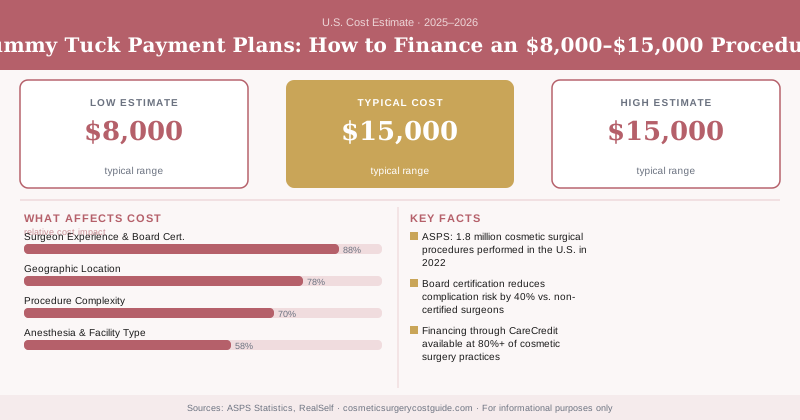
Tummy tuck costs of $8,000–$15,000 can be financed through medical credit cards, fixed-rate medical loans, in-house practice plans, or personal loans, each with meaningfully different total cost structures. Deferred-interest promotional offers carry real risk if not paid off in full and on time — compare total repayment cost across at least two or three options, and consider a personal loan from your own bank as a genuine alternative to medical-specific financing.
Frequently Asked Questions
The most common financing routes are medical credit cards like CareCredit, dedicated medical loans through companies like Prosper Healthcare Lending or Alphaeon, in-house payment plans offered directly by some surgical practices, and personal loans from banks or credit unions. Each has different interest rate structures and approval requirements.
CareCredit offers promotional 0% interest periods, typically 6, 12, or 18 months, for approved purchases, but if the balance isn't paid in full by the end of the promotional period, deferred interest is charged retroactively on the entire original amount, not just the remaining balance — a detail that surprises many patients who assumed the interest was calculated only going forward.
Yes, and for some patients with strong credit, a personal loan from a bank or credit union offers a lower fixed interest rate than medical credit cards, with predictable monthly payments and no deferred-interest trap. It's worth comparing rates from your own bank or credit union against medical financing options before committing, since medical-specific lenders don't always offer the best rate.