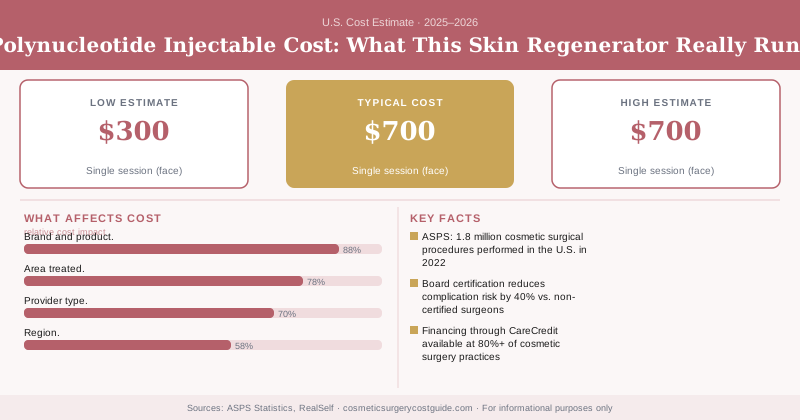
What does an injectable that doesn’t add volume or freeze muscles actually cost — and why would you pay $300–$700 for it? Polynucleotides are a different animal, and the price reflects what they do: regenerate skin from the inside instead of filling or paralyzing it.
Polynucleotide injectables are made from purified fragments of DNA, typically derived from salmon or trout sperm, and they’re used to improve skin quality, hydration, and elasticity rather than to plump a fold. They’ve been popular in Europe and Asia for years and have surged in US clinics more recently as the “skin booster” category exploded. They’re regenerative biostimulators, not traditional fillers — and that distinction shapes both how they’re priced and how many sessions you’ll need.
Polynucleotide pricing breakdown
| Treatment | Cost |
|---|---|
| Single session (face) | $300–$700 |
| Course of 2 sessions | $550–$1,300 |
| Course of 3 sessions | $700–$1,800 |
| Under-eye area only | $250–$500 |
| Maintenance session (every 4–6 months) | $300–$600 |
Why you need a course, not a single shot
Polynucleotides work by stimulating fibroblasts to repair and rebuild over time, so a single session won’t show you the full effect. Most providers recommend a starter course of two or three sessions spaced two to four weeks apart, then maintenance a couple of times a year.
That changes the budgeting math: the headline per-session price is $300–$700, but the realistic first-year cost runs $700–$1,800 plus maintenance. Skin boosters as a whole have grown fast — the Aesthetic Society has tracked rising demand for non-surgical “skin quality” treatments alongside the broader injectables boom, where Americans received millions of soft-tissue filler procedures in recent years.
Polynucleotide injectables cost $300–$700 per session, but they’re sold as a course of 2–3 ($700–$1,800) because the regenerative effect builds over time. They don’t add volume like a filler — so if your goal is plumping, you want a different product. If your goal is skin quality, this is the category to price out.
What affects the price
Brand and product. Several polynucleotide products are on the market, and pricing varies by brand and by how much your provider uses per session.
Area treated. Under-eye-only sessions cost less than full face. Neck and hands add to the total.
Provider type. Dermatology and plastic surgery offices price above medspas. Injector experience with this specific product matters — it’s newer than Botox or dermal fillers in the US market.
Region. Coastal metros run 30–50% above the national midpoint.
How it compares
Polynucleotides overlap with other regenerative options. If you want a collagen-stimulating injectable that also restores lost volume over time, Sculptra does that and is priced per vial. Polynucleotides are more about skin texture and hydration than volume, so think of them as a complement to — not a replacement for — volumizing treatments. They’re frequently layered with microneedling for skin-quality results.
Because this is a newer category in the US, product names and protocols vary widely between clinics, and not every product marketed as a “polynucleotide” or “salmon DNA” booster is the same. Ask exactly which product is being used, how much per session, and whether your injector has run a full course on multiple patients before.
Common questions
Does it replace filler? No. It improves skin quality, not volume. Many patients use both for different goals.
Does insurance cover it? No — purely cosmetic. Some clinics offer financing for multi-session courses.
How long do results last? The skin-quality improvements build over weeks and typically hold for several months, which is why maintenance sessions are recommended a few times a year.
Bottom line
Polynucleotide injectables cost $300–$700 per session and $700–$1,800 for the starter course that delivers real skin-quality change. They’re a regenerative treatment, not a filler, so price them against your actual goal. If that goal is texture, hydration, and elasticity rather than volume, this category earns its spot in the budget.
Frequently Asked Questions
A single polynucleotide injection session costs between $300 and $700, depending on the provider, location, and amount of product used. Most patients complete a course of 2–3 sessions spaced 2–4 weeks apart, bringing the total investment to $700–$1,800 for full results.
No, polynucleotide injectables are considered cosmetic procedures and are not covered by standard health insurance plans. Patients pay entirely out-of-pocket, though some clinics offer financing options or package discounts for multiple sessions.
Most patients require 2–3 sessions spaced 2–4 weeks apart to see optimal skin regeneration results. Results typically improve over 3–6 months as collagen rebuilds, and effects can last 9–12 months before maintenance sessions are recommended.