What does a 63-year-old woman in Manhattan pay to restore that lit-from-within glow her skin had at 45? Increasingly, the answer is Profhilo — and the bill runs $1,800–$2,400 for the recommended two-session course. That’s less than a syringe of premium filler, with zero volumizing effect. Which is exactly the point.
Profhilo isn’t a filler. It doesn’t add volume, it doesn’t sculpt, and it won’t lift a jawline. It does one thing: intensely hydrate and remodel skin from the inside, triggering collagen and elastin production through a mechanism called bio-remodeling. For patients whose primary concern is skin quality — dullness, crepiness, fine dehydration lines — it’s a category of its own.
Profhilo pricing breakdown
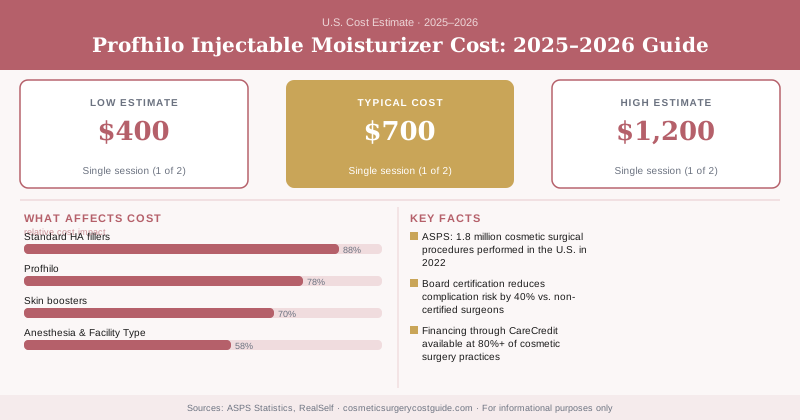
| Treatment Package | Low | Typical | High |
|---|---|---|---|
| Single session (1 of 2) | $400 | $700–$900 | $1,200 |
| Full course (2 sessions, 4 weeks apart) | $800 | $1,400–$1,800 | $2,400 |
| Annual maintenance (1 session/year after initial course) | $400 | $700–$900 | $1,200 |
| Neck treatment (add-on or standalone) | $350 | $600–$800 | $1,000 |
| Hand rejuvenation with Profhilo | $300 | $500–$700 | $900 |
Profhilo is priced per session, not per syringe, because the injection protocol is standardized: 5 specific anatomical points per side of the face (the BAP — Bio Aesthetic Points — technique), using one 2mL syringe per session.
Why it costs what it does
Profhilo contains one of the highest concentrations of hyaluronic acid (HA) available in any injectable — 64mg of HA per 2mL syringe, split as a hybrid complex of high- and low-molecular weight HA. The manufacturing process is thermal-crosslinking rather than chemical-crosslinking (no BDDE crosslinker), which is more expensive to produce and why it spreads differently under the skin.
The product cost to the practice is high relative to standard fillers. On top of that, the BAP technique requires specific training and precise anatomical placement. Providers who cut corners on Profhilo training tend to produce poor distribution, bruising, and suboptimal results.
How it differs from traditional hyaluronic acid fillers
Standard HA fillers (Juvederm, Restylane): Crosslinked gel that stays where it’s injected, adds volume, lifts, and contours. Lasts 6–18 months.
Profhilo: Hybrid HA complex that spreads diffusely through tissue, doesn’t add volume, stimulates collagen/elastin remodeling, improves skin texture and hydration. Lasts 6 months before a maintenance session is recommended.
Profhilo works best for patients who want to improve skin quality — hydration, elasticity, fine lines from dehydration — without adding volume. It’s particularly effective for neck and hand rejuvenation where volumizing fillers would look unnatural. It pairs well with toxin treatments (Botox/Dysport) but doesn’t replace them. It’s not a substitute for fillers if you need volume restoration or lifting.
What results look like — and when
Most patients see visible improvement after the second session (8 weeks total). The change is subtle but real: skin looks more hydrated, more elastic, with a natural radiance. It’s not the dramatic before/after of a surgical procedure. Patients describe it as “my skin looks like mine, just better.”
A 2020 clinical study published in the Journal of Cosmetic Dermatology found statistically significant improvements in skin hydration and elasticity measured by cutometer at 4 and 12 weeks post-treatment. The effect on collagen density was still measurable at 6 months, which is why annual maintenance is recommended rather than quarterly.
Is it available everywhere in the US?
Profhilo received FDA clearance in 2023 — it was available in Europe and Asia for years before that. It’s now stocked at most dermatology practices, plastic surgeon offices, and higher-end med spas in major US markets. If you’re in a smaller market, some providers may not yet carry it; Sculptra or skin boosters like Restylane Skinboosters can achieve somewhat similar bio-stimulating effects.
Profhilo vs. skin boosters: what’s the difference?
Skin boosters (Restylane Skinboosters, Juvederm Volite): Injected superficially throughout the treatment area via multiple microinjections. Good hydration effect. Typically $600–$1,200 per session.
Profhilo: Fewer injection points (10 total, 5 per side) using the BAP protocol, spreads diffusely. Higher HA concentration. Less bruising at injection sites but requires precise placement. Generally slightly higher cost per session.
Both achieve skin hydration and subtle glow. Profhilo’s bio-remodeling mechanism (collagen/elastin stimulation) differentiates it from pure hydration products.
The biggest risk with Profhilo isn’t medical — it’s overpaying for poor technique. The BAP protocol must be followed precisely for the HA complex to distribute correctly. If a provider injects Profhilo like a standard filler (bolus deposits, wrong depth), you’ll see visible lumps and poor spread. Ask your provider specifically whether they use the BAP technique and how many Profhilo treatments they’ve performed.
Financing and insurance
Profhilo is 100% elective and not covered by insurance. It’s also not eligible for HSA/FSA. Most practices accept CareCredit. Given the relatively modest cost of a two-session course compared to surgical options, many patients pay out of pocket.
Summary: is Profhilo worth the cost?
If your concern is skin quality — not volume, not structure — and you want a natural-looking improvement with minimal downtime, Profhilo occupies a useful niche. ASPS 2023 data shows injectables broadly continuing to grow as a category, with patients increasingly interested in “skin health” treatments that don’t change their features. Profhilo fits that trend precisely.
For most patients, the two-session starting course at $1,400–$1,800 is the right way to evaluate it. If you see results you value, maintenance is one session per year. If you don’t, you’re not locked into an ongoing protocol.
Frequently Asked Questions
A complete Profhilo treatment course typically costs $800–$3,000 for two sessions, with most patients in major US markets like Manhattan paying $1,800–$2,400 total. Individual session costs range from $400–$1,500 depending on your provider's location, experience level, and whether you're combining Profhilo with other treatments.
No, Profhilo is classified as a cosmetic procedure and is not covered by any major US health insurance plans, including Medicare and Medicaid. You will pay the full cost out-of-pocket, though some medical spas and clinics offer payment plans or package discounts if you prepay for both sessions.
The standard protocol is two treatments spaced 2–4 weeks apart, after which results typically last 6–9 months before a maintenance session is recommended. Most patients see visible hydration and skin quality improvements within 2–3 weeks of completing the two-session course.