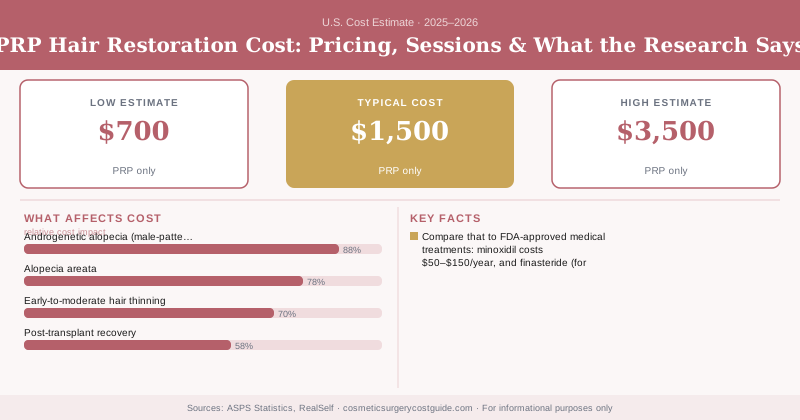
What does PRP hair restoration actually cost — and does it work? Those two questions come up together for a reason. PRP (platelet-rich plasma) has exploded in popularity for hair loss, but the evidence base is still evolving and the price range is all over the place. Here’s an honest breakdown.
PRP Hair Restoration Cost in 2025–2026
| Treatment | Cost Per Session | Initial Series (3 sessions) | Annual Maintenance | Duration |
|---|---|---|---|---|
| PRP only | $700–$1,500 | $1,500–$3,500 | $700–$1,500/yr | Ongoing |
| PRP + microneedling | $900–$1,800 | $2,000–$4,500 | $900–$1,800/yr | Ongoing |
| Exosome-enhanced PRP | $1,500–$3,000 | $3,500–$7,500 | $1,500–$3,000/yr | Ongoing |
| A-cell + PRP | $1,200–$2,500 | $3,000–$6,500 | $1,200–$2,500/yr | Ongoing |
Why 3 Sessions? Why Not Just One?
PRP doesn’t work in a single treatment. The platelet-released growth factors (PDGF, TGF, VEGF, and others) stimulate the hair follicle over time — they extend the anagen (growth) phase and reduce the resting phase, but that process takes months to show up as visible hair. The standard initial protocol is 3 sessions spaced 4–6 weeks apart, followed by annual maintenance.
Some practices sell single sessions — often at medspa prices of $400–$700 — without being clear that one treatment won’t produce meaningful results. If someone quotes you a single session and says that’s enough, that’s worth questioning.
Who Benefits Most From PRP?
PRP performs best for:
- Androgenetic alopecia (male-pattern and female-pattern hair loss) — the most studied indication, with the most evidence
- Alopecia areata — some evidence for patchy loss, less for totalis/universalis
- Early-to-moderate hair thinning — PRP works on existing miniaturized follicles; it can’t resurrect truly dead ones
- Post-transplant recovery — often used alongside surgical hair restoration to accelerate graft survival
If your scalp shows significant slick baldness with no fine vellus hairs remaining in that zone, PRP won’t regrow hair there. A dermatologist or hair restoration specialist can assess your scalp and tell you honestly whether you’re a good candidate.
According to the American Academy of Dermatology, PRP has shown statistically significant improvement in hair count and diameter in multiple controlled studies — but it’s not a cure, it requires maintenance, and response varies substantially between patients.
Not all PRP is equal. The concentration of platelets (and specifically growth factors) in your PRP depends on three things: your own platelet count, the centrifuge system used, and the protocol. Clinical-grade systems like Eclipse PRP, Selphyl, or Arthrex Angel produce consistently high platelet concentrations (5–8× baseline). Basic centrifuges at low-cost medspas may produce PRP with only 2–3× concentration.
When comparing prices between providers, ask what system they use and what platelet concentration they target. Higher-quality systems often explain why higher-priced providers get better results — and why the $400 medspa deal may genuinely not be worth it.
Adding Microneedling or Exosomes: Is It Worth the Extra Cost?
PRP + microneedling — The combination adds scalp microneedling at the same session, creating microchannels that enhance PRP absorption. Research suggests the combination produces better follicle stimulation than PRP alone. Most practices charge $200–$400 more per session for the combo. Generally considered worth it.
Exosome-enhanced PRP — Exosomes are cell-derived vesicles loaded with growth factors and signaling molecules. They’re being positioned as the next evolution beyond PRP, but the FDA has not approved exosomes for hair restoration and has issued warnings about unapproved exosome products. Results are anecdotally impressive but the research base is thin. If you go this route, use a physician-supervised practice that can explain exactly what product they’re using.
A-cell (extracellular matrix) + PRP — A-cell is an acellular tissue matrix originally developed for wound healing. Combined with PRP in hair restoration, it’s theorized to create a scaffold for follicle regeneration. Higher cost, limited direct comparisons to PRP alone.
Maintenance Is Ongoing
This is the part that changes the math significantly. PRP requires annual maintenance to sustain results — typically one session per year after the initial 3-session series. At $700–$1,500 per maintenance session, you’re looking at a recurring annual cost indefinitely.
Compare that to FDA-approved medical treatments: minoxidil costs $50–$150/year, and finasteride (for women, off-label) costs $100–$300/year. PRP is dramatically more expensive than medications, though it works through a different mechanism and some patients who don’t respond to topicals do respond to PRP.
PRP Alongside a Hair Transplant
The ASPS notes that hair restoration procedures have seen consistent year-over-year growth, and combination approaches — PRP alongside surgical transplantation — are increasingly common. Many hair transplant surgeons offer PRP at the time of the procedure and at the first post-op follow-up to improve graft survival rates. When bundled with a transplant, the cost is typically $1,000–$2,000 added to the surgical fee.
PRP results vary significantly — some patients see 25–40% improvement in hair density, others see minimal change. Honest providers will tell you upfront that response is unpredictable and that you should plan for 6–9 months before evaluating whether it worked. Be cautious of any practice guaranteeing dramatic regrowth or using before-and-after photos under ideal lighting conditions. Ask to speak with actual patients from the practice when possible.
What to Budget
For an honest initial series of 3 standard PRP sessions, plan $1,500–$3,500 at a dermatologist or hair restoration specialist. Add $300–$500 per session if you want the microneedling combo. Annual maintenance runs $700–$1,500.
That’s real money — especially for a treatment that requires ongoing commitment. But for patients with early androgenetic hair loss who respond well, PRP can meaningfully slow progression and modestly improve density. The best candidates start it early, before significant follicle loss has occurred.
Frequently Asked Questions
A complete initial series of 3 PRP sessions typically costs $1,500–$4,500 total, with individual sessions ranging from $500–$1,500 depending on your geographic location, clinic reputation, and whether additional treatments are combined. Most patients budget $2,000–$3,000 for the standard 3-session starter package.
Most health insurance plans do not cover PRP hair restoration because it is considered a cosmetic or elective procedure rather than a medically necessary treatment. You should expect to pay the full cost out-of-pocket, though some clinics offer financing plans or payment packages to help manage the $1,500–$4,500 upfront expense.
The standard protocol involves 3 sessions spaced 4–6 weeks apart to complete the initial treatment course, which takes approximately 3–4 months total. Most patients then require annual maintenance sessions ($500–$1,500 per year) to sustain results, as the effects of PRP gradually diminish over time without follow-up treatments.