In 2010, you couldn’t get PRP hair treatment at most plastic surgery practices in the US. By 2023, the American Society of Plastic Surgeons counted platelet-rich plasma among the fastest-growing non-surgical treatments in the country. That growth reflects one thing: it works for the right patients.
“Works” means meaningful improvement in hair density and thickness in patients with androgenetic alopecia — the genetic pattern hair loss that affects roughly 50 million men and 30 million women in the US, according to the American Academy of Dermatology. It doesn’t mean growing hair on completely bald scalp, or reversing scarring alopecia, or replacing a hair transplant. Understanding where PRP falls on the treatment spectrum is the key to knowing whether the $4,500–$10,000 you’d spend on a full initial course is money well spent.
Here’s what it actually costs and what you’ll realistically get.
PRP Hair Treatment Cost Breakdown
| Cost Item | Typical Range |
|---|---|
| Single PRP session | $1,500–$3,500 |
| Initial treatment course (3–4 sessions) | $4,500–$14,000 |
| Most common initial course cost | $5,000–$8,000 |
| Maintenance session (every 6–12 months) | $1,000–$2,500 |
| Annual maintenance (1 session/yr) | $1,000–$2,500 |
| Annual maintenance (2 sessions/yr) | $2,000–$5,000 |
| Total cost, Year 1 (4 sessions) | $5,000–$12,000 |
| Total cost, Year 2+ (maintenance) | $1,000–$5,000/yr |
How PRP Hair Treatment Works
The procedure starts with a blood draw — usually 30–60 mL from your arm. That blood goes into a centrifuge that spins it down into layers, isolating the platelet-rich plasma: the component of your blood dense with growth factors including PDGF, VEGF, TGF, and IGF-1. The concentrated plasma is then injected in a grid pattern across the thinning areas of your scalp using a fine-needle technique.
The whole appointment takes 45–60 minutes. There’s mild scalp soreness and occasional bruising for 24–48 hours, but no real downtime — most patients return to normal activities immediately.
The growth factors in the PRP signal dormant or miniaturizing hair follicles to re-enter the active growth phase. The follicles don’t disappear; they strengthen. Hair shafts become thicker, growth cycles lengthen, and hair counts increase. Results develop gradually over 3–6 months after treatment.
Who It Actually Works For
This is where most marketing materials fall short. PRP produces measurable improvement in:
- Early-to-moderate androgenetic alopecia: The ideal patient has visible thinning but still has active follicles. Think Hamilton-Norwood scale II–IV in men, Ludwig scale I–II in women.
- Telogen effluvium (diffuse shedding from stress, illness, or postpartum): PRP accelerates the recovery of dormant follicles.
- Post-transplant support: Many surgeons use PRP at the time of hair transplant to improve graft survival and accelerate density.
It does not work well for:
- Advanced pattern baldness (Norwood V–VII): Follicles in completely bald areas are typically dead or absent — no growth factors will revive them.
- Scarring alopecia (lichen planopilaris, frontal fibrosing alopecia): The follicle destruction is permanent; PRP can’t reverse structural damage.
- Alopecia areata: Results are inconsistent; this autoimmune condition requires different treatment approaches.
PRP for hair loss produces improvement — not transformation. The clinical studies show meaningful increases in hair density and shaft diameter, but if you go in expecting the hairline of a 25-year-old, you’ll be disappointed. Realistic outcomes for appropriate candidates: a 20–40% improvement in hair count density, noticeably thicker hair shafts, and slower progression of thinning. Photographs taken at baseline and 6 months later are often the clearest way to appreciate results, because the change is gradual enough that it’s easy to miss in the mirror. Ask your provider if they document baseline photos — the ones who do are also more likely to give you honest outcome expectations.
How the Price Varies
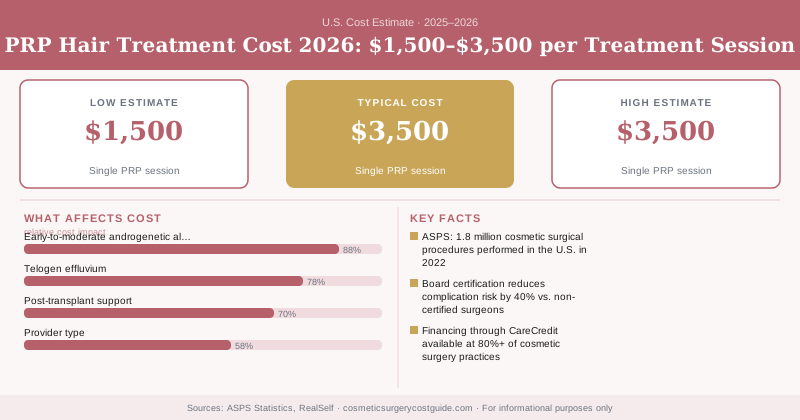
The $1,500–$3,500 range per session isn’t arbitrary. Here’s what drives the variation:
Provider type: Plastic surgeons and hair restoration specialists typically charge more than med spas. But for PRP hair treatment, provider experience matters — the injection technique, PRP preparation protocol, and concentration all affect outcomes.
PRP system used: Not all centrifuge systems produce the same platelet concentration. Some practices use FDA-cleared systems (ACell, Eclipse, Selphyl) that produce higher platelet concentrations; others use basic centrifuges. Higher-concentration PRP systems cost more to operate and typically produce better results. Ask your provider which system they use and what platelet concentration they achieve.
Geographic market: New York, LA, and Miami practices run 30–50% above the national average. Practices in mid-size cities often charge $1,500–$2,000 per session.
Add-ons: Some providers combine PRP with ACell (extracellular matrix) or exosomes at additional cost ($500–$1,500 extra per session). These combinations are promising but less well-studied than PRP alone.
PRP vs. Rogaine vs. Propecia: The Annual Cost Comparison
| Treatment | Annual Cost | Evidence Level | Key Consideration |
|---|---|---|---|
| Minoxidil (Rogaine) | $240–$600/yr | Strong (FDA-approved) | Daily use required; stops working if discontinued |
| Finasteride (Propecia) | $120–$720/yr | Strong (FDA-approved) | DHT blocker; sexual side effects in some men |
| PRP (maintenance phase) | $1,000–$5,000/yr | Good (multiple RCTs) | No daily compliance needed; no systemic effects |
| Hair transplant (one-time) | $4,000–$15,000 | Excellent | Permanent; doesn’t prevent future loss in non-transplanted areas |
The annual cost of PRP maintenance is significantly higher than daily minoxidil or finasteride. But PRP doesn’t require daily compliance, doesn’t carry the systemic side effect profile of finasteride (sexual dysfunction, mood effects in some patients), and stimulates follicles through a different mechanism. Most hair restoration specialists don’t recommend choosing between PRP and medications — they recommend combining them.
A 2019 systematic review in Aesthetic Plastic Surgery found that PRP significantly improved hair density versus control conditions in androgenetic alopecia, with the strongest results when combined with minoxidil. Using PRP alongside finasteride and minoxidil addresses three different mechanisms simultaneously: growth factor stimulation (PRP), DHT blockade (finasteride), and topical vasodilation (minoxidil). The combination approach tends to outperform any single treatment alone.
What an Initial Treatment Course Looks Like
Most practices use a 3-month initial protocol:
- Session 1: Baseline photos + first PRP treatment
- Session 2 (4–6 weeks later): Second treatment
- Session 3 (4–6 weeks later): Third treatment
- Evaluation (3 months post-treatment): Compare baseline photos, assess response
After the initial course, patients move to maintenance: every 6 months for most, every 12 months for strong responders. Skipping maintenance allows hair loss to resume — PRP manages the condition, it doesn’t cure it.
PRP is not regulated as a drug by the FDA — the procedure is classified as a surgical procedure using your own blood, which puts it outside the traditional pharmaceutical approval pathway. This means there’s no standardized protocol, platelet concentration requirement, or treatment schedule that all providers must follow. A provider using a low-quality centrifuge system that produces minimal platelet concentration can legally call their service “PRP hair treatment” with the same name as a provider using a validated high-concentration system. Ask specifically: what PRP system do you use, what platelet concentration do you typically achieve, and can you show me your before/after documentation? Practices that can’t answer these questions clearly are not the right fit for a treatment this expensive.
Bottom Line
Budget $5,000–$8,000 for a 3–4 session initial PRP hair treatment course at a reputable practice, plus $1,000–$2,500 annually for maintenance. PRP produces real, measurable results in androgenetic alopecia patients with active follicles — don’t expect miracles on advanced thinning, but expect meaningful improvement on early-to-moderate loss. Compare it honestly against finasteride and minoxidil before committing: both are cheaper and well-proven, and the best outcomes in most patients come from combining all three approaches. Choose your provider based on their PRP system, documentation practices, and outcome transparency — not on price alone.
Frequently Asked Questions
Most protocols call for 3–4 sessions spaced 4–6 weeks apart as an initial treatment course, followed by maintenance sessions every 6–12 months. Results continue to improve for 3–6 months after completing the initial series as hair follicles respond to the growth factors. Patients who skip maintenance typically see progressive hair thinning return within 12–18 months.
PRP shows consistent results in patients with androgenetic alopecia (pattern hair loss) who still have viable, active follicles. A 2019 systematic review in Aesthetic Plastic Surgery found that PRP significantly increased hair density and thickness in androgenetic alopecia patients versus controls. It doesn't work for scarring alopecia (where follicles are destroyed) or completely bald scalp patches where follicles are no longer present. Early-stage hair thinning responds better than advanced loss.
Rogaine and Propecia are significantly cheaper — minoxidil runs $20–$50/month, finasteride $10–$60/month — and both have robust clinical evidence for androgenetic alopecia. PRP costs more per year but doesn't require daily compliance and avoids the systemic side effects some patients experience with finasteride. Many hair restoration specialists combine all three: PRP to stimulate follicles, finasteride to block DHT, and minoxidil for topical stimulation. The combination approach tends to produce better outcomes than any single treatment alone.