Elena, 52, had been using hyaluronic acid fillers in her nasolabial folds for three years. Her results lasted about 9 months, then she’d come back for a repeat. When her injector suggested trying Radiesse — a calcium hydroxylapatite filler that stimulates collagen and lasts 12–18 months — she hesitated at the higher per-syringe price. Two years later, she’s had one treatment instead of two, and she says the result looks more natural than her HA results ever did.
That’s the Radiesse story in miniature. It costs more upfront. It often lasts longer. And it works differently from HA fillers, which matters both for results and for who it’s appropriate for.
What is Radiesse?
Radiesse is an FDA-approved dermal filler made from calcium hydroxylapatite (CaHA) microspheres suspended in a gel carrier. Unlike hyaluronic acid fillers (Juvederm, Restylane), it works through two mechanisms:
- Immediate volume: The CaHA gel adds lift and structure right away
- Collagen stimulation: The microspheres trigger the body’s own collagen production, creating longer-lasting structural improvement
It’s FDA-approved for nasolabial folds, marionette lines, hand rejuvenation (volume restoration in the backs of hands), and — when diluted — for skin biostimulation across broader areas.
Radiesse pricing by treatment area
| Treatment Area | Low | Typical | High |
|---|---|---|---|
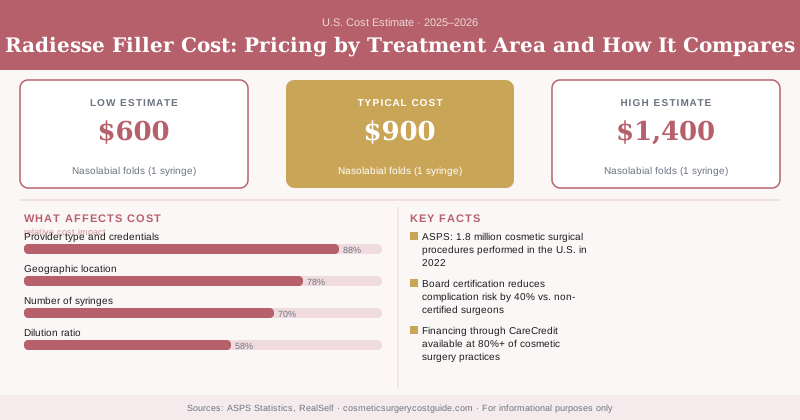
| Nasolabial folds (1 syringe) | $600 | $900 | $1,400 |
| Marionette lines (1 syringe) | $600 | $900 | $1,400 |
| Jawline contouring (1–2 syringes) | $700 | $1,200 | $2,000 |
| Hand rejuvenation (per hand) | $700 | $1,000 | $1,600 |
| Diluted Radiesse (biostimulator, full face) | $1,200 | $1,800 | $3,000 |
| Chin augmentation (1 syringe) | $650 | $950 | $1,500 |
Radiesse vs. hyaluronic acid fillers: cost comparison
This is the comparison most patients want. Here’s the honest look:
Per-syringe cost: Radiesse typically runs $600–$1,400 per syringe, compared to $500–$1,000 for most HA fillers. Radiesse costs more per syringe on average.
Duration: Radiesse typically lasts 12–18 months; HA fillers typically last 6–12 months depending on area and product.
Dissolveability: HA fillers can be dissolved with hyaluronidase if you don’t like the result. Radiesse cannot be dissolved — it has to be waited out or surgically removed (rare but worth knowing).
Biostimulation: Radiesse continues stimulating collagen after the initial gel absorbs. With repeated treatments, some patients see cumulative improvement in skin quality and structure — not just filler volume.
One of the most talked-about uses of Radiesse in 2024–2025 is “hyperdiluted” Radiesse — mixing it with saline or lidocaine to create a thinner consistency and injecting it across broader areas like the chest, neck, or face for collagen stimulation and skin tightening rather than volumizing.
This biostimulator use is off-label but widely practiced. Cost is typically quoted per full syringe used (1–2 syringes per area), running $1,200–$3,000 per treatment. Results build gradually over 3–6 months and may last 18–24 months.
What’s included in the price?
Most Radiesse pricing includes:
- The filler itself (priced by syringe used)
- Injector fee (usually bundled for in-office treatments)
- Local anesthetic (Radiesse comes premixed with lidocaine in some formulations, reducing discomfort)
- Follow-up visit if needed
What varies: whether the consultation fee ($50–$150 range) is credited toward treatment, and whether touch-up syringes are included or charged separately.
Factors that affect Radiesse pricing
Provider type and credentials: Plastic surgeons and dermatologists typically charge more than med spa injectors. For Radiesse specifically — a thicker product that requires precise technique, especially for jawline work and hand rejuvenation — provider experience matters significantly.
Geographic location: American Society of Plastic Surgeons (ASPS) data consistently shows that soft-tissue filler costs in New York and Los Angeles run 40–65% above the national average. The same syringe of Radiesse might cost $1,400 in Manhattan and $750 in Nashville.
Number of syringes: Most treatment areas require 1–2 syringes. The chin might need 1 syringe; the jawline might need 2–3; hand rejuvenation (both hands) often uses 2–4 syringes total. Get a clear estimate of expected syringe count before agreeing to a treatment plan.
Dilution ratio: Hyperdiluted Radiesse for biostimulation uses more total volume than standard Radiesse injections, but may use fewer syringes of the concentrated product. Ask your injector exactly how many syringes they plan to use.
Who is Radiesse best for?
Radiesse works best for:
- Deeper facial folds (nasolabial, marionette) where more structural support is needed
- Hand rejuvenation — Radiesse is one of the few fillers with specific FDA approval for hand volume loss
- Jawline definition in patients with good skin laxity who want structural enhancement
- Patients who want fewer treatment sessions and are comfortable with the non-dissolvable nature
- Collagen-stimulation goals — patients who want gradual skin quality improvement over time, not just immediate filling
Radiesse is generally NOT recommended for:
- Lips (too thick for this delicate area — HA fillers are standard there)
- Under-eye (tear trough) — high risk of nodule formation in this thin-skinned area
- Patients who want flexibility to dissolve results if unhappy
Because Radiesse cannot be dissolved, the stakes for injector skill are higher than with HA fillers. Overcorrection, uneven placement, or nodule formation requires time (and sometimes surgical intervention) to resolve. This is one area where cost-shopping for the cheapest injector carries real risk. Verify board certification and ask specifically about the injector’s Radiesse case volume.
Does insurance cover Radiesse?
No — it’s a cosmetic filler. One exception: patients who’ve lost significant facial volume due to HIV-associated lipodystrophy may have some insurance coverage for facial augmentation, but this doesn’t apply to standard cosmetic use.
Some practices accept CareCredit or medical financing for filler treatments. If you’re doing a larger Radiesse treatment (multiple areas, multiple syringes), financing can make the upfront cost more manageable.
How long does Radiesse last?
Based on clinical data and real-world outcomes: most patients see results lasting 12–18 months in the nasolabial area. ASPS provider surveys suggest the longevity advantage over HA fillers is most pronounced in patients over 45, whose natural collagen stimulation response to the CaHA microspheres tends to be more visible.
Hands: results typically last 12–15 months before noticeable regression.
Individual metabolism, sun exposure, lifestyle, and skin quality all affect longevity.
Bottom line: Radiesse costs $600–$1,800 per syringe depending on area and provider — generally 20–40% more per syringe than HA fillers. But with 12–18 month duration and collagen-stimulating benefits, many patients find the annual cost comparable or lower over time. It’s not dissolvable, so injector skill is non-negotiable. For nasolabial folds, jawline, and hands, it’s one of the most clinically validated filler options available.
Frequently Asked Questions
Radiesse typically costs $600–$1,800 per syringe, with pricing varying by treatment area and provider location. Hands and larger areas like the neck may require more syringes, increasing total treatment cost to $1,200–$3,600 or more for a complete session.
No, Radiesse is considered a cosmetic procedure and is not covered by health insurance plans. You will pay the full out-of-pocket cost, though some practices offer financing options or package discounts for multiple syringes.
Radiesse lasts 12–18 months, significantly longer than hyaluronic acid fillers which typically last 6–9 months. This longer duration means fewer repeat treatments per year, which can offset the higher per-syringe cost over time.