The problem with liposuction has always been skin. Remove fat, and you’ve eliminated the support structure — if the overlying skin doesn’t contract, you’re left with looser skin than you started with. Renuvion J-Plasma was developed specifically to address that gap: it tightens skin from the inside, simultaneously with liposuction, without a separate surgical lift.
It’s a technology that’s genuinely new to cosmetic surgery — FDA-cleared for use under the skin in 2018, with a growing body of clinical data showing skin contraction results that weren’t achievable with previous energy-based methods. Understanding what it can and can’t do — and what it costs — is the essential homework before any consultation.
Renuvion J-Plasma Cost by Treatment Area
| Treatment Area | Cost Range (standalone or add-on) |
|---|---|
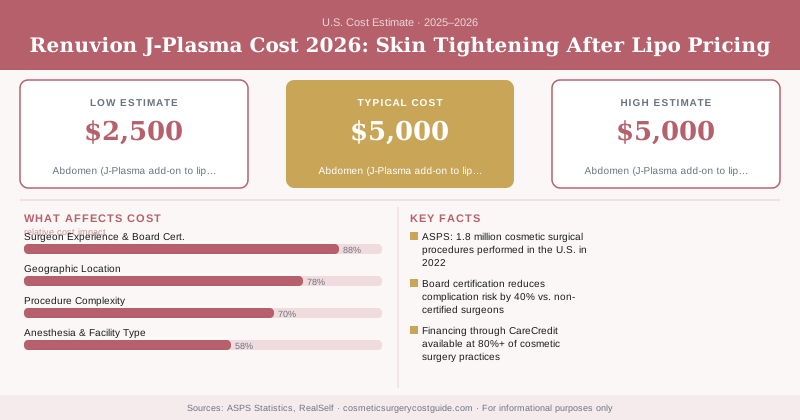
| Abdomen (J-Plasma add-on to lipo) | $2,500–$5,000 |
| Arms (bilateral, combined) | $2,000–$4,500 |
| Thighs (inner or outer) | $2,500–$5,500 |
| Neck and lower face | $2,000–$4,000 |
| Flanks / lower back | $2,000–$4,500 |
| Full torso (abdomen + flanks + back) | $5,000–$10,000 add-on |
| Full body combination (multiple areas) | $8,000–$18,000 total |
| Combined lipo + J-Plasma (all-in quote) | $8,000–$20,000 |
How Renuvion J-Plasma Works
Renuvion uses a proprietary combination of radiofrequency energy and helium plasma gas through a small probe inserted subdermally — beneath the skin, above the muscle. The helium gas conducts RF energy to create a plasma state, delivering intense heat energy very precisely to the undersurface of the dermis. That heat causes immediate collagen contraction (you can actually see the skin tighten during the procedure) and triggers ongoing collagen remodeling over the following 3–6 months.
The key distinction from external skin-tightening devices: Renuvion works from inside, delivering energy directly to the target tissue without having to penetrate through the surface of the skin. External devices like Ultherapy, Thermage, and radiofrequency systems must overcome the skin surface — losing energy and limiting how much can safely reach the deep dermis. J-Plasma bypasses that limitation entirely.
It’s almost always performed in combination with liposuction in the same session — the cannula creates the access path, and the J-Plasma wand follows through the same incision sites. The combined procedure runs longer (add 1–2 hours to the lipo time) but requires only one anesthesia event and one recovery.
What Kind of Results to Expect
A 2021 clinical study published in the Aesthetic Surgery Journal evaluated Renuvion outcomes across 300 patients treated at multiple sites, finding measurable skin tightening in 87% of patients at 6 months, with mean contraction of 30–40% in treated areas. Patient satisfaction rates exceeded 90% in that cohort.
That’s genuinely impressive for a minimally invasive skin-tightening approach. But context matters: these results were best in patients with mild to moderate skin laxity. Patients with severe skin excess — post-massive-weight-loss patients with large amounts of hanging skin — still needed surgical lifts for complete correction. J-Plasma doesn’t eliminate the need for surgical excision in extreme cases; it extends the range of patients who can get meaningful tightening without surgery.
The practical patient profile: someone who’s a good liposuction candidate but has a concern about skin retraction — they’re in their 40s or 50s with slightly diminished skin elasticity, or they’re treating an area like the inner arm or inner thigh where skin laxity is expected after fat removal. J-Plasma combined with lipo in that scenario can produce results that match what a surgical lift would achieve for a patient with mild laxity.
Renuvion J-Plasma works best for mild to moderate skin laxity in patients who are good candidates for liposuction. Think: inner arm skin that’s slightly loose but not dramatically drooping, abdominal skin with moderate loss of elasticity rather than hanging folds, thigh skin that needs tightening but not excision. Surgical lifts — arm lift (brachioplasty), tummy tuck, thigh lift — are necessary when the amount of excess skin exceeds what energy-based contraction can address, or when a scar trade-off is acceptable in exchange for more dramatic correction. J-Plasma dramatically blurs the line between “needs a lift” and “good candidate for lipo alone” — but it doesn’t eliminate the line entirely.
What Recovery Looks Like
Recovery from Renuvion-combined procedures is longer and more intense than lipo alone, because the J-Plasma adds a thermal injury component to the healing process.
- Days 1–5: Significant swelling, more discomfort than lipo alone, compression garment worn 24/7
- Week 2: Swelling continues to peak before beginning to decline; blistering or texture change at the skin surface is occasionally visible in heavy-treatment areas and resolves
- Week 3–6: Gradual reduction in swelling, compression transitioned to daytime
- Month 2–3: Early skin tightening visible; this is not the final result
- Month 4–6: Full collagen remodeling completes; final result visible
The thermal component of healing means patients sometimes see temporary numbness, firmness, and surface texture irregularity that resolves over 2–3 months. This isn’t a complication — it’s expected thermal healing. Knowing this in advance prevents unnecessary alarm during recovery.
Choosing a Provider
Renuvion requires specific training and credentialing through the device manufacturer (Apyx Medical). Not every practice offering “J-Plasma” or “helium plasma” is using genuine Renuvion — and not every Renuvion-credentialed provider has significant case volume with it.
Ask specifically:
- Are you using the actual Renuvion/J-Plasma system by Apyx Medical?
- How many combined lipo + J-Plasma cases do you perform per month?
- Can I see before/after photos at 6 months post-treatment?
- What’s your protocol for surface texture changes during recovery?
The ASPS encourages patients considering new energy devices to verify both device authenticity and provider training documentation — the “plasma” category has attracted marketing from unrelated devices with significantly different safety profiles.
Renuvion can cause burns if overused in a single area or applied too close to the skin surface. In inexperienced hands, thermal overcorrection leads to surface texture irregularities, hyperpigmentation, or in rare cases, full-thickness injury. These risks are dramatically lower with properly trained, high-volume providers. The technology is safe when used correctly — the phrase “when used correctly” is doing significant work here. Volume of experience matters more than almost any other provider credential for this specific procedure.
The Bottom Line
Renuvion J-Plasma adds $2,500–$8,000 to the cost of a liposuction procedure, depending on treatment area and scope. For patients who are borderline candidates for lipo because of skin elasticity concerns, that addition can be the difference between a genuinely satisfying result and one that requires a follow-up surgical lift. It’s not magic — it can’t substitute for excisional surgery in severe cases — but it significantly expands what’s achievable without a scar. The consultation, including honest skin assessment and before/after review, will tell you which side of that line you’re on.
Frequently Asked Questions
Renuvion J-Plasma typically costs $2,500–$8,000 per treatment area when combined with liposuction, depending on the size of the area being treated and your surgeon's location and experience. Most patients treat one to three areas in a single session, bringing total costs to $5,000–$24,000 for a complete procedure.
Renuvion J-Plasma is considered a cosmetic procedure and is not covered by health insurance, even when combined with liposuction. You will pay the full out-of-pocket cost, though some surgeons offer financing options or payment plans to help manage expenses.
Renuvion J-Plasma recovery is significantly faster than a surgical lift—most patients return to normal activities within 1–2 weeks, compared to 4–6 weeks for a facelift or body lift. However, combined liposuction and Renuvion procedures still require several days of downtime for swelling and bruising to subside.