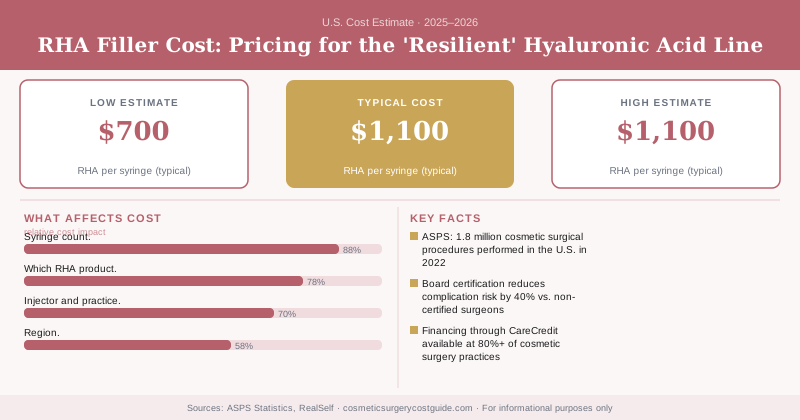
The $900 quote for a single syringe of RHA is completely normal — and here’s why it tends to run a touch higher than the filler you got two years ago. RHA is positioned as a premium “resilient” hyaluronic acid, and the per-syringe price reflects that positioning.
RHA stands for Resilient Hyaluronic Acid, made by Teoxane and distributed in the US by Revance. The FDA approved the first RHA fillers for dynamic facial wrinkles and folds in 2017. The pitch is a gel designed to stretch and recoil with facial movement, so it’s marketed as looking more natural in expressive areas like the nasolabial folds and around the mouth. That “moves with you” engineering is the entire premium.
RHA filler pricing breakdown
| Treatment | Cost |
|---|---|
| RHA per syringe (typical) | $700–$1,100 |
| RHA Redensity (fine lines) per syringe | $600–$1,000 |
| Nasolabial folds (1–2 syringes) | $700–$2,000 |
| Cheeks (2–4 syringes) | $1,400–$4,000 |
| Lips with RHA per syringe | $650–$1,000 |
How RHA is priced
Like most hyaluronic acid fillers, RHA is priced per syringe, and most people need one to four syringes depending on the area. The per-syringe number sits slightly above many standard HA options because it’s marketed as a premium, movement-friendly product.
How many syringes you need is the real cost driver. A single syringe might soften smile lines; full cheek augmentation can take three or four. The Aesthetic Society has reported that hyaluronic acid fillers remain among the most-performed non-surgical procedures in the US, with millions done each year — and RHA competes inside that crowded, well-established category.
RHA filler costs $700–$1,100 per syringe — slightly above many standard HA fillers because it’s marketed as a premium “resilient” gel for expressive areas. Your total depends on syringe count: 1 for fine lines, 3–4 for full cheeks. Compare against other HA options before assuming you need the premium product.
What affects your total
Syringe count. This is the biggest factor. Always get the per-syringe price and an estimate of how many you’ll need.
Which RHA product. The line includes several formulations (RHA 2, 3, 4, and Redensity) for different depths and areas, with slightly different pricing.
Injector and practice. Board-certified dermatologists and plastic surgeons charge more than medspas, but injector skill matters enormously for natural results.
Region. Coastal metros price 30–50% above the national midpoint.
How RHA compares
RHA competes directly with other hyaluronic acid lines. If you want a broad look at the category and typical price ranges, the overview of dermal fillers is the place to start. For lips specifically, the lip filler breakdown covers product choice and syringe count. RHA’s edge is its flexibility in animated areas — whether that’s worth the premium over a standard HA depends on where you’re treating and how much movement that spot sees.
Don’t pay a premium price for a premium product placed in the wrong area or by an inexperienced hand. RHA’s movement advantage shows up most in dynamic zones like the mouth and folds. In a static area, a less expensive HA filler may give you nearly identical results for less. Ask your injector to justify the choice.
Common questions
How long does RHA last? Depending on the product and area, results typically last around 12–15 months — comparable to other premium HA fillers.
Is it reversible? Yes. Because it’s hyaluronic acid, it can be dissolved with hyaluronidase if you’re unhappy or have a complication.
Does insurance cover it? No — it’s cosmetic. Many practices accept financing for larger multi-syringe treatments.
Bottom line
RHA filler costs $700–$1,100 per syringe, and your total hinges on how many syringes your treatment area needs. It’s a premium hyaluronic acid built for expressive areas, and it’s reversible like other HA products. Worth the slight premium in dynamic zones — but compare against standard HA fillers before committing for static areas.
Frequently Asked Questions
A single syringe of RHA filler typically costs between $700 and $1,100, with $900 being a common average price. This premium pricing reflects RHA's positioning as a resilient hyaluronic acid product and is generally higher than standard hyaluronic acid fillers from previous years.
No, RHA filler injections are considered cosmetic procedures and are not covered by health insurance plans. Patients should expect to pay the full out-of-pocket cost of $700–$1,100 per syringe, as insurers do not reimburse elective aesthetic treatments.
RHA filler results typically last 9 to 12 months, after which follow-up injections are needed to maintain the effect. Most patients schedule touch-up appointments annually or as needed based on how quickly their body metabolizes the product.