Maya, 31, had rhinoplasty three years ago. She wanted a refined tip and a smoother profile. What she got instead was a pinched tip that looks unnatural from the front, a nostril she can barely breathe through on one side, and a result that doesn’t look like her. Her original surgery cost $7,500. She’s now been told revision will cost $11,000–$13,000 — and that’s the lower end.
Her situation is not unusual. ASPS data shows rhinoplasty consistently ranks among the top five cosmetic surgical procedures performed annually, with well over 200,000 primary rhinoplasties per year in the US. Revision rates in published literature range from 5–15%, depending on the surgeon and complexity of the primary case. That’s tens of thousands of patients in Maya’s position every year — facing a second surgery that’s harder and more expensive than the first.
Here’s why, and what to do about it.
Why Revision Rhinoplasty Costs More
The short answer: it’s harder. The longer answer involves three distinct factors.
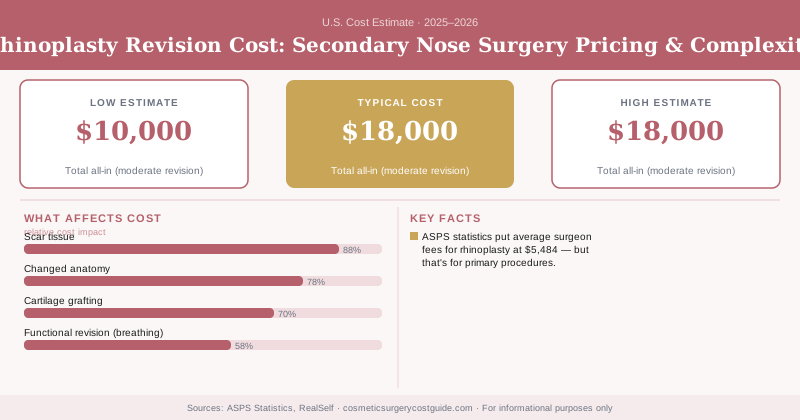
Scar tissue: Every surgical wound creates internal scar tissue, and the nose is no exception. Working through existing scar in confined anatomical spaces is slower and more technically demanding than operating on native, undisturbed tissue.
Changed anatomy: The primary surgery altered structural relationships. Cartilage may have been removed or repositioned. The nasal lining may have contracted. Understanding and working around what a previous surgeon changed requires experience that primary rhinoplasty simply doesn’t build.
Cartilage grafting: In many revision cases, the structures that need to be rebuilt require new raw material. That means harvesting cartilage from your ear or rib cage — adding a separate procedure, separate incision, and additional OR time. It also adds $1,000–$2,500 to the surgeon’s fee.
ASPS statistics put average surgeon fees for rhinoplasty at $5,484 — but that’s for primary procedures. Revision fees routinely run 30–60% higher.
Revision Rhinoplasty Cost Breakdown
| Cost Component | Typical Range |
|---|---|
| Surgeon fee (minor revision) | $6,000–$9,000 |
| Surgeon fee (moderate revision with ear graft) | $8,000–$12,000 |
| Surgeon fee (complex revision with rib graft) | $10,000–$15,000+ |
| Facility fee (ambulatory surgery center) | $1,500–$3,500 |
| Anesthesia fee | $1,200–$2,500 |
| Cartilage graft harvesting (rib) | $1,000–$2,500 additional |
| Pre-op imaging and consultation | $200–$500 |
| Total all-in (moderate revision) | $10,000–$18,000 |
Geographic market matters as much as complexity. A revision rhinoplasty in New York or Beverly Hills from a recognized specialist will run toward the top of these ranges. The same procedure from an equally skilled surgeon in a mid-sized market may run $2,000–$4,000 less.
When Is Revision Appropriate?
Functional revision (breathing): If your primary rhinoplasty resulted in a deviated septum, narrowed internal or external nasal valves, or other structural changes that impair breathing, you may be a candidate for functional septorhinoplasty — and this may be partially or fully covered by insurance. You’ll need documentation of the functional deficit, often including objective testing (nasal airflow measurement) and possibly a trial of conservative management (nasal strips, steroid sprays).
Cosmetic revision: Asymmetry, unexpected shape, tip issues, profile irregularities. This requires patience first: most surgeons won’t operate cosmetically until 12–18 months post-primary, because the nose continues to change as scar tissue matures and residual swelling resolves. What looks problematic at 6 months sometimes self-corrects by 15 months.
After rhinoplasty, your nose isn’t done changing for well over a year. Swelling resolves gradually — especially at the tip, which can hold swelling for 12–18 months. Scar tissue continues to remodel and soften. The final result at 18 months can look meaningfully different from what you see at 6 months.
Operating in this window — before the tissues have stabilized — means you’re operating on a moving target. The revision result will also take 12–18 months to fully appear. If you’re considering revision at 5–6 months post-primary because you don’t like what you see, most revision specialists will ask you to wait. This is the right recommendation. If your surgeon offers to revise at 4 months, that’s a red flag.
Cartilage Grafting: Sources and What They’re Used For
In most significant revision rhinoplasties, the surgeon needs additional cartilage to rebuild structural support, refine the tip, or correct collapsed nasal valves. Here’s where that material comes from:
Ear cartilage (auricular graft): Harvested from the back of the ear through a small incision, leaving no visible scar. Softer and more pliable — well-suited for tip grafts and smaller structural work. Usually the first choice when available in sufficient quantity.
Rib cartilage: Harvested from the lower rib cage through a 1–2 inch incision. Provides larger volume, greater strength, and more versatility for major reconstruction. The harvesting adds surgical time and a second incision with its own recovery. Necessary for complex revisions where ear cartilage isn’t sufficient.
Cadaveric cartilage (AlloDerm): Processed donor tissue — no harvesting incision required. Convenient but has lower long-term stability than autologous (your own) cartilage and carries a small risk of resorption over time. Some surgeons use it for specific applications; most prefer autologous grafts for primary structural work.
Ask your surgeon specifically: “What graft source do you plan to use and why?” Their answer tells you about their planned approach and their experience level.
Finding the Right Revision Surgeon
This is not the time to work with a generalist. Revision rhinoplasty is technically demanding in a way that primary rhinoplasty is not, and the gap between surgeons who do occasional revisions and those who specialize in them is substantial.
What to look for:
- Board certification in plastic surgery or otolaryngology (ENT) — both specialties train rhinoplasty, but you want certification, not just a claim
- High revision volume — ask what percentage of their rhinoplasty practice is revision work; 20–40% is meaningful; surgeons whose revision volume is under 10% may not have the specific experience set you need
- Willingness to show you 5-year post-op photos — 6-month photos are easy to produce; 5-year results show durability
- Realistic expectation-setting — be suspicious of any surgeon who promises perfection; revision rhinoplasty has its own limitations
Don’t go back to your original surgeon for revision simply because they did the original surgery. While some surgeons will offer to revise their own work at a reduced fee, you’re not obligated to work with the same person — and you may get a better outcome from a surgeon who specializes in correcting the type of problem you have. Get at least two revision consultations from different surgeons before deciding. The consultation itself — typically $150–$300 — is money well spent before committing $10,000+.
Realistic Expectations for Revision Outcomes
Revision rhinoplasty can achieve meaningful improvement. It can rarely achieve perfection — and any surgeon who implies otherwise is selling something.
The nose is small, anatomically complex, and highly visible. Even excellent revision surgeons work with the constraints of your existing anatomy, your scar tissue, and the grafting materials available. Most patients who’ve had careful, realistic consultations with experienced revision specialists report high satisfaction with their results. Most patients who entered revision expecting to finally get the “perfect” nose they originally envisioned are disappointed.
The right expectations going in: meaningful improvement in shape and function, scars that integrate with surrounding skin, and a nose that looks like you again — just a better version. Results take 12–18 months to fully reveal themselves. Plan for that timeline from the day of surgery.
Frequently Asked Questions
For cosmetic revisions, most surgeons require 12–18 months after your primary rhinoplasty before operating. This waiting period isn't arbitrary — nasal tissues continue to change, swelling continues to resolve, and scar tissue continues to mature throughout this window. What looks like a problem at 6 months may look significantly different at 14 months. Operating too early means operating on tissue that's still in flux, which makes predicting the outcome much harder. Functional revision for breathing obstruction can sometimes be addressed earlier, but cosmetic correction almost always requires the full maturation period.
Rib cartilage grafting means harvesting a small segment of cartilage from your rib cage — typically through a 1–2 inch incision — to use as structural support or tip material in the revision. It's needed when your nasal septum and ear cartilage don't provide enough raw material, which is common in revision cases where the septum was already used in the primary surgery or where significant structural support is needed. Ear cartilage (auricular graft) is softer and better for smaller corrections; rib cartilage is stronger and more versatile for major reconstruction. Cadaveric cartilage (AlloDerm) is an alternative but has lower long-term stability.
Three reasons: complexity, time, and risk. Revision rhinoplasty involves operating through scar tissue, which is harder to work with than native tissue. Anatomy is often distorted from the previous surgery. Cartilage grafting — harvesting from the ear or rib and shaping it — adds 30–90 minutes of OR time. And the stakes are higher: revision surgeons are correcting both the cosmetic problem and the functional result of someone else's decisions. All of that commands a higher surgeon fee, and the longer OR time increases anesthesia and facility costs.