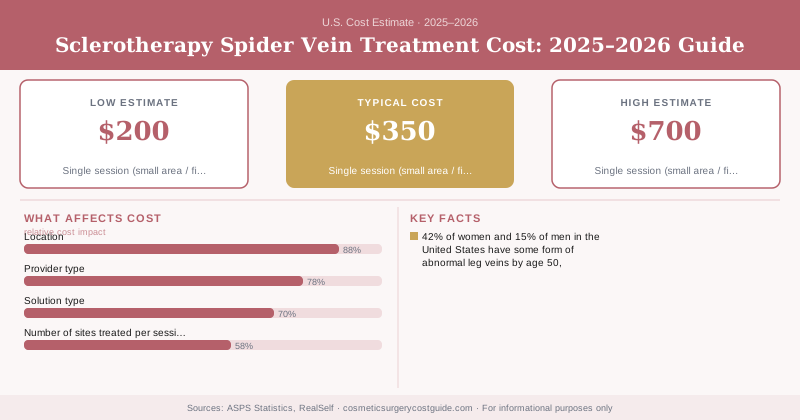
42% of women and 15% of men in the United States have some form of abnormal leg veins by age 50, according to American Vein and Lymphatic Society data. Most of those are spider veins — the small, web-like red and purple clusters that appear on the thighs, calves, and ankles. Sclerotherapy has been the standard treatment for over 80 years, and it works. The question is how much it costs and how many sessions you’ll actually need.
The answer depends almost entirely on how extensive your spider veins are and how many areas you’re treating in a session.
Sclerotherapy cost by session and coverage area
| Treatment Description | Low | Typical Range | High |
|---|---|---|---|
| Single session (small area / first visit) | $200 | $350–$500 | $700 |
| Single session (both legs, multiple zones) | $400 | $600–$900 | $1,200 |
| Package: 3 sessions (both legs) | $700 | $1,200–$1,800 | $3,000 |
| Ultrasound-guided sclerotherapy (deeper veins) | $600 | $900–$1,500 | $2,500 |
| Foam sclerotherapy (larger varicose veins) | $500 | $800–$1,500 | $2,500 |
| Facial spider veins (nose, cheeks) — laser only | $200 | $400–$700 | $1,500 |
Note: Facial spider veins are typically treated with laser (V-beam or IPL), not injection sclerotherapy — the vessels are too small for needle injection. The cost above reflects that distinction.
How sclerotherapy actually works
A tiny needle injects a sclerosing solution directly into each spider vein. The solution (typically polidocanol or sodium tetradecyl sulfate) irritates the vessel wall, causing it to swell shut, collapse, and eventually be absorbed by the body. Treated veins fade over 3–6 weeks. Sessions take 30–60 minutes. You walk out, wear compression stockings for 1–2 days, and resume normal activities immediately.
It’s not painful in the dramatic sense — most patients describe a mild burning or stinging sensation during injection that passes quickly. Each session typically treats 20–40 injection sites per leg.
How many sessions do you need?
For mild spider veins (isolated clusters, one or two areas): 1–2 sessions. For moderate coverage across both legs: 2–4 sessions. For extensive spider veins or any varicose veins mixed in: 3–6+ sessions. Each session can only safely inject a limited number of sites; new veins can also develop over time, so touch-up sessions every 1–3 years are common even after initial clearance.
Most patients with typical cosmetic spider veins need 2–3 sessions to achieve the clearance they want. Providers who promise complete elimination in a single session on extensive veins are setting unrealistic expectations.
Does insurance cover sclerotherapy?
Here’s the key distinction: cosmetic sclerotherapy for spider veins that cause no symptoms is almost never covered. Medical sclerotherapy for varicose veins causing pain, swelling, skin changes, or bleeding may be covered after conservative treatment (compression stockings for 3–6 months) has failed.
If you have spider veins AND symptomatic varicose veins, get a venous insufficiency evaluation (duplex ultrasound) before starting treatment. Your vascular surgeon or phlebologist can document which veins are medically significant — and that documentation can support insurance coverage for the varicose vein treatment, even if the cosmetic spider vein work remains out-of-pocket.
Sclerotherapy vs. laser for spider veins
Sclerotherapy: Gold standard for leg spider veins. More effective per dollar than laser for vessels 1–3mm. Direct injection reaches deeper vessels that surface lasers can’t reliably hit.
Laser (Nd:YAG, V-beam): Better for facial spider veins (cheeks, nose). Also used for very fine leg vessels too small for needles, or for patients who can’t tolerate injections. More expensive per session, often $400–$1,000 vs. $200–$600 for injection sclerotherapy.
Combination treatment: Many practices use injection sclerotherapy for medium vessels and laser for the finest surface vessels in a single session or series.
What drives price variation
Location: Practices in high-cost-of-living areas (NYC, San Francisco, Miami) charge 30–50% more than the national average.
Provider type: Vascular surgeons and phlebologists (vein specialists) typically charge more than dermatologists; both produce good results if experienced. Med spas offering sclerotherapy should be supervised by a licensed physician.
Solution type: Polidocanol (Asclera) is FDA-approved and widely used; sodium tetradecyl sulfate (Sotradecol) is also common. Foam formulations used for larger vessels require more time and expertise.
Number of sites treated per session: Some practices charge per-injection-zone; others charge a flat session fee. Clarify this before booking.
Avoid sclerotherapy offered at deep-discount clinics or spas where you can’t verify the supervising physician’s vein training. While the procedure is relatively low-risk in trained hands, complications — including matting (fine red vessels that appear after treatment), hyperpigmentation, and rarely deep vein thrombosis — do occur. A trained phlebologist or vascular surgeon can identify patients at risk and manage complications appropriately. The American Board of Venous and Lymphatic Medicine (ABVLM) certifies vein specialists.
After the procedure: what to expect
- Compression stockings: Worn 24–48 hours post-treatment; improve outcomes and reduce bruising
- Walking: Encouraged immediately; avoid strenuous exercise for 24–48 hours
- Sun avoidance: Direct sun on treated areas for 2 weeks minimizes hyperpigmentation risk
- Bruising: Common, resolves in 1–2 weeks
- Fading timeline: Treated vessels take 3–6 weeks to disappear; final result visible at 3 months
Financing
Cosmetic sclerotherapy is not covered by insurance and isn’t eligible for HSA/FSA (unless medically necessary). Most vein practices offer in-house payment plans, and many accept CareCredit. For multiple-session series, ask about package pricing — most practices discount 10–20% when you pay for 3 sessions upfront.
Frequently Asked Questions
Sclerotherapy typically costs $200–$2,000 per session, depending on the size and number of veins being treated. Most patients require 2–6 sessions spaced 4–6 weeks apart to achieve optimal results, bringing total treatment costs to $400–$12,000 for a complete course.
Most insurance plans classify sclerotherapy as cosmetic when treating spider veins and do not cover it. However, if sclerotherapy is medically necessary to treat venous insufficiency or related symptoms, some insurers may cover 50–80% of costs; you should verify coverage with your specific plan before scheduling treatment.
Most patients need 2–6 sessions scheduled 4–6 weeks apart to achieve desired results, though some may see improvement after just one session. Results are often permanent for treated veins, but new spider veins can develop over time, potentially requiring touch-up sessions every few years.