Here’s the thing most patients don’t realize before their first Sculptra consultation: you don’t see results the day of the appointment. Unlike hyaluronic acid fillers — Juvederm, Restylane — where volume is immediate, Sculptra works gradually. You’re injecting poly-L-lactic acid, a biostimulator that triggers your own collagen production over weeks to months. The results emerge slowly, look more natural than traditional filler, and last 2+ years. The tradeoff: you need multiple sessions, multiple vials per session, and patience.
The American Society of Plastic Surgeons notes that filler procedures exceeded 3.4 million treatments in 2023 — with collagen-stimulating biostimulators like Sculptra growing as a category as patients seek longer-lasting alternatives to quarterly HA touch-ups.
Sculptra Cost Breakdown
| Treatment Component | Typical Cost |
|---|---|
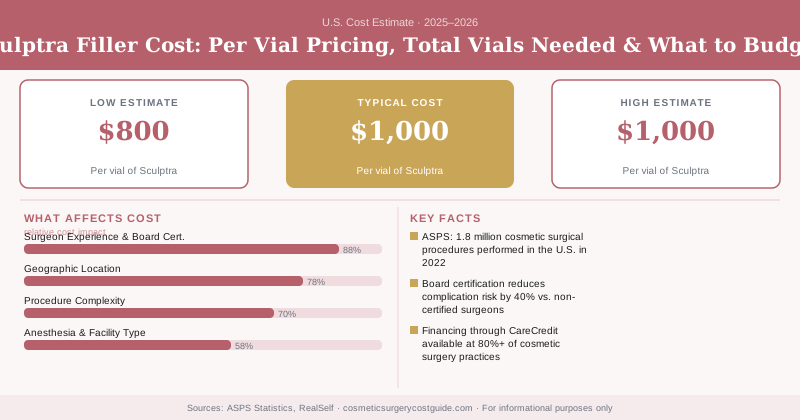
| Per vial of Sculptra | $800–$1,000 |
| Typical session (2–3 vials) | $1,600–$3,000 |
| Full face treatment (3 sessions, 6–9 vials total) | $4,800–$9,000 |
| Sculptra Aesthetic for buttocks augmentation (10–20 vials) | $8,000–$20,000 |
| Annual touch-up (1–2 vials) | $800–$2,000 |
The vial count required depends on treatment area and degree of volume loss. A 35-year-old with mild midface deflation might need 4–6 vials total. A 55-year-old with significant facial volume loss could need 9–12 vials for full correction. The “rule of thumb” some injectors use: one vial per decade of age, per session. That’s a rough guide, not a guarantee.
What Sculptra actually does
Poly-L-lactic acid (PLLA) is a biocompatible, biodegradable synthetic polymer — the same material used in dissolvable sutures for decades. When injected into the deep dermis and subcutaneous tissue, the PLLA microparticles act as a scaffold that stimulates fibroblasts to produce new collagen. Over 4–6 weeks, new collagen fibers replace the PLLA as it’s absorbed.
The practical result: gradual, diffuse volumization that mimics the appearance of facial fat and collagen restoration — not the localized plump of a HA filler. It’s particularly effective for treating:
- Temple hollowing
- Midface and cheek deflation
- Marionette lines and jowl pre-correction
- General facial volumetric loss from aging
- Non-surgical buttock augmentation (“Sculptra BBL”)
Results develop over 2–3 months post-final-session and typically last 2–2.5 years. Annual touch-ups of 1–2 vials extend maintenance.
Sculptra vs. hyaluronic acid fillers: the real cost comparison
This is where the math gets interesting. HA fillers like Juvederm Voluma last 12–18 months and cost $800–$1,500 per syringe. For significant cheek volumization, most patients need 3–4 syringes across the midface — and then repeat annually or biannually. Over 5 years: $12,000–$20,000+.
A full Sculptra correction requiring 8 vials ($6,400–$8,000) with annual 1–2 vial maintenance ($800–$2,000/year) costs roughly the same over 5 years, but produces a different result — more diffuse, gradual, and natural-looking than the targeted volume of HA filler.
Neither is objectively better. They’re different tools. HA filler is better for specific lip, nasolabial, or targeted cheek augmentation. Sculptra is better for overall facial volumetric restoration in patients who want 2-year durability and a more gradual, natural result.
After every Sculptra session, you’re instructed to massage the treated areas for 5 minutes, 5 times a day, for 5 days — this is called the “5-5-5 rule.” It’s not optional. The massage distributes the PLLA particles evenly through tissue to prevent nodule formation (papules), which can occur when the product pools in one spot. Nodules are a known complication of Sculptra — historically more common before the massage protocol became standard. Follow the instruction precisely. Set phone alarms if you need to. The massage takes 25 minutes total per day and prevents a complication that would require corticosteroid injection or surgical removal.
The Sculptra BBL: non-surgical buttock augmentation
Sculptra injected into the buttocks (off-label but widely performed) uses 10–25 vials to create gradual volumization. It’s marketed as a “non-surgical BBL” — which is technically misleading, since a BBL involves fat transfer and this doesn’t, but the outcome is similar: added projection and shape.
Cost: $8,000–$20,000 depending on vial count and practice. Results appear over 2–4 months and last approximately 2 years. It’s not a substitute for surgical BBL in patients wanting significant reshaping, but it’s appropriate for modest augmentation without anesthesia or surgical recovery.
Sculptra should only be injected by experienced providers who have specific training with biostimulators. The technique is different from HA filler injection — product is placed more deeply, dilution ratios matter, and volume per injection point must be carefully controlled. Injectors who primarily work with HA fillers and occasionally use Sculptra aren’t the right choice for this procedure. Ask how many Sculptra treatments your provider performs per month before booking. The answer should be in the double digits, not single.
What to ask at your consultation
- How many vials do you estimate I’ll need in total, across how many sessions?
- How often do you inject Sculptra? What’s your monthly volume?
- What’s your nodule rate, and how do you manage them if they occur?
- Do you dilute with bacteriostatic water, and what’s your dilution ratio?
- How long after the final session do you expect to see full results?
Bottom Line
Sculptra costs $800–$1,000 per vial, and most patients invest $4,800–$9,000 for full facial correction across 3 treatment sessions. That’s more upfront than a first-time HA filler appointment, but the 2-year durability and gradual natural result make it cost-competitive over time. It’s not for patients who want immediate results or a specific targeted plump — it’s for patients willing to invest in a process that builds gradually and looks like it happened naturally. Choose an experienced biostimulator injector, follow the massage protocol religiously, and budget time as much as money: results emerge over months, not days.
Frequently Asked Questions
A single vial of Sculptra costs $800–$1,000, and most patients require 3–6 vials per treatment series, bringing the total to $2,400–$6,000. Some practices charge a flat treatment fee instead of per-vial pricing, which typically ranges from $1,500–$3,000 depending on the area treated and provider location.
No, Sculptra is considered a cosmetic procedure and is not covered by health insurance plans. You will pay the full out-of-pocket cost at your appointment, though some practices offer payment plans or financing options through medical credit companies like CareCredit to help spread the expense.
Results develop gradually over 4–12 weeks as Sculptra stimulates collagen production, unlike immediate-result fillers like Juvederm. Most patients need 2–3 treatment sessions spaced 4–6 weeks apart for optimal results, with full effects visible 3–6 months after the final injection.