Over 15 million cosmetic procedures were performed in the US in 2024 according to the American Society of Plastic Surgeons, and non-surgical skin treatments were among the fastest-growing categories. Within that segment, RF microneedling has become the go-to recommendation for patients who want real collagen remodeling without a laser’s recovery timeline. Secret RF — made by Cutera — is one of the more clinically vetted options in that space, with FDA clearance specifically for skin resurfacing.
That specific FDA designation matters more than it might seem. “FDA cleared” versus “FDA cleared for skin resurfacing” isn’t the same thing. The latter means the device was specifically evaluated for its ability to improve skin texture, tone, and surface quality — not just shown to be safe for general dermal heating. At $600–$1,100 per session, Secret RF falls squarely in the mid-range of the RF microneedling market, and for the right patient, that clearance backs up the pricing with meaningful clinical evidence.
Secret RF Pricing
| Treatment Area | Cost Per Session | Sessions Recommended | Total Estimate |
|---|---|---|---|
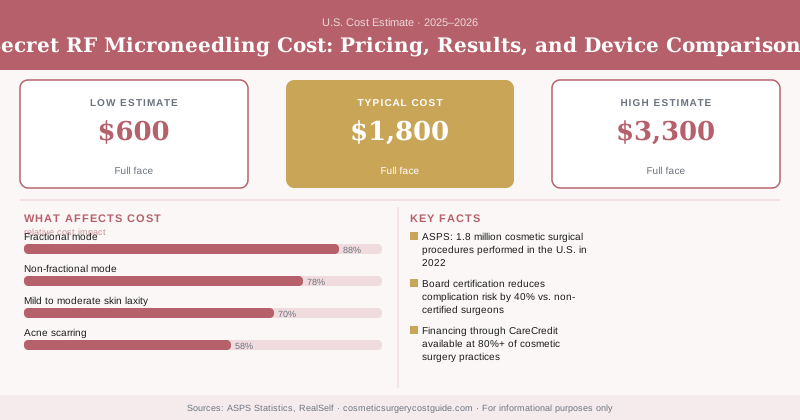
| Full face | $600–$1,100 | 3 | $1,800–$3,300 |
| Face + neck | $900–$1,500 | 3 | $2,700–$4,500 |
| Neck only | $400–$700 | 3 | $1,200–$2,100 |
| Acne scarring (face) | $700–$1,100 | 3–6 | $2,100–$6,600 |
| Chest/décolletage | $400–$700 | 3 | $1,200–$2,100 |
| Stretch marks (targeted area) | $500–$900 | 4–6 | $2,000–$5,400 |
Prices in high-cost markets (New York, Los Angeles, Chicago) run at the upper end. Physician-owned practices typically price 10–20% higher than med spas — that premium reflects physician oversight and more personalized protocol selection. Series packages offered by many practices discount 10–20% versus per-session pricing, which can meaningfully reduce the total if you’re confident about committing to the full course.
What Secret RF’s Fractional and Non-Fractional Modes Mean
Most RF microneedling devices deliver energy in one mode. Secret RF has two:
Fractional mode: RF energy discharges only at the needle tips, creating distinct zones of treated tissue surrounded by untreated tissue. This fractional pattern — similar in concept to fractional lasers — preserves neighboring cells to accelerate healing. It’s particularly effective for texture and scarring where you want concentrated focal energy with fast recovery.
Non-fractional mode: RF energy distributes more uniformly across the needle depth. This is better for diffuse collagen remodeling and mild laxity, where you want consistent heating across a broad dermis area rather than concentrated focal points. For patients whose primary concern is overall tightening rather than spot texture issues, non-fractional mode may produce more even results.
The ability to choose or combine modes within a single session is clinically meaningful. A provider can address both scattered acne scarring (fractional mode) and overall skin laxity (non-fractional mode) in the same visit, rather than choosing one treatment goal over another.
Secret RF vs. Competing RF Microneedling Systems
| Device | Manufacturer | Max Depth | Needle Count | Special Features | Cost/Session |
|---|---|---|---|---|---|
| Secret RF | Cutera | 3.5mm | 25 insulated | Fractional + non-fractional modes | $600–$1,100 |
| Morpheus8 | InMode | 8mm | 24 gold-tipped | Subdermal depth, body applicator | $800–$1,500 |
| Vivace | Aesthetics Biomedical | 3.5mm | 36 gold-plated | Built-in LED therapy | $600–$1,200 |
| Potenza RF | Cynosure | 4mm | 25 or 49 | Monopolar/bipolar, ultrasound option | $700–$1,300 |
| Sylfirm X | Benev | 4mm | 25 | Pulsed + continuous wave modes | $600–$1,200 |
| Genius RF | Lutronic | 3.5mm | 49 | Real-time impedance feedback | $700–$1,400 |
The comparison that comes up most often is Morpheus8 versus Secret RF. The distinction is straightforward: Morpheus8 operates at up to 8mm depth, reaching subdermal fat for a dual tightening + mild contouring effect. Secret RF maxes at 3.5mm — purely dermal. That’s not a weakness; it’s a design choice. Most skin concerns (texture, pores, fine lines, mild laxity) exist in the dermis, and over-treating with excessive depth in patients who don’t need it adds recovery time without proportional benefit.
For patients with mild to moderate concerns and no significant jowling or body laxity, Secret RF often produces equivalent results to Morpheus8 at lower per-session cost and with less post-treatment redness and swelling.
Vivace is the direct head-to-head competitor at comparable pricing and depth. The key difference: Vivace includes built-in LED light therapy that reduces post-treatment inflammation, which some patients prefer. Secret RF’s two-mode flexibility may give providers more protocol customization options. Neither is objectively better — it often comes down to provider experience with the specific device.
Potenza RF from Cynosure (the same company behind PicoSure) uses monopolar and bipolar RF modes and optionally combines ultrasound, which allows a different tissue interaction profile. It’s a newer device and not as broadly studied as Morpheus8 or Secret RF, but clinicians who use it report strong results for diffuse laxity.
Secret RF produces the best outcomes for patients who have:
- Mild to moderate skin laxity — early jowling, slightly loose lower face
- Acne scarring — rolling and boxcar scars respond particularly well; ice-pick scars less so
- Large pores and uneven skin texture
- Fine lines that don’t respond adequately to Botox (static vs. dynamic)
- Fitzpatrick III–VI skin tones — insulated needles deliver RF at the tip only, bypassing the epidermis and dramatically reducing hyperpigmentation risk compared to ablative treatments
- Minimal downtime requirement — 24–48 hours of redness is typical versus 5–7 days for ablative lasers
Secret RF is a poor fit for patients with significant skin laxity requiring surgical correction, active cystic acne in the treatment zone, or unrealistic expectations about non-surgical results.
The Treatment Experience: What to Expect
The typical Secret RF appointment runs 60–75 minutes including numbing time. Topical anesthetic cream is applied 30–60 minutes beforehand; some patients opt for additional injectable nerve blocks for lower pain tolerance or more aggressive energy settings.
During treatment, the handpiece is stamped systematically across the treatment zone, with slight adjustments to depth and energy based on the area. Most patients describe the sensation as mild to moderate pressure with occasional sharp warmth — generally well-tolerated with proper numbing.
Immediately after: redness, minor swelling, and visible puncture marks (which fade within 24–48 hours). Unlike ablative lasers, there’s no peeling phase — the surface of the skin isn’t removed. By day 2, most patients are back to normal activities and can apply makeup. Some patients notice the skin feels tight and slightly rough for 3–5 days before improving.
Peak results develop over 3–6 months as newly formed collagen matures. Plan on assessing final results around month 4 after your last session, not immediately after the series.
Patients with a history of oral herpes (cold sores) should request prophylactic antiviral medication before treatment — RF microneedling can trigger outbreaks. This applies to Secret RF, Morpheus8, Vivace, and all RF microneedling devices. Don’t skip this conversation with your provider.
Combining Secret RF With Complementary Treatments
RF microneedling corrects texture, tightness, and collagen quality. It doesn’t replace volume (that’s dermal fillers), stop dynamic muscle movement (that’s Botox), or treat significant vascular redness (that’s IPL or vascular laser). The best results come from addressing all dimensions of skin aging, not just one.
Common combination protocols:
- Secret RF + Botox: Schedule Botox first; wait 2 weeks before RF microneedling
- Secret RF + Hyaluronic acid fillers: Same timing principle — fillers first, allow 2 weeks before RF in the same area
- Secret RF + Chemical peel: Light peels can maintain surface brightness between RF sessions
- Secret RF + PRP: Some practices apply PRP topically immediately after needling to enhance growth factor delivery
For patients who’ve had microneedling without RF before and want to step up intensity, Secret RF is a natural next option — same concept, deeper collagen remodeling.
What You’re Actually Buying at $600–$1,100/Session
Three Secret RF sessions at $800 average = $2,400. Compare that to 3–4 sessions of standard microneedling at $300–$700 each ($900–$2,800 total) or 3–5 sessions of IPL photofacials at $400–$600 each ($1,200–$3,000 total).
For strictly texture and pore concerns, standard microneedling can be sufficient. For mild skin tightening alongside texture improvement, Secret RF’s RF component justifies the step up in cost — you’re getting collagen remodeling at a tissue depth and heat level that mechanical needling alone doesn’t achieve. For significant laxity, Morpheus8 or Ultherapy are more appropriate investments.
Like every RF microneedling device, Secret RF’s results depend significantly on who’s operating it. Ask for before-and-after photos that match your specific skin concerns, not generic glow-up results. A provider comfortable with both modes and experienced in depth calibration for your skin type will make a meaningful difference in outcome.
Frequently Asked Questions
Secret RF microneedling costs $600–$1,100 per full-face session, with most patients needing 3 sessions spaced 4–6 weeks apart. Total treatment investment runs $1,800–$3,300. Add-on areas like the neck typically cost $300–$500 extra per session. Some practices discount 10–20% for prepaid series packages.
Secret RF is made by Cutera and is specifically FDA-cleared for skin resurfacing — not just general 'skin rejuvenation.' It uses 25 insulated gold-coated needles and features both fractional and non-fractional delivery modes, which allows providers to customize treatment for different skin concerns and depths. The non-fractional mode delivers energy more uniformly across tissue, which can be advantageous for diffuse laxity.
It depends on the concern. Secret RF (max 3.5mm depth) is better suited for texture, pores, fine lines, and mild laxity in patients who want minimal downtime. Morpheus8 (up to 8mm depth) is stronger for significant jowling, deeper laxity, or body treatments where reaching subdermal fat is the goal. Secret RF is gentler and appropriate for all skin tones including Fitzpatrick V–VI. Both require a series of 3 sessions for optimal results.