Not every injectable is a filler. That distinction matters more than most patients realize when they’re budgeting for skin quality improvement versus volume correction.
Skin boosters are injectable hyaluronic acid treatments designed to hydrate the skin from within, improve texture and elasticity, and stimulate collagen — without creating significant volume or structural change. They’re the category between topical skincare and traditional filler. The results are subtler than filler but cumulative, and the patient experience is meaningfully different.
The global skin booster market grew at 14.2% annually between 2020 and 2024 according to the ISAPS market analysis report, driven by demand for natural-looking skin quality improvement — the “skin health” rather than “work done” aesthetic that’s dominated patient preferences in recent years.
Skin Booster Cost by Product
| Product | Cost Per Session | Sessions for Initial Course | Total Initial Investment |
|---|---|---|---|
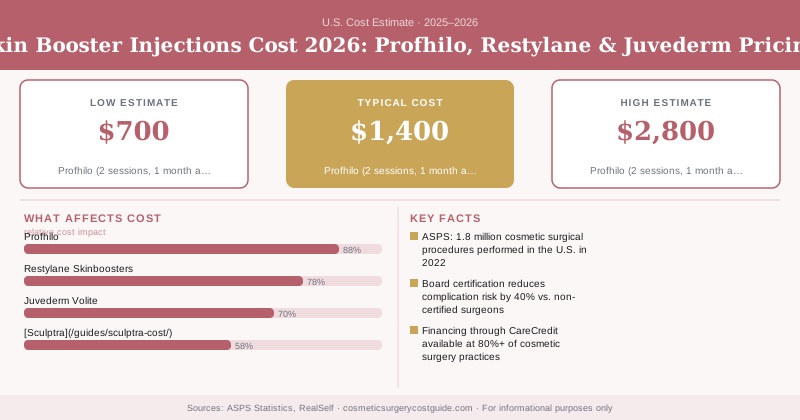
| Profhilo (2 sessions, 1 month apart) | $700–$1,400 | 2 | $1,400–$2,800 |
| Restylane Skinboosters | $600–$1,200 | 3 | $1,800–$3,600 |
| Juvederm Volite (where available) | $800–$1,500 | 1–2 | $800–$3,000 |
| Belotero Revive | $600–$1,100 | 2–3 | $1,200–$3,300 |
| Teosyal RHA Redensity | $700–$1,300 | 2 | $1,400–$2,600 |
| Sculptra (biostimulator, off-label skin quality) | $800–$1,600 per vial | 2–4 vials | $1,600–$6,400 |
| Maintenance session (every 6–12 months) | $600–$1,400 | — | Per session |
What Each Product Does
Profhilo is the highest-profile product in this category — an ultra-high-concentration HA (64mg/2mL) that spreads beneath the skin through what the manufacturer calls bio-remodeling. It’s injected at 5 specific points on each side of the face using the BAP (Bio Aesthetic Points) technique and disperses widely, hydrating large areas with minimal injection points. Two sessions 4 weeks apart form the initial course. Results include improved hydration, skin tone, and elasticity — visible at 4–8 weeks and lasting 6–9 months. It’s not available at every U.S. practice (still awaiting some FDA clearances for specific indications), so pricing varies more than for FDA-approved products.
Restylane Skinboosters use a softer HA gel injected via multiple small injections (using a cannula or serial point technique) across treatment areas — face, neck, hands, décolletage. Three sessions over 3 months form the standard initial course, with maintenance every 6–9 months. More injections per session than Profhilo, but each individual deposit is small.
Juvederm Volite is FDA-cleared specifically for skin quality improvement (not volume) — one of the few products in this category with that specific indication in the U.S. It improves skin smoothness and elasticity with a single treatment per year in many patients.
Sculptra (poly-L-lactic acid) is a biostimulator, not technically hyaluronic acid, but belongs in this category for skin quality use. It stimulates collagen production rather than providing immediate hydration. Results build over 3–6 months. It’s used off-label for skin quality improvement as well as for volume restoration — costs more per session but lasts 2+ years.
Skin Boosters vs. Traditional Filler: Key Differences
Traditional dermal fillers add volume — they fill nasolabial folds, plump lips, restore cheek volume. You see the result immediately. Skin boosters work on a different mechanism: improving the intrinsic quality of the skin itself — hydration, elasticity, radiance — without adding visible volume. You don’t look “filled.” You look healthier.
Think of it this way: fillers correct specific structural deficits. Skin boosters improve the substrate — the skin quality that makes everything else look better. Many patients use both: skin boosters for overall quality, targeted filler for specific volume concerns.
Skin boosters deliver the most noticeable results in patients with dull, dehydrated, fine-textured skin who want a “glass skin” or refreshed look without obvious cosmetic work. They’re particularly popular for: early aging skin in the late 20s to 40s before volume loss is significant, skin with fine lines and texture irregularity from dehydration or mild sun damage, and areas where filler isn’t appropriate — the décolletage, neck, and backs of hands respond well to skin boosters and poorly to traditional filler. They’re less impactful for patients with significant volume loss or deep structural facial aging, where traditional filler remains the primary tool.
Treatment Areas and Pricing Variations
Face is the most common treatment area, but skin boosters are used extensively for:
- Neck: Crepe-y, lax neck skin responds well to HA skin boosters — an area where traditional filler is rarely appropriate
- Décolletage: Sun-damaged, thin chest skin — visible improvement with Restylane Skinboosters or Profhilo
- Hands: Thin, crepey hand skin responds well; back of hand treatments add $200–$400 to face session pricing
- Under-eye area: Some practitioners use diluted skin boosters under the eyes for hydration — requires very skilled technique
Multi-area treatment in a single session reduces overall cost per area — most practices offer package pricing.
What to Ask Before Booking
The skin booster category has specific products and specific techniques. Not all providers offering “hydration injections” or “skin boosters” are using the same products or equivalent expertise.
- What specific product are you using?
- Are you certified in the BAP technique (for Profhilo)?
- What’s your protocol for the initial course and maintenance?
- Do you combine this with other treatments in the same session?
The American Society of Plastic Surgeons notes in its injectable guidelines that HA products require different injection planes and techniques depending on their formulation — skin boosters are placed in the superficial dermis or mid-dermis, not the deep dermis or subdermis where traditional fillers sit. Cross-contamination of technique is a genuine provider skill issue.
Skin boosters injected into the wrong plane — particularly too superficially — can cause visible bumps, white papules, or Tyndall effect (bluish discoloration under thin skin). Under-eye treatments with skin boosters carry higher risk of these complications than cheek or forehead treatment. Only consider under-eye skin booster treatment with a provider who has specific, documented experience with this area and who can show patient photos demonstrating smooth results.
Maintenance and Long-Term Investment
Skin boosters aren’t a one-time investment. The initial course gets you to a baseline; maintenance sessions every 6–9 months sustain results. Annual cost for maintenance is typically $600–$1,400 per session plus any topical skincare the provider recommends alongside treatment.
Many patients find that consistent skin booster maintenance for 12–24 months produces cumulative skin quality improvement beyond what individual sessions suggest — the ongoing collagen stimulation builds over time.
The Bottom Line
Skin boosters cost $600–$2,500 per session, with an initial course running $1,400–$4,000 depending on product and sessions needed. They’re the right investment for patients focused on skin quality — hydration, glow, fine texture — rather than structural volume correction. For the growing segment of patients who want to look fresher rather than altered, they’ve become a staple injectable alongside Botox and targeted fillers.
Frequently Asked Questions
A single Profhilo session typically ranges from $600 to $1,200 per treatment, depending on the provider's location and experience level. Most patients require 2 sessions spaced 2–4 weeks apart for optimal results, bringing the total initial cost to $1,200–$2,400.
No, skin booster injections are considered cosmetic procedures and are not covered by standard health insurance plans. Patients pay the full cost out-of-pocket, though some medical spas and clinics offer package discounts or payment plans to reduce upfront expenses.
Most skin boosters require maintenance sessions every 6–12 months after the initial 2-session series to sustain hydration and collagen-stimulating benefits. Some patients opt for quarterly touch-ups ($150–$300 per session) for continuous improvement, while others stretch treatments to annual visits depending on their skin goals and budget.