42% of Americans have never had a professional skin consultation, according to survey data cited across the dermatology industry — which helps explain why skin boosters, a treatment category focused purely on skin quality rather than visible shape change, remain less understood than filler or Botox despite growing rapidly in popularity.
Skin booster costs
| Package | Typical Cost |
|---|---|
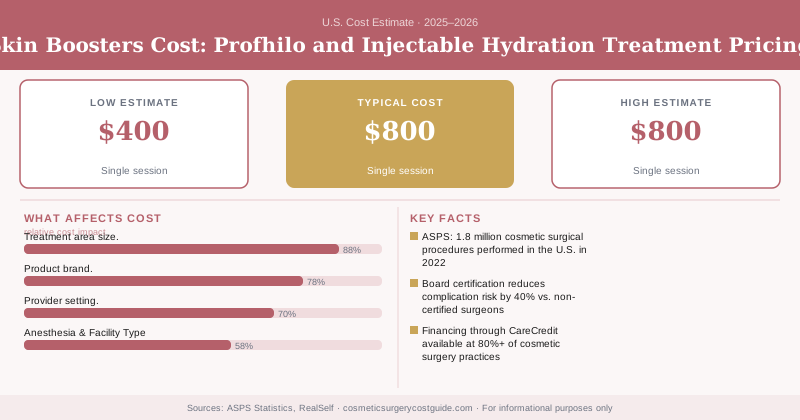
| Single session | $400–$800 |
| Initial series (2–3 sessions) | $1,200–$2,200 |
| Maintenance session (every 6 months) | $400–$700 |
What actually makes a skin booster different from filler
Traditional dermal fillers use a highly cross-linked, thick hyaluronic acid gel formulated to hold shape and add visible structural volume in a specific location — think cheeks, lips, or jawline. Skin boosters use a much lower-viscosity, less cross-linked hyaluronic acid formula that disperses more broadly once injected, distributed across many small injection points over a treatment area like the full face, neck, or hands.
The goal isn’t shape or volume — it’s hydration, elasticity, and overall skin texture improvement. The low-viscosity formula binds water within the skin’s dermal layer and, over a series of treatments, is believed to stimulate the skin’s own collagen and elastin production, gradually improving skin quality from within rather than adding visible contour.
Why you need a series, not a single session
Because skin boosters work partly through cumulative biostimulation rather than immediate volumizing effect, a single session produces modest, often subtle improvement. Most providers recommend an initial series of 2–3 sessions spaced 4–6 weeks apart to build a meaningful, visible improvement in skin texture and hydration — patients who try a single session and stop are often disappointed by results that a completed series would have delivered.
Skin boosters work best for patients whose primary concern is overall skin quality — dullness, fine crepey texture, or dehydration-related fine lines — rather than volume loss or deep wrinkles, which are better addressed by traditional filler or neuromodulators respectively. Many providers combine a skin booster series with targeted filler in specific areas for patients who have both concerns, treating each with the tool actually designed for that specific problem.
How it compares to other skin quality treatments
Microneedling, at $300–$600 per session, and chemical peels, at $150–$400 per session, both address skin texture through a different mechanism — controlled injury that stimulates the skin’s natural healing and collagen response, rather than direct hydration and biostimulation from an injected substance. Many providers combine skin boosters with microneedling in the same visit, since the micro-channels created by needling can enhance product absorption, a technique sometimes marketed as “skin booster microneedling” at a modestly higher combined price than either treatment alone.
What changes your specific price
Treatment area size. Full-face treatment costs more than a targeted area like under-eyes or neck alone.
Product brand. Different manufacturers’ skin booster formulations (Profhilo, Restylane Skinboosters, Juvéderm Volite, among others) are priced somewhat differently based on their specific formulation and marketing positioning, though clinical differences between them are often subtle.
Provider setting. Board-certified dermatology and plastic surgery practices typically charge more per session than medspas, though technique consistency matters more for this treatment than most, given how many small, evenly distributed injection points are required.
Skin boosters are not a substitute for sun protection or a basic skincare routine, and providers who market them as a complete solution to all skin aging concerns are overselling their actual scope. They address hydration and texture specifically — they won’t correct significant volume loss, deep static wrinkles, or pigmentation issues, which require different, targeted treatments.
Bottom line
Skin boosters cost $400–$800 per session, with a complete initial series of 2–3 sessions running $1,200–$2,200 and results lasting 6–9 months before a maintenance session is needed. They’re a genuinely different tool than traditional filler — designed for hydration and texture rather than volume or shape — and work best for patients whose primary concern is overall skin quality rather than structural volume loss.
Frequently Asked Questions
Skin boosters like Profhilo or Restylane Skinboosters typically cost $400–$800 per session, and most treatment plans recommend an initial series of 2–3 sessions spaced 4–6 weeks apart, bringing total cost to $1,200–$2,200 for the complete initial series.
Traditional dermal fillers use a thicker, more cross-linked hyaluronic acid formula designed to add structural volume and shape to specific areas like cheeks or lips. Skin boosters use a much lower-viscosity hyaluronic acid formula injected in multiple small points across a broader area, designed to improve skin hydration, elasticity, and overall texture rather than add visible volume or contour.
Results from a full initial series typically last 6–9 months before skin hydration and elasticity gradually decline, with most providers recommending a maintenance session every 6 months to sustain results. Some patients report that skin quality improvements persist somewhat longer after multiple treatment cycles as the treatment stimulates the skin's own collagen and elastin production over time.