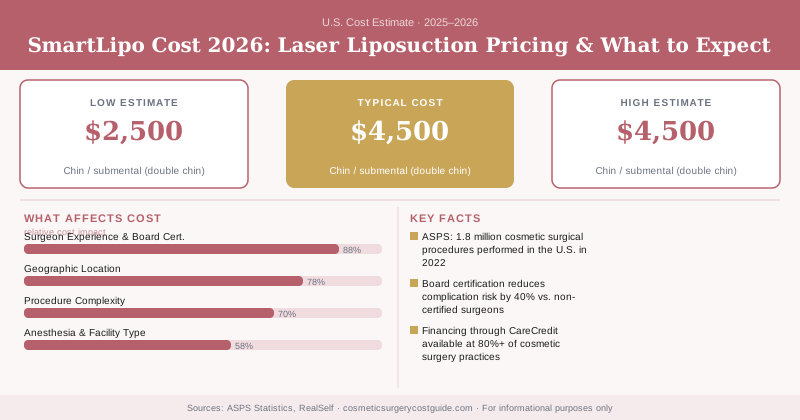
$3,200 for your chin. $4,500 for your abdomen. $6,000 for flanks and back. These are the quotes people get when they look into SmartLipo — and then the immediate follow-up question is whether the laser technology justifies paying more than traditional liposuction. The honest answer: sometimes yes, often no. It depends entirely on what you’re trying to achieve and where.
SmartLipo (manufactured by Cynosure) is a laser-assisted liposuction system. The laser fiber is threaded through a small cannula and melts fat before aspiration, while theoretically stimulating collagen contraction in the overlying skin. That skin-tightening claim is what separates SmartLipo’s marketing from traditional lipo — and also what most deserves scrutiny.
SmartLipo Cost by Treatment Area
| Treatment Area | SmartLipo Cost Range |
|---|---|
| Chin / submental (double chin) | $2,500–$4,500 |
| Arms (bilateral) | $3,500–$6,500 |
| Abdomen (upper or lower) | $3,500–$7,000 |
| Full abdomen | $4,500–$8,500 |
| Flanks / love handles | $3,000–$6,000 |
| Inner thighs | $3,000–$5,500 |
| Outer thighs | $3,000–$5,500 |
| Back / bra rolls | $3,500–$6,500 |
| Multiple areas (same session) | $7,000–$15,000 |
How SmartLipo Works
Traditional liposuction uses tumescent fluid and mechanical or ultrasound-assisted cannulas to loosen and aspirate fat. SmartLipo adds a laser component: a thin fiber (typically 1064nm, 1320nm, or dual-wavelength) is inserted first and delivers laser energy directly into the fat layer. This:
- Liquefies fat cells thermally (easier aspiration)
- Coagulates small blood vessels (less bruising than traditional lipo)
- Delivers heat to the undersurface of the skin (the claimed skin-tightening mechanism)
The procedure is typically performed under local anesthesia with oral sedation rather than general anesthesia, which is a genuine advantage for lower-risk patients — no anesthesiologist fee, shorter procedure time, faster recovery.
Does the Skin Tightening Actually Work?
This is the honest part. The thermal heating of the undersurface of the skin does stimulate some collagen remodeling, and clinical studies show SmartLipo produces modest skin contraction advantages over traditional lipo in the right candidates.
The American Society for Dermatologic Surgery published data showing laser-assisted lipo produced measurable improvement in skin laxity at 6 months compared to traditional techniques — but the effect was clinically significant mainly in patients with mild to moderate skin looseness, not severe laxity. For patients with significant loose skin after pregnancy or major weight loss, SmartLipo isn’t a replacement for a tummy tuck or arm lift.
Where SmartLipo genuinely excels: fibrous or dense fat areas (upper back, male flanks, previously treated areas), small areas under local anesthesia (chin, small arm areas), and patients with mild skin laxity who want modest skin tightening alongside fat removal.
SmartLipo’s advantages are real but specific: less bruising from vessel coagulation, local-anesthesia option for small areas, and modest skin contraction in patients with mild laxity. It does NOT replace a surgical lift for loose skin, does NOT remove more fat than traditional lipo, and does NOT produce dramatically different contouring results in most patients. The premium over traditional lipo ($1,000–$3,000 more per area) is best justified when skin tightening is a meaningful goal, when local anesthesia is preferred, or when treating dense fibrous fat. For simple fat reduction in a patient with good skin tone, traditional tumescent lipo often delivers equivalent results at lower cost.
SmartLipo vs. CoolSculpting
They’re frequently compared but are fundamentally different interventions. CoolSculpting is non-surgical fat freezing — no incisions, no anesthesia, no downtime, but limited fat reduction per session (typically 20–25% per treatment cycle). SmartLipo is a surgical procedure that removes fat in one session with more dramatic results.
For someone with a small, discrete fat pocket who wants zero downtime, CoolSculpting may be the right starting point. For someone ready for a surgical procedure and wants definitive results, SmartLipo or traditional liposuction delivers more.
Recovery After SmartLipo
Recovery is generally faster than traditional lipo, largely because the local anesthesia option reduces the physiological burden of the procedure. Typical timeline:
- Day 1: Soreness, some fluid discharge from incision sites (normal) — wear compression
- Days 2–5: Return to desk work for most patients, continued compression garment
- Week 2: Bruising fading, swelling still present
- Week 4–6: Compression transitioned out, most swelling resolved
- Month 3: Skin tightening results become visible as collagen matures
The ASPS reports that local-anesthesia liposuction procedures have a lower complication rate than those performed under general anesthesia, making SmartLipo’s option for awake procedures a legitimate safety consideration for smaller areas.
Finding the Right Provider
SmartLipo is a branded technology — not every provider offering “laser lipo” is using the same system. Ask specifically:
- What laser system do you use?
- Are you a board-certified plastic surgeon or dermatologist?
- Do you have before/after photos at 6 months showing skin tightening results?
- What wavelength settings do you use for my area?
Providers matter enormously for liposuction outcomes. A skilled surgeon with traditional lipo will typically outperform an inexperienced surgeon using SmartLipo — the technology amplifies good technique but doesn’t substitute for it.
SmartLipo and all laser-assisted lipo carry a specific risk traditional lipo does not: thermal burns to the skin or deeper structures if the laser fiber is held too close to the skin surface or operated at incorrect settings. These burns can cause permanent scarring. This risk is technique-dependent and rare with experienced operators — but it’s worth confirming your provider’s specific experience with laser systems, not just liposuction generally.
The Bottom Line
SmartLipo costs $2,500–$8,500 per area — typically $1,000–$3,000 more than traditional lipo in the same area. That premium is justified for the right patient: mild skin laxity, local anesthesia preference, dense fat areas, or small areas where the laser’s precision shines. For straightforward fat removal in a patient with good skin tone who’s comfortable under general anesthesia, traditional lipo or VASER often delivers equivalent results for less.
Frequently Asked Questions
SmartLipo typically costs $2,500–$8,500 per area, with common pricing around $3,200 for the chin, $4,500 for the abdomen, and $6,000 for flanks and back. The final cost depends on the size of the treatment zone, the amount of fat to be removed, and your surgeon's experience and location.
No, SmartLipo is considered a cosmetic procedure and is not covered by health insurance plans. You will pay the full out-of-pocket cost, though many surgeons offer financing options such as payment plans or medical credit cards to help spread payments over 6–24 months.
SmartLipo typically has a slightly faster recovery than traditional liposuction due to less tissue trauma from the laser technology, with most patients returning to light activity within 3–5 days and full activity within 2–3 weeks. However, final results take 2–3 months as swelling gradually subsides, similar to traditional lipo recovery timelines.