Stretch marks affect roughly 80% of Americans at some point in their lives — after pregnancy, rapid weight gain, puberty, or significant muscle building. Yet the treatment market is flooded with products that don’t work and procedures that might. Sorting the real options from the noise takes some digging, and the price range is enormous: from $15 drugstore creams to $5,000+ laser series. Here’s what’s actually worth your money.
The American Society of Plastic Surgeons reported in its 2020 statistics that skin procedures — including treatments targeting scarring and texture irregularities — accounted for over 1.8 million procedures annually in the U.S., making this one of the fastest-growing aesthetic categories. Stretch marks are classified as a form of dermal scarring, which is why they respond to scar-remodeling technologies.
Stretch Mark Treatment Cost by Method
| Treatment | Cost Per Session | Sessions Needed | Total Estimate |
|---|---|---|---|
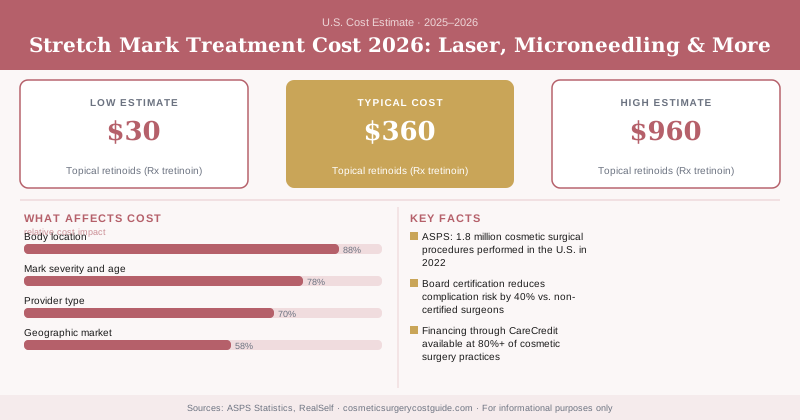
| Topical retinoids (Rx tretinoin) | $30–$80/month | Ongoing | $360–$960/year |
| Chemical peel (glycolic/TCA) | $150–$400 | 3–6 | $450–$2,400 |
| Microneedling (traditional) | $200–$700 | 3–6 | $600–$4,200 |
| RF microneedling (Morpheus8, Potenza) | $600–$1,500 | 3–4 | $1,800–$6,000 |
| Fractional laser (non-ablative) | $400–$1,200 | 4–6 | $1,600–$7,200 |
| CO2 fractional laser (ablative) | $800–$2,500 | 2–4 | $1,600–$10,000 |
| PRP (platelet-rich plasma) combined | $500–$1,200 add-on | — | Varies |
| Tummy tuck (surgical excision) | $6,000–$14,000 | 1 | $6,000–$14,000 |
Why Stretch Marks Are Hard to Treat
You need to understand what you’re dealing with before spending money. Stretch marks — striae distensae — are tears in the dermis (the middle skin layer), caused when skin stretches faster than collagen and elastin can accommodate. The dermis heals, but with disorganized scar tissue that lacks normal pigment and texture. That’s the pink/red phase (striae rubra). Once they fade to white or silver (striae alba), the blood supply has withdrawn and they’re significantly harder to treat.
Red, newer stretch marks respond meaningfully better to treatment than old white ones. If yours are still pink or purple, you have a better window — act sooner rather than later.
What Actually Works (Evidence-Based Ranking)
Most effective: Fractional CO2 laser and RF microneedling. Both create controlled micro-injuries that trigger collagen remodeling in the dermis — exactly where stretch marks live. A 2023 review in the Journal of Cosmetic Dermatology found RF microneedling produced measurable improvement in texture and pigment in 70–85% of patients with striae alba after 3–4 sessions.
Effective for newer marks: Traditional microneedling, non-ablative fractional laser (1540nm, 1927nm). These work through the same remodeling principle with less downtime and lower cost per session, but require more sessions.
Helpful but limited: Tretinoin (Retin-A) is genuinely evidence-backed for early red stretch marks — it stimulates collagen and can reduce severity if used consistently. Don’t expect miracles on white marks. OTC retinol is weaker but better than nothing.
Not worth it: Most “miracle stretch mark creams” (cocoa butter, vitamin E, bio-oil applied alone). Clinical evidence for these preventing or treating established stretch marks is minimal. They won’t hurt, but don’t expect transformation.
Red/purple stretch marks (striae rubra) are actively inflamed and have better blood supply — they respond meaningfully to multiple treatments, including topical tretinoin, vascular laser, and microneedling. White/silver marks (striae alba) have no blood supply and require dermis-remodeling technologies (CO2 laser, RF microneedling) to see improvement. Even with the best treatments, complete elimination is unrealistic for old white marks. Most patients see 40–70% improvement in texture and appearance, not 100% erasure.
What Affects the Cost
Body location: Stretch marks on the abdomen, thighs, and buttocks require large treatment areas, which increases both session time and cost. Treating an entire abdomen with CO2 laser costs more than treating a small patch on the hip.
Mark severity and age: Older, more extensive stretch marks need more sessions. A post-pregnancy abdomen with widespread striae alba requires a longer treatment course than isolated marks from a growth spurt.
Provider type: A board-certified dermatologist or plastic surgeon using medical-grade equipment charges more than a med spa tech using lower-powered devices. For laser treatments especially, provider credentials and equipment quality matter significantly for both results and safety.
Geographic market: New York, Los Angeles, Miami, and Chicago price 30–60% higher than mid-size cities for the same procedures.
The Surgical Option
If you have significant abdominal stretch marks concentrated below the navel — especially after pregnancy or major weight loss — a tummy tuck removes that skin entirely. It’s not a “stretch mark treatment” in the traditional sense, but it’s the only intervention that physically eliminates stretch marks rather than improving their appearance. The stretch marks go with the skin. This is why abdominoplasty is the most popular component of a mommy makeover for women with post-pregnancy abdominal changes.
Building a Realistic Treatment Plan
Don’t start with the most expensive option. A logical progression:
- Start with prescription tretinoin if marks are still red/pink — low cost, meaningful evidence
- Add traditional microneedling for texture improvement across larger areas
- Escalate to RF microneedling or fractional CO2 for stubborn or older marks
- Combine PRP with microneedling sessions if budget allows — some practices offer it as an add-on for enhanced results
Most patients see their best results with 3–6 sessions of an energy-based treatment spaced 4–6 weeks apart, followed by at-home maintenance with retinoids.
Stretch mark treatments on darker skin tones (Fitzpatrick types IV–VI) carry higher risk of post-inflammatory hyperpigmentation (PIH) with aggressive laser treatments. If you have medium to dark skin, prioritize RF microneedling over ablative CO2 laser — it has a significantly better safety profile for melanin-rich skin. Always confirm your provider has experience treating your skin tone and ask specifically about their PIH protocol before any energy-based treatment.
The Bottom Line
There’s no single-session cure for stretch marks, and any provider who tells you otherwise is overselling. But significant improvement — 50–80% reduction in visibility for most patients — is achievable with the right technology. Budget $1,500–$5,000 for a meaningful treatment course if you’re dealing with established white marks. Newer red marks cost less to treat and respond faster. Be realistic about goals: improvement, not perfection.
Frequently Asked Questions
Laser resurfacing for stretch marks typically costs $800–$2,500 per session, with most patients requiring 3–6 sessions spaced 4–8 weeks apart for optimal results. Total treatment costs usually range from $2,400–$15,000 depending on the size of the treated area and laser technology used (fractional CO2 or erbium lasers are most common).
Most insurance plans classify stretch mark removal as cosmetic and do not cover it, leaving patients responsible for 100% out-of-pocket costs. However, if stretch marks cause functional impairment or are treated as part of reconstructive surgery (such as after major weight loss), some plans may provide partial coverage—contact your insurer with medical documentation to inquire.
RF microneedling typically requires 4–6 sessions spaced 4–6 weeks apart, costing $300–$750 per session ($1,200–$4,500 total). Most patients see visible improvement in texture and color after 2–3 sessions, with continued collagen remodeling for up to 12 months post-treatment.