Most acne scar treatments work on the surface. TCA CROSS works from the inside out. At $200–$600 per session with results that typically require 3–6 visits, it’s one of the most cost-effective treatments for ice pick and deep boxcar scars — the ones that laser resurfacing and microneedling consistently underperform on. The procedure itself takes about 15 minutes. The chemistry is the interesting part.
CROSS stands for Chemical Reconstruction of Skin Scars. A high-concentration TCA solution (65–100%) is applied with a toothpick-like applicator directly into the base of each scar — not spread over the skin’s surface, but deposited precisely at the scar’s lowest point. The acid causes focal protein coagulation and controlled wound healing that stimulates collagen synthesis from the bottom up. The scar literally fills in as new collagen forms beneath it.
TCA CROSS Cost by Setting
| Provider Type | Cost Per Session | Typical Sessions Needed | Total Treatment Cost |
|---|---|---|---|
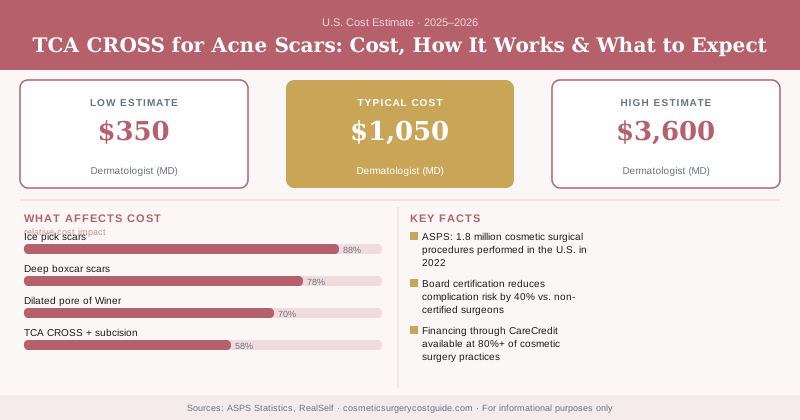
| Dermatologist (MD) | $350–$600 | 3–6 | $1,050–$3,600 |
| Cosmetic surgeon | $400–$700 | 3–6 | $1,200–$4,200 |
| Med spa (NP/PA) | $200–$400 | 4–6 | $800–$2,400 |
| Combined with other scar treatment | $150–$300 add-on | Varies | Varies |
Sessions are spaced 4–6 weeks apart to allow complete healing between treatments. Most patients see meaningful improvement after 2–3 sessions, with maximum results at 6 months post-final session.
What types of scars TCA CROSS actually treats
This matters more than people realize before booking. TCA CROSS is specifically indicated for:
- Ice pick scars: Narrow, deep, V-shaped pits — TCA CROSS is the gold standard treatment for these
- Deep boxcar scars: Square-edged depressions with steep walls — responds well to CROSS
- Dilated pore of Winer: A single large, deepened follicle opening — highly responsive
It is not indicated for:
- Rolling scars (broad, wave-like depressions) — these have tethered fibrous bands beneath them that require subcision, not acid
- Superficial scars — standard peels or microneedling are more appropriate
- Hypertrophic or raised scars — contraindicated, could worsen elevation
The American Academy of Dermatology notes that acne scarring affects approximately 20% of people with acne, and selecting the correct treatment modality for each scar type is the single most important factor in achieving results. Using TCA CROSS on rolling scars doesn’t work — using it on ice pick scars is one of the better-evidenced scar treatments available.
What the procedure involves
After cleansing, the provider identifies each scar under magnification or bright lighting. Using a fine applicator (often a wooden toothpick or a fine-tipped applicator), highly concentrated TCA (typically 65–100%) is applied into each individual scar — not onto the skin broadly. Each application is held for a few seconds until the area “frosts” (turns white) — that visual indicator confirms protein coagulation. Total treatment time for a cheek with 20–30 scars: 10–20 minutes.
The frosting resolves within minutes. Treated scars turn dark and crust over 3–7 days, then slough off naturally. The healing period produces fresh, pinkish skin at the base of each scar that gradually normalizes over 4–6 weeks.
TCA CROSS pairs well with complementary scar modalities, especially when scars are mixed types. A common combination protocol:
- TCA CROSS + subcision: For patients with both ice pick scars (CROSS) and rolling scars (subcision releases fibrous tethering beneath the surface)
- TCA CROSS + Morpheus8 or RF microneedling: After a series of CROSS sessions, RF microneedling helps with residual surface texture, enlarged pores, and mild post-inflammatory discoloration
- TCA CROSS + CO2 laser: Best reserved for after CROSS series is complete; laser resurfacing addresses surface texture that CROSS doesn’t target
Dermatologists who specialize in acne scarring often build a customized multi-modality plan based on your specific scar types — ask to have each scar photographed and classified at your consultation.
Downtime and what to expect
- Day 1–2: Redness, mild swelling, slight stinging in treated areas
- Days 2–7: Dark crusting at each treated scar — do not pick or scrub
- Week 2: Crusts slough naturally, leaving pink new skin
- Weeks 2–6: Pink fades, collagen synthesis occurs beneath the surface
- Results visible: 4–6 weeks per session; cumulative improvement over the full series
You’re not “bruised” in the traditional sense — the dark crusts are small and localized to each scar point, not a broad treatment area. Most patients return to work within 2–3 days with minimal visible signs.
Sun protection is mandatory. Newly treated areas are highly susceptible to post-inflammatory hyperpigmentation (PIH) if exposed to UV — SPF 30+ daily for 4–6 weeks post-session is non-negotiable.
TCA CROSS uses very high acid concentrations — 65–100% TCA. At that strength, application technique matters enormously. Over-application or spillover onto surrounding skin causes unwanted skin damage and potential scarring. This is not a DIY procedure and should not be attempted with online-purchased TCA kits. At-home kits typically use 15–30% concentration (effective for general peeling) and cannot replicate the focal, high-concentration application technique used clinically. Attempting it at home can cause chemical burns and worsen scarring.
TCA CROSS vs. laser resurfacing for acne scars
Ablative CO2 and Erbium lasers are excellent for surface-level texture, shallow scars, and overall skin quality — but they’re limited in how deep they can safely go in a single pass. Ice pick scars often extend deeper than lasers can effectively treat without risking collagen destruction at depth.
TCA CROSS works at the exact depth of the scar’s base. For ice pick and deep boxcar scars, the clinical evidence favors CROSS over laser as the primary treatment. Lasers work better as an adjunct after CROSS has elevated the scar base closer to the skin surface. The most effective treatment plans use both — CROSS first, laser after.
Bottom Line
TCA CROSS costs $200–$600 per session, and a full series of 3–6 sessions totals $800–$3,600 depending on your provider and scar severity. It’s one of the most cost-effective treatments specifically for ice pick and deep boxcar acne scars — the scar types that standard resurfacing consistently underdelivers on. Get a consultation with a dermatologist who specializes in acne scarring, have your scars classified by type before any treatment is recommended, and build a multi-modality plan if your scars are mixed. Results take time and patience — plan for 6+ months of the full treatment course before evaluating final outcomes.
Frequently Asked Questions
TCA CROSS costs $200–$600 per session, and most patients require 3–6 sessions to see optimal results, bringing total treatment costs to $600–$3,600. Individual session pricing depends on the number and depth of scars being treated and your provider's location and experience.
Most insurance plans do not cover TCA CROSS because it is considered a cosmetic procedure rather than medically necessary treatment. You should expect to pay the full cost out-of-pocket, though some dermatology offices offer payment plans or financing options to help spread costs across multiple sessions.
Most patients need 3–6 sessions spaced 4–6 weeks apart to achieve noticeable improvement in ice pick and boxcar scars. Recovery typically involves mild redness and swelling for 2–5 days after each 15-minute procedure, with most patients able to return to normal activities within a week.