Thread lifts shot to popularity as a “lunchtime facelift” — a no-surgery, minimal-downtime way to get a lifted look. The reality is more nuanced. They work. They have real limits. And the cost calculation looks very different from a surgical lift when you factor in how long results actually last.
The American Board of Cosmetic Surgery notes that thread lifts are best suited for patients with mild to moderate tissue laxity — typically in their late 30s to early 50s — who want a modest, natural correction without surgery. If your expectations match that description, the pricing below gives you a clear picture of what you’re comparing.
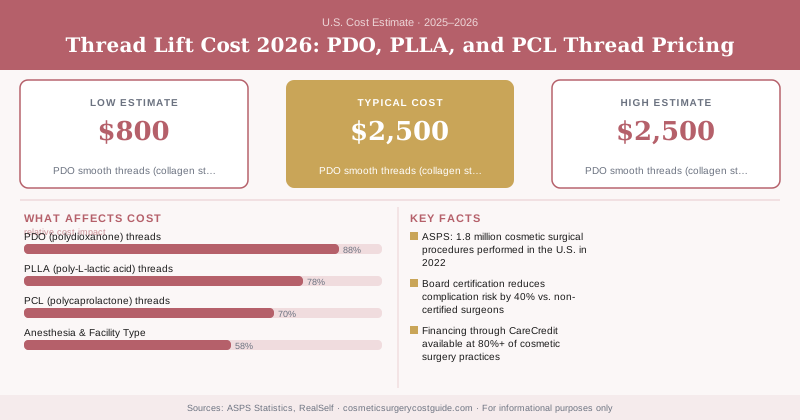
Thread Lift Cost by Type and Area
| Thread Type / Area | Cost Range |
|---|---|
| PDO smooth threads (collagen stimulation) | $800–$2,500 |
| PDO barbed threads — full face | $1,500–$4,000 |
| PDO threads — midface / cheeks only | $1,000–$2,800 |
| PDO threads — neck and jawline | $1,200–$3,000 |
| PLLA (Sculptra-type) threads | $2,000–$5,500 |
| PCL threads (longer-lasting) | $2,500–$6,000 |
| Combination PDO + smooth threads | $2,000–$4,500 |
Understanding the Thread Types
PDO (polydioxanone) threads: The most common type. Fully absorbed by the body within 6 months. They work through two mechanisms: immediate mechanical lifting via barbed threads that grip tissue, and collagen stimulation as the threads dissolve. The lift effect from barbed PDO typically lasts 12–18 months. Smooth PDO threads placed in a grid pattern stimulate collagen and improve skin texture without significant lifting.
PLLA (poly-L-lactic acid) threads: Stimulate significantly more collagen production than PDO. Results can last 18–24 months. Higher upfront cost, but better longevity.
PCL (polycaprolactone) threads: The newest generation. Absorbed more slowly (24–36 months) and may produce the longest-lasting results of the three types. Cost reflects the newer technology.
What’s Included in the Price
Thread lift pricing is typically all-inclusive for a single session — the procedure is done in-office, under topical or local anesthesia, by a plastic surgeon, dermatologist, or trained aesthetic provider. Costs generally include:
- Provider fee
- Thread materials
- Local anesthesia or numbing cream
- Aftercare instructions
There’s no facility fee, no anesthesiologist cost, and no hospital involvement. The simplicity of the setting is part of what makes thread lifts more affordable than surgery. Recovery is minimal: most patients return to normal activity within 1–3 days, with bruising and swelling typically resolving in 5–7 days.
Thread Lift vs. Surgical Facelift: The Real Comparison
Here’s the honest math that most providers don’t spell out clearly.
A thread lift at $3,000 sounds dramatically cheaper than a facelift at $15,000. But thread lift results typically last 1–2 years. A surgical facelift can last 7–12 years or more. Repeat thread lifts every 18 months over a 10-year period cost $15,000–$20,000+ — more than a surgical lift, with less dramatic and less durable results.
Thread lifts are genuinely useful for patients who: have mild tissue laxity (not significant sagging), want a subtle refreshed look without downtime, are in their late 30s to early 50s, or want to delay surgical intervention. They’re not the right tool for patients with significant jowling, heavy neck laxity, or those seeking dramatic transformation. A thread lift on someone who actually needs a facelift typically produces a disappointing result and money that doesn’t go toward the surgery they ultimately need. An honest provider will tell you which category you’re in.
Provider Matters Enormously
Thread lifts are performed by a wide range of providers — from board-certified plastic surgeons to nurse practitioners at med spas. The price range reflects this spread. A $1,500 thread lift at a med spa and a $4,000 thread lift with a facial plastic surgeon involve very different levels of anatomical training, thread quality, and technique.
Risks of thread lifts — dimpling, thread visibility, asymmetry, infection, migration — are significantly more common with less experienced providers. The ASAPS has noted that thread-related complications have risen in proportion to the procedure’s popularity, driven largely by undertrained practitioners using budget thread materials.
Questions to ask any provider:
- What thread brand and gauge do you use?
- How many thread lift procedures have you performed?
- What’s your complication protocol if I develop dimpling or thread visibility?
- Can I see before/after photos of patients at 12 months (not just 1–2 weeks)?
Recovery and Aftercare
Thread lift recovery is genuinely minimal compared to surgery. Most patients:
- Return to desk work within 1–2 days
- See bruising and swelling resolve within 5–7 days
- Can resume exercise at 2 weeks
- Notice optimal results at 4–8 weeks as inflammation resolves and collagen builds
Avoid aggressive facial massage, sleeping face-down, and wide mouth movements (yawning, dental cleanings) for 2–4 weeks to avoid thread displacement.
Thread lifts placed incorrectly or with poor technique can cause permanent dimpling, visible thread tracks under the skin, or asymmetry that’s difficult to correct. If you’re considering a thread lift, prioritize the provider’s specific experience with this procedure over pricing. Ask about their protocol for managing complications — a provider who dismisses complication questions is a red flag.
The Bottom Line on Thread Lift Cost
For the right patient — mild laxity, realistic expectations, good skin quality — a thread lift delivers real and visible improvement at a fraction of surgical cost, with essentially no downtime. For the wrong patient, it’s an expensive disappointment. The consultation is where that distinction gets made. Go in knowing both what the procedure can achieve and what it can’t.
Frequently Asked Questions
Thread lift costs range from $1,500 to $5,500 depending on the thread type (PDO, PLLA, or PCL) and the number of treatment areas. PDO threads are typically the most affordable option at $1,500–$2,500, while PLLA and PCL threads cost $2,500–$5,500 due to their longer-lasting results.
Thread lifts are considered cosmetic procedures and are not covered by health insurance plans, including Medicare and Medicaid. Patients should expect to pay the full cost out-of-pocket, though some providers offer financing options or payment plans to help manage the expense.
PDO threads dissolve within 6–12 months, while PLLA and PCL threads last 12–24 months or longer. Because results fade gradually, many patients schedule follow-up treatments annually or every 18–24 months to maintain the lifted appearance, making the total cost over time significantly higher than a one-time surgical facelift.