In 2023, blepharoplasty was the second most performed cosmetic surgical procedure in the United States, with more than 175,000 procedures completed — according to the American Society of Plastic Surgeons (ASPS) annual report. Of those, upper eyelid procedures account for the significant majority. There’s a reason for that: the upper eyelids age faster than almost anywhere else on the face, and the impact of correcting them is enormous relative to the procedure’s simplicity.
If you’re noticing heavy lids, excess skin that touches your lashes, or a tired look that makeup can’t fix, here’s what upper blepharoplasty actually costs — and what you’re paying for.
Upper Blepharoplasty Cost in 2025–2026
| Component | Cost Range | Notes |
|---|---|---|
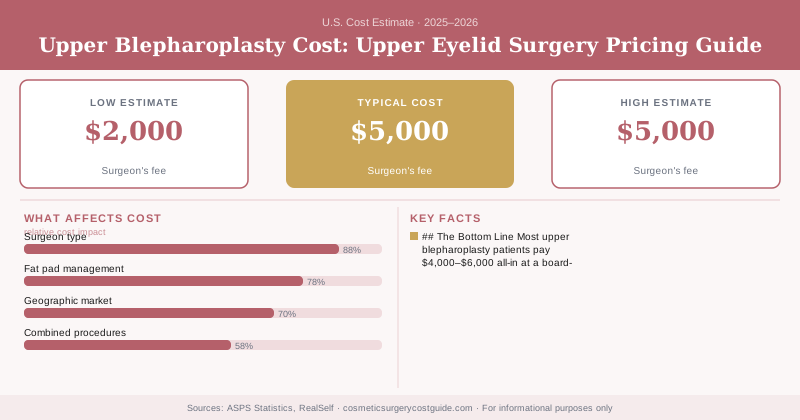
| Surgeon’s fee | $2,000–$5,000 | Bilateral (both upper lids) |
| Anesthesia | $500–$1,200 | Local with sedation; general rare for upper only |
| Facility fee | $600–$1,500 | ASC or office-based OR |
| Total all-in | $3,000–$7,500 | Most patients pay $4,000–$6,000 |
Bilateral means both upper lids — which is the standard. Unilateral (one lid) correction for asymmetry runs approximately 60–70% of bilateral pricing since anesthesia and facility costs are fixed regardless.
Cosmetic vs. Functional: The Insurance Question
This is the most important variable in upper eyelid surgery costs. If your drooping upper eyelid skin is obstructing your vision — impairing your superior visual field — the procedure may be medically necessary and at least partially covered by health insurance.
To qualify for insurance coverage, you typically need:
- A visual field test performed by an ophthalmologist or optometrist demonstrating superior field loss
- Photographs documenting lid overhang touching or approaching the lashes
- A physician referral or documented medical indication
If you qualify, insurance typically covers the functional component — meaning the excess skin removal that restores vision. Any cosmetic refinement (muscle work, fat pad removal, extended incision for aesthetic contouring beyond what’s medically required) remains an out-of-pocket cost.
Patients who qualify for medical coverage often pay $500–$1,500 out-of-pocket after insurance, compared to $3,000–$7,500 for purely cosmetic cases.
These are two different procedures often confused with each other. Upper blepharoplasty removes excess skin and sometimes fat from the upper eyelid. Ptosis repair corrects a drooping muscle — the levator muscle — when the lid margin itself sits too low. Many patients have both conditions simultaneously: excess skin (blepharoplasty) AND a weak levator muscle (ptosis). If you’re told you have ptosis, ptosis repair costs are separate and can be combined with blepharoplasty in the same surgical session.
What Drives the Price Range
Surgeon type: Oculoplastic surgeons (ophthalmologists who subspecialized in eyelid surgery) are often considered the gold standard for upper blepharoplasty. Board-certified plastic surgeons with facial subspecialty training are equally well-qualified. Non-specialty cosmetic surgeons performing eyelid surgery tend to charge less — but the eye is the last place to compromise on credentials. Oculoplastic and facial plastic surgeons typically charge $2,500–$5,000 in surgeon fees; general cosmetic surgeons may charge $1,500–$3,000.
Fat pad management: Simple skin excision is the most conservative approach. More comprehensive upper blepharoplasty includes removing or repositioning the medial and central fat pads that cause upper lid hollowing or puffiness. Fat pad work adds $500–$1,000 to surgical time.
Geographic market: Beverly Hills and New York oculoplastic surgeons routinely charge $5,000–$7,500 all-in for upper blepharoplasty alone. Chicago, Dallas, and Atlanta markets average $3,500–$5,500 for equivalent work. Smaller markets in the Midwest and Southeast often run $3,000–$4,500.
Combined procedures: Upper blepharoplasty is frequently combined with lower eyelid surgery, a brow lift, or facelift. Combined cases save on anesthesia and facility time — upper + lower blepharoplasty combined typically runs $5,500–$9,000, compared to $3,000–$7,500 + $4,000–$7,000 if done separately.
What the Surgery Involves
Upper blepharoplasty is performed under local anesthesia with or without oral or IV sedation — you don’t need to be completely out for this procedure, and most patients prefer not to be.
The incision is placed precisely in the natural upper eyelid crease. Through that incision, the surgeon removes a measured amount of excess skin, excises or repositions fat if needed, and closes with very fine sutures. The scar lies entirely within the crease — invisible when the eye is open, barely visible with the eye closed.
Operative time is typically 45–90 minutes for bilateral upper lids.
Recovery Timeline
Upper blepharoplasty recovery is shorter than most facial procedures:
- Days 1–3: Significant bruising and swelling, eyes may feel tight; cold compresses and head elevation
- Days 5–7: Sutures removed; most bruising has peaked and begins fading
- Week 2: Presentable for social situations with light makeup
- Week 4–6: Swelling largely resolved; incision fading to thin pink line
- Month 3–6: Final result established; scar nearly imperceptible
Most patients take 7–10 days off work. You can’t wear contact lenses for 2 weeks.
Upper blepharoplasty results are long-lasting — typically 8–15 years before re-operation might be considered, and many patients never need a repeat procedure. The surgery removes actual skin; it doesn’t just tighten it. That excess skin won’t return quickly. What can change over time is continued brow descent (which pushes new skin downward onto the lid) — which is why some patients combine their blepharoplasty with a brow lift to address both anatomical layers simultaneously.
Alternatives Worth Considering
Non-surgical options: Plasma pen skin tightening and [radiofrequency](/ guides/skin-tightening-radiofrequency-cost/) devices can improve very mild upper lid laxity. These are best for patients with minimal excess skin who want a maintenance treatment. They don’t address significant hooding or true dermatochalasis (excess skin). Budget $500–$2,000 per session.
BOTOX for brow lift: Strategic Botox placed under the brow tail can elevate the lateral brow 1–3mm, creating a subtle lid-opening effect. This helps patients whose heavy lids are driven primarily by brow descent rather than excess lid skin. Useful for mild cases; costs $300–$600 and lasts 3–4 months.
Neither of these replaces surgical blepharoplasty for moderate to significant hooding.
Upper blepharoplasty is not a high-risk procedure in experienced hands, but complications do occur: dry eye exacerbation, asymmetric skin removal, lagophthalmos (inability to fully close the eyes), and in rare cases, temporary or permanent changes in vision. These risks are minimized by choosing a surgeon with specific, documented eyelid surgery experience — not just general surgical credentials. Ask your surgeon how many upper blepharoplasties they perform annually and request to see before/after photos of their own patients, not stock images.
The Bottom Line
Most upper blepharoplasty patients pay $4,000–$6,000 all-in at a board-certified oculoplastic or facial plastic surgeon. Check whether your case qualifies for insurance coverage first — it’s worth an ophthalmology consultation if your lids are significantly obstructing your vision. If it’s a purely cosmetic case, budget realistically, verify credentials carefully, and don’t cut corners on a procedure that’s this close to your eyes.
Frequently Asked Questions
Upper blepharoplasty typically costs between $3,000 and $7,500, depending on surgeon experience, geographic location, and facility fees. Board-certified plastic surgeons in major metropolitan areas generally charge $5,000–$7,500, while costs in less urban areas may range $3,000–$5,000. This price typically includes the surgeon's fee, anesthesia, and facility costs but excludes pre-operative testing or post-operative medications.
Insurance may cover upper blepharoplasty if it is deemed medically necessary—such as when drooping eyelids (ptosis) obstruct vision—rather than purely cosmetic. Patients with functional upper eyelid surgery typically pay $500–$2,000 out-of-pocket after insurance, though this varies by plan and deductible. Purely cosmetic upper blepharoplasty is never covered by insurance and remains an out-of-pocket expense.
Most patients can return to light activities and work within 7–10 days, though complete healing and final results take 4–6 weeks. Swelling and bruising peak within the first 3–5 days and gradually subside over 2–3 weeks; wearing dark sunglasses during this time helps conceal visible signs. Strenuous exercise, heavy lifting, and swimming should be avoided for at least 3 weeks post-surgery.