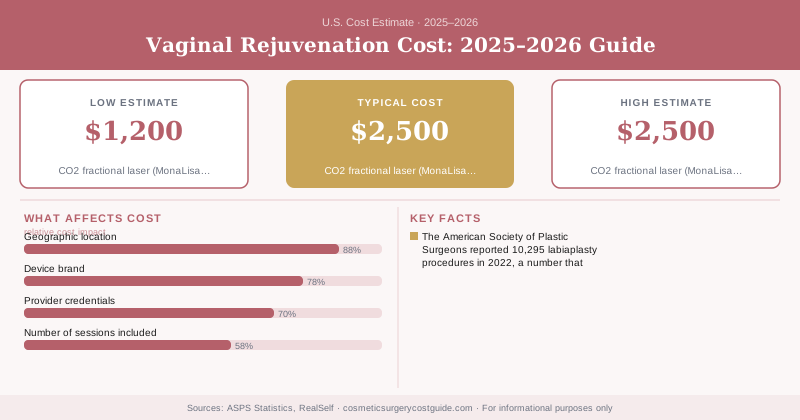
“Vaginal rejuvenation” is one of the fastest-growing categories in women’s aesthetics — and one of the most confusing to price-shop. The term covers everything from a $1,200 laser treatment done in a gynecologist’s office to a $7,000 surgical labiaplasty. They’re not remotely the same thing. Knowing which procedure matches your concern is the first step to understanding what you’ll actually spend.
The American Society of Plastic Surgeons reported 10,295 labiaplasty procedures in 2022, a number that has grown more than 200% over the prior decade. Non-surgical options — laser and radiofrequency treatments — add tens of thousands more procedures annually that ASPS data doesn’t capture because they’re performed by gynecologists, urogynecologists, and dermatologists.
Cost by procedure type
| Procedure | What It Addresses | Typical Cost |
|---|---|---|
| CO2 fractional laser (MonaLisa Touch, FemTouch) | Vaginal dryness, laxity, mild incontinence | $1,200–$2,500/session |
| Radiofrequency (ThermiVa, Votiva) | Laxity, dryness, mild incontinence | $1,000–$2,000/session |
| PRP (O-Shot) | Sexual function, dryness | $800–$1,800/session |
| Labiaplasty | Labial size/symmetry (surgical) | $3,500–$7,000 |
| Vaginoplasty | Vaginal tightening (surgical) | $4,000–$9,000 |
| Clitoral hood reduction | Cosmetic and functional | $2,500–$5,500 |
| Full surgical rejuvenation | Combination surgical procedures | $6,000–$15,000 |
Non-surgical laser and RF treatments are typically priced per session, with full protocols requiring 3 sessions. That means total costs of $3,000–$7,500 for a complete course.
Non-surgical options: what they actually do
CO2 fractional laser (MonaLisa Touch, FemTouch, DiVaTyte) uses heat energy to stimulate collagen production in vaginal tissue. It’s FDA-cleared for vaginal health and is most commonly used by women experiencing genitourinary syndrome of menopause (GSM) — dryness, discomfort during intercourse, and urinary symptoms. Three sessions spaced 6 weeks apart is the standard protocol.
Radiofrequency devices (ThermiVa, Votiva, Forma V) work similarly but use RF energy rather than laser. Some patients find RF more comfortable. Results are comparable.
Neither non-surgical option creates dramatic tightening. They improve tissue health, moisture, and mild laxity. Women expecting “surgical-level tightening” from a laser treatment are going to be disappointed.
Non-surgical vaginal rejuvenation is cosmetic and not covered by insurance when performed for aesthetic reasons.
Exception: Some insurance plans cover laser or RF treatment for genitourinary syndrome of menopause (GSM) when prescribed by a gynecologist and coded as a medical condition rather than a cosmetic procedure. If you have documented vaginal atrophy symptoms related to menopause, ask your gynecologist about billing through insurance before paying out of pocket at a med-spa.
Surgical labiaplasty is also not covered when performed purely cosmetically, but functional labiaplasty (for labial hypertrophy causing pain, irritation, or interference with activity) may have partial coverage depending on your plan.
Surgical vs. non-surgical: how to choose
The decision depends entirely on what you’re trying to address:
Choose non-surgical if:
- Your primary concern is vaginal dryness, discomfort during intercourse, or mild urinary leakage related to menopause or childbirth
- You want improvement without downtime
- You’re not concerned with external appearance changes
Choose surgical if:
- Your concern is labial size, asymmetry, or excess tissue (labiaplasty is the only effective option)
- You want vaginal tightening for functional or sexual reasons (vaginoplasty)
- You’ve had non-surgical treatments without sufficient results
What the recovery looks like
Non-surgical: No downtime. You may experience mild sensitivity for 24–48 hours. Most patients return to all activities, including intercourse, within 3–5 days.
Labiaplasty: 1–2 weeks of significant discomfort. Most patients take at least one week off work. No intercourse for 6–8 weeks. Swelling and bruising for 2–4 weeks. Final results visible at 3–6 months.
Vaginoplasty: 2–3 weeks recovery. No intercourse for 6–8 weeks. Like labiaplasty, final results take months to fully appear.
The FDA has issued warnings about some vaginal rejuvenation devices marketed with aggressive efficacy claims. Specifically, devices claiming to “rejuvenate” or “tighten” vaginal tissue for cosmetic purposes without peer-reviewed data drew scrutiny in 2018. Established devices with legitimate clinical data (MonaLisa Touch, ThermiVa) are well-studied. Be cautious of newer devices at bargain prices with minimal published research. Ask your provider what device they use and request to see published clinical studies on it.
Finding the right provider
Non-surgical vaginal rejuvenation can be performed at med-spas, but for this area specifically, a board-certified gynecologist, urogynecologist, or plastic surgeon with documented training in the procedure is strongly preferred. This isn’t a facial — anatomy is complex and proximity to sensitive structures demands real expertise.
For surgical procedures, only a board-certified plastic surgeon or gynecologic surgeon with specific training in genitourinary aesthetics should perform labiaplasty or vaginoplasty. Ask how many procedures they perform annually. A surgeon doing fewer than 20 per year is not a specialist in this area.
Cost factors that shift the price
- Geographic location: Coastal metro practices charge 40–60% more than Midwest or Southern practices for equivalent treatments
- Device brand: Some newer RF devices command a premium over established platforms
- Provider credentials: Gynecologists and plastic surgeons charge more than nurse practitioners or estheticians — and for this procedure, that premium is justified
- Number of sessions included: Some practices quote per session; others price the full 3-session protocol as a package (usually better value)
Frequently Asked Questions
Vaginal rejuvenation costs between $1,000 and $5,000 for non-surgical laser or radiofrequency treatments, while surgical procedures like labiaplasty typically range from $3,000 to $7,000. The final cost depends on the specific procedure type, surgeon experience, and geographic location, with major metropolitan areas generally charging 20–40% more than regional centers.
Most insurance plans classify vaginal rejuvenation as a cosmetic procedure and do not cover it, leaving patients responsible for the full out-of-pocket cost. However, if the procedure addresses a functional medical concern (such as labial hypertrophy causing discomfort), some insurers may cover partial costs—typically requiring pre-authorization and documentation from your physician.
Non-surgical laser and RF treatments typically have minimal downtime, with patients returning to normal activities within 2–3 days and avoiding sexual activity for 1–2 weeks. Surgical procedures like labiaplasty require 2–3 weeks of restricted activity and 4–6 weeks before resuming exercise and intercourse.