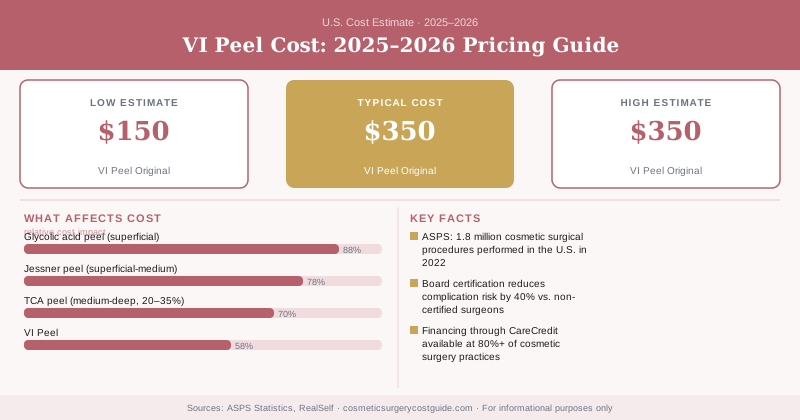
$350 for skin that looks genuinely refreshed — smoother, brighter, with noticeably less pigmentation — in about a week. That’s the VI Peel’s value proposition, and for a lot of patients, it delivers. This medium-depth chemical peel has become one of the most popular in-office treatments at dermatology and plastic surgery practices, partly because it works across skin tones and partly because the downtime is predictable and manageable.
Here’s what it actually costs, what the different formulas do, and whether it’s worth it compared to other peeling options.
VI Peel cost by formula
| VI Peel Formula | Target Concern | Typical Cost |
|---|---|---|
| VI Peel Original | General skin rejuvenation, tone, texture | $150–$350 |
| VI Peel Precision | Active acne, oily skin, breakout-prone | $175–$375 |
| VI Peel Precision Plus | Hyperpigmentation, melasma, sun damage | $200–$450 |
| VI Peel Body Treatment | Arms, chest, décolletage, back | $250–$500 |
| VI Peel Advanced | Anti-aging, mature skin, deep wrinkles | $200–$450 |
| VI Peel with Booster | Enhanced brightening, stubborn pigment | $250–$500 |
| Series of 3 treatments (package) | Any formula, spaced 4–6 weeks | $450–$1,200 |
Prices vary significantly by location — a VI Peel in New York or Beverly Hills costs more than the same treatment in Nashville or Omaha. Provider type also matters: plastic surgeon offices typically charge the high end; med spas and solo esthetician practices often fall at the lower end.
What’s in a VI Peel?
VI Peel is a medium-depth chemical peel containing five active acids: trichloroacetic acid (TCA), salicylic acid, phenol, retinoic acid, and vitamin C. The combination gives it efficacy across multiple concerns simultaneously — pigmentation, texture, fine lines — without requiring the deep peel protocols (like full phenol peels) that carry higher risk and longer recovery.
It’s safe for all Fitzpatrick skin types (I–VI), which is a meaningful differentiator. Many chemical peels, particularly those with higher TCA concentrations, carry real risk of post-inflammatory hyperpigmentation on darker skin tones. VI Peel’s formulation is specifically designed to minimize that risk.
The peeling process: what actually happens
The peel is applied in-office in about 20–30 minutes. You leave with it on and wash it off 4–6 hours later at home. The visible peeling typically begins on day 2 or 3 and lasts through day 5–7. Some people peel dramatically (large sheets of skin); others peel subtly (fine flaking). Both are normal — the peeling you see doesn’t determine how well the peel worked at depth.
During the peel week: no active exfoliation, no retinol, no direct sun exposure. After: SPF 30+ daily for at least 4 weeks.
One treatment produces noticeable improvement in skin tone and texture. For stubborn hyperpigmentation or melasma, most providers recommend a series of 3 treatments spaced 4–6 weeks apart. For anti-aging maintenance, many patients do 2–3 treatments per year. Precision Plus (the hyperpigmentation formula) is the one most likely to require a series for full results.
VI Peel vs. other chemical peels
Glycolic acid peel (superficial): $75–$200. Targets surface layer only. Gentler, less downtime, but less transformative. Good for mild maintenance.
Jessner peel (superficial-medium): $100–$300. Good for oily/acne-prone skin. Less depth than VI Peel.
TCA peel (medium-deep, 20–35%): $150–$600. Stronger pigmentation correction, longer downtime (7–14 days), higher risk on darker skin tones.
VI Peel: Sits in the medium category with a formulation that works across skin types and concerns, predictable 5–7 day downtime, and multiple targeted formulas.
CO2 laser resurfacing (for comparison): $1,000–$5,000. Dramatically more powerful but 7–14+ days downtime, much higher cost, and not appropriate for darker skin tones.
For most patients wanting meaningful skin improvement without the cost and recovery of a laser, VI Peel represents a strong middle ground.
A 2023 survey note on chemical peels
According to the ASPS 2023 statistics, chemical peels remain among the top five minimally invasive cosmetic procedures performed in the US, with over 1.3 million treatments annually. Medium-depth peels like VI Peel have grown specifically because they address the demand for visible results without surgical recovery.
Avoid at-home “VI Peel” kits sold online — they’re either counterfeit or contain significantly diluted formulas. The authentic VI Peel protocol requires a licensed provider. The phenol component in particular requires professional assessment before application. Applying high-concentration phenol incorrectly can cause cardiac arrhythmia; in clinical settings, this is managed by applying the product slowly and monitoring the patient.
Who shouldn’t get a VI Peel
- Pregnant or nursing women
- Active cold sores (herpes simplex) — peel can trigger an outbreak; antiviral pre-treatment required
- Active inflammatory acne lesions over large areas
- Recent Accutane use (typically wait 6–12 months)
- Allergy to aspirin (salicylic acid component)
Where to get it
VI Peel is exclusively available through licensed professional accounts — it’s not sold to the public. Dermatology practices, plastic surgeon offices, and med spas are all appropriate settings. Verify your provider is trained specifically on VI Peel protocols (VI Aesthetics offers training certification).
Bottom line
At $150–$450 per treatment, the VI Peel is one of the more affordable medium-depth peeling options with strong clinical backing and a formulation designed to be safe across skin tones. It’s not a replacement for laser resurfacing if your concerns are deep or severe, but for most patients dealing with uneven tone, mild-moderate hyperpigmentation, or overall dullness, it’s a cost-effective, well-tolerated choice.
Frequently Asked Questions
A single VI Peel treatment typically costs between $150 and $700, with most patients paying around $350 for the standard formula. The final price depends on the specific VI Peel type (original, Radiance, Royal, or Precision Plus), the treatment area size, and your provider's location and experience level.
No, VI Peels are considered cosmetic procedures and are not covered by health insurance plans, including Medicare and Medicaid. You will be responsible for the full out-of-pocket cost, though some dermatology and plastic surgery offices offer financing plans or package discounts if you purchase multiple treatments.
VI Peel has minimal downtime compared to deeper peels—most patients experience mild redness and peeling for 3 to 7 days. Visible results typically appear within one week, with skin looking noticeably smoother, brighter, and more even in tone, and improvements continuing over the following weeks as skin fully heals.