You’ve had Botox. Fillers. Maybe a peel or two. But the skin texture issue — the subtle roughness, the pore size, the way your skin just doesn’t catch light the way it used to — that’s not a volume problem. It’s a collagen problem. And RF microneedling is where a lot of patients end up next.
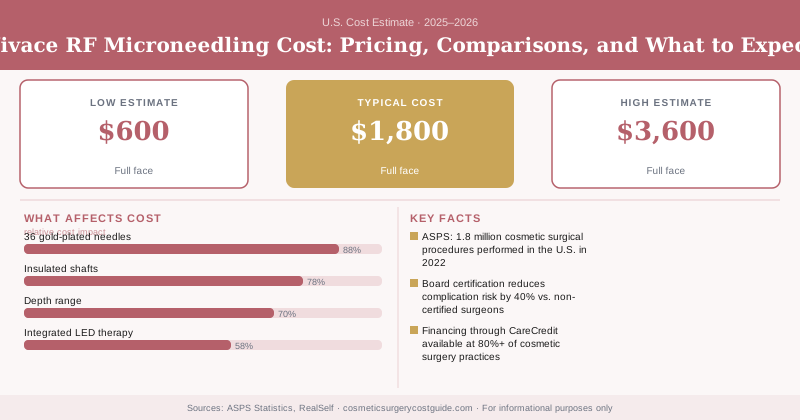
Vivace is one specific RF microneedling system, made by Aesthetics Biomedical, that differentiates itself through precision engineering and an integrated LED component. At $600–$1,200 per full-face session, it sits roughly in the middle of the RF microneedling market — less expensive than Morpheus8, comparable to Secret RF, and more than standard microneedling without RF. Whether that positioning is justified depends entirely on what you’re trying to treat.
The American Board of Cosmetic Surgery notes that RF microneedling procedures have grown steadily in demand as patients seek treatments with less downtime than ablative lasers but more significant results than surface-level options.
Vivace Pricing by Treatment Area
| Treatment Area | Cost Per Session | Sessions Typically Needed | Total Estimate |
|---|---|---|---|
| Full face | $600–$1,200 | 3 | $1,800–$3,600 |
| Face + neck | $900–$1,600 | 3 | $2,700–$4,800 |
| Neck only | $400–$800 | 3 | $1,200–$2,400 |
| Acne scar treatment | $700–$1,200 | 3–6 | $2,100–$7,200 |
| Forehead/jawline (targeted) | $300–$600 | 2–3 | $600–$1,800 |
| Décolletage | $400–$700 | 3 | $1,200–$2,100 |
These figures reflect typical US pricing. Major metro areas (NYC, LA, Miami) run toward the upper end. Suburban practices and Med spas in secondary markets are often 15–25% lower. Practices that perform the procedure exclusively under physician supervision may charge a premium, but the consistency of results typically justifies it.
How Vivace Works: The Technology Difference
Standard microneedling creates micro-channels in the skin that trigger a wound-healing response — collagen production follows. Add RF energy through those needles, and you’re also heating the dermis directly, which causes collagen fibers to contract and remodel. That combination is what RF microneedling devices, including Vivace, use.
What makes Vivace distinct:
- 36 gold-plated needles (vs. 24 for Morpheus8) — more contact points per pass, which some practitioners argue delivers more even energy distribution
- Insulated shafts — RF energy delivers exclusively at the tip, not along the needle shaft, reducing epidermal heating and post-treatment inflammation
- Depth range: 0.5mm to 3.5mm — appropriate for dermal targeting without reaching subdermal fat
- Integrated LED therapy: Red light (anti-inflammatory, promotes healing) and blue light (antibacterial, useful for acne-prone patients) delivered simultaneously with or after treatment
The LED component is worth calling out because it’s unusual in the RF microneedling space. It’s not a dramatic clinical differentiator on its own, but it does reduce immediate post-treatment redness and supports faster recovery.
Vivace vs. Competing RF Microneedling Devices
| Device | Manufacturer | Needle Depth | Needles | Built-in Features | Cost/Session |
|---|---|---|---|---|---|
| Vivace | Aesthetics Biomedical | 0.5–3.5mm | 36 gold-plated | LED therapy | $600–$1,200 |
| Morpheus8 | InMode | 1–8mm | 24 gold-tipped | Body applicator available | $800–$1,500 |
| Secret RF | Cutera | 0.5–3.5mm | 25 insulated | Fractional & non-fractional modes | $600–$1,100 |
| Sylfirm X | Benev | 0.3–4mm | 25 | Pulsed wave + continuous wave modes | $600–$1,200 |
| Genius RF | Lutronic | 0.5–3.5mm | 49 | Real-time impedance monitoring | $700–$1,400 |
| Potenza RF | Cynosure | 0.5–4mm | 25/49 | Ultrasound, monopolar/bipolar modes | $700–$1,300 |
Morpheus8 is the device Vivace gets compared to most often, and the comparison is genuinely useful. Morpheus8’s 8mm penetration depth reaches subdermal fat — enabling a dual tightening + mild contouring effect that no 3.5mm device replicates. For patients with notable jowling, loose jawline skin, or body laxity (arms, abdomen), Morpheus8 is clinically stronger. For patients primarily dealing with texture, pores, mild laxity, and early skin aging, Vivace’s shallower but more numerous needle array is well-matched to the concern.
Sylfirm X is worth mentioning because it uses both pulsed wave and continuous wave RF — making it particularly effective for vascular concerns like rosacea and post-inflammatory redness that standard RF microneedling doesn’t specifically address. If redness is your primary complaint, Sylfirm X may outperform Vivace for that specific indication.
Vivace works best for patients who have:
- Mild to moderate skin laxity — early jowling, soft jawline, slightly loosened neck skin
- Large pores and rough skin texture
- Acne scarring (mild to moderate) — especially rolling and boxcar scars
- Fine lines across forehead, around eyes, perioral area
- Fitzpatrick I–VI skin tones — insulated needles and controlled depth make it safer for darker skin than ablative lasers
- Active lifestyle, minimal downtime tolerance — 24-hour recovery rather than 5–7 days
It is NOT the right choice for patients who need significant skin tightening (consider Morpheus8 or Ultherapy), have severe acne scarring, or want surgical-equivalent results from a non-surgical device.
The Treatment Experience
Vivace sessions begin with topical numbing cream applied 30–60 minutes before treatment. The procedure itself takes 30–45 minutes for the full face. The sensation during treatment is typically described as mild to moderate pressure and warmth — most patients tolerate it well with topical anesthesia alone, though some practices offer injectable numbing for sensitive areas like the upper lip.
Immediately after: redness and minor swelling, similar to a moderate sunburn. The LED therapy applied at the end of the session noticeably reduces this. By the next morning, most patients are presentable with minimal visible signs of treatment — this recovery profile is Vivace’s clearest advantage over deeper-penetrating devices like Morpheus8 (which can produce 3–5 days of noticeable redness and swelling) or ablative lasers (5–14 days of peeling).
Results follow a gradual timeline. You’ll notice some immediate skin tightening from the thermal effect that fades within a few weeks as temporary tissue contraction resolves. The sustained improvements — improved texture, pore minimization, subtle tightening — build as collagen remodels over 3–6 months post-treatment. The improvement from session three is typically more apparent at month 3 than at week 3 after your last session.
Don’t schedule Vivace within 2 weeks of active skin inflammation, sunburn, or a cold sore outbreak. RF microneedling can reactivate the herpes simplex virus in patients with oral herpes history. If you have a history of cold sores, ask your provider about prophylactic antiviral medication before your appointment.
Pairing Vivace With Other Treatments
RF microneedling addresses collagen and texture but doesn’t correct volume loss, dynamic wrinkles, or vascular issues. Most patients who are in the right age range for Vivace (typically late 30s through 60s) see the best comprehensive results from a combination approach:
- Vivace + Botox: Botox handles dynamic lines (crow’s feet, forehead, glabella); Vivace handles skin quality. Schedule Botox first; allow 2 weeks before RF treatment.
- Vivace + Dermal fillers: Fillers replace volume; Vivace improves the skin surface sitting on top of it. Allow 2 weeks between filler injection and RF microneedling in the same area.
- Vivace + PRP (platelet-rich plasma): PRP applied topically or injected after microneedling adds growth factors that may enhance collagen response — offered by some practices as an upgrade.
- Vivace + Chemical peel: Superficial peels can maintain results between Vivace sessions for patients dealing with ongoing pigmentation or texture concerns.
The Value Question
Three Vivace sessions at $800 average = $2,400. That’s comparable to 3–4 IPL photofacial sessions at $400–$600 each, or half the cost of a 3-session Morpheus8 protocol. For the patient whose concerns are texture, pores, mild laxity, and early aging — not significant sagging or body contouring — Vivace’s positioning is reasonable. You’re getting real collagen remodeling and a dermal treatment, not just a surface-level light treatment, at accessible pricing and with minimal disruption to your schedule.
Frequently Asked Questions
Vivace RF microneedling typically costs $600–$1,200 per session for a full-face treatment, with most patients requiring 3 sessions spaced 4–6 weeks apart. That puts total treatment investment at $1,800–$3,600. Some practices offer package pricing that reduces per-session cost by 10–20% when prepaying for a series.
Vivace uses 36 gold-plated microneedles and penetrates to 3.5mm depth, targeting the dermis for collagen stimulation, texture improvement, and mild tightening. Morpheus8 uses 24 needles at up to 8mm depth — reaching the subdermal fat layer — making it more effective for significant laxity and body treatments. Vivace is better suited for patients with mild-to-moderate concerns who want minimal downtime; Morpheus8 is stronger for patients with more pronounced jowling or laxity.
Vivace's main selling point is minimal downtime. Most patients experience 12–24 hours of redness and mild swelling, similar to a moderate sunburn, and can typically return to regular activities the next day. The built-in LED therapy (red and blue light) reduces post-treatment inflammation compared to other RF microneedling devices. Makeup can usually be applied within 24 hours.