Most patients expect rhinoplasty to cost somewhere around what a breast augmentation costs. Then they get their quote — $10,000, $14,000, sometimes $18,000 or more — and they’re blindsided. That sticker shock has a real explanation, and it’s worth understanding before you start comparing surgeons on price alone.
It’s the Most Technically Complex Facial Procedure
That’s not marketing language. The nose sits at the center of the face and interacts visually with every other feature. Small errors — millimeters of asymmetry, a subtle twist in the dorsum, a tip that drops slightly over time — are immediately visible in a way that equivalent imprecision in other procedures simply isn’t.
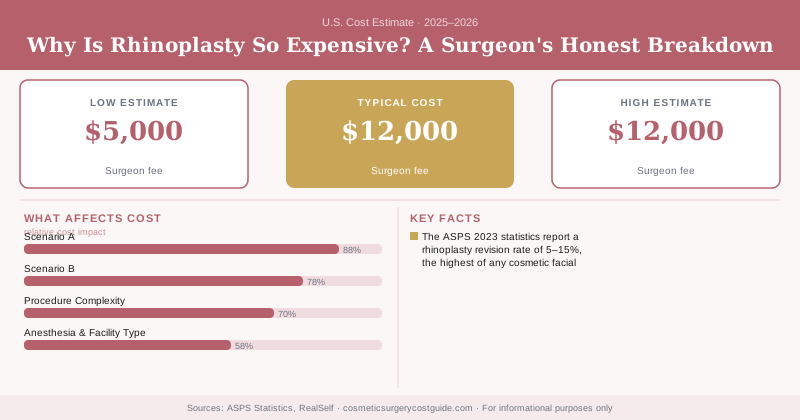
The ASPS 2023 statistics report a rhinoplasty revision rate of 5–15%, the highest of any cosmetic facial procedure. That number exists because the operation is genuinely hard. When you see a surgeon with a very low revision rate and 10+ years of high-volume rhinoplasty experience, you’re paying for outcomes that are statistically better. That premium is rational, not cosmetic.
The Cost Breakdown
| Cost Component | Typical Range | Notes |
|---|---|---|
| Surgeon fee | $5,000–$12,000 | Largest variable; reflects experience & geography |
| Anesthesia | $1,200–$2,500 | General anesthesia; ~2.5–4 hours |
| Facility/OR fee | $800–$2,000 | Hospital vs. accredited outpatient |
| Revision rhinoplasty premium | +$3,000–$8,000 | Over primary pricing |
| Septoplasty add-on (if functional) | +$1,500–$3,500 | May be covered by insurance |
| Cartilage graft harvest | Included–$2,000 | If rib or ear cartilage needed |
The surgeon fee is where most of the variance lives — and it’s largely a function of:
- Training and subspecialty focus: Board-certified facial plastic surgeons and plastic surgeons with dedicated rhinoplasty subspecialty training command premium fees because their outcome data justifies it.
- Volume: A surgeon who does 150 rhinoplasties a year has simply done the operation more times than one who does 20. Volume-outcome relationships are well-documented in surgery research.
- Geography: Rhinoplasty in New York or Los Angeles routinely runs $14,000–$20,000. The same-caliber surgeon in Dallas or Chicago typically charges $9,000–$14,000.
Why Experience Has Such a Premium
Here’s the detail most patients don’t know: rhinoplasty results continue changing for 12–18 months post-surgery as swelling resolves and scar tissue matures. An experienced surgeon knows how to build in allowances for that change — how a tip will “drop,” how the dorsum will settle, where to plan for tissue contracture.
An inexperienced surgeon may produce a result that looks good at 3 months and problematic at 18. By then, you’re in revision territory — which is harder, more expensive (typically $3,000–$8,000 more than primary rhinoplasty), and produces smaller incremental improvements because scar tissue limits what’s workable.
Going with a $6,000 “deal” rhinoplasty that ends up requiring revision is often more expensive than starting with a $13,000 surgeon.
Scenario A: $6,000 primary + $8,000 revision = $14,000 total (plus a second recovery)
Scenario B: $13,000 primary, no revision = $13,000 total (one recovery)
This isn’t hypothetical — it’s why experienced rhinoplasty surgeons often point out that their higher fees actually represent better value per outcome. The math works.
Ethnic and Structural Complexity Add Cost
Standard Caucasian rhinoplasty involves straightforward cartilage reduction and refinement. But ethnic rhinoplasty — preserving ethnic identity while refining specific features — requires different techniques, often cartilage grafting rather than just reduction, and a different skill set.
Similarly, thick-skin rhinoplasty (common in Middle Eastern and Hispanic patients) requires extensive tip work because the skin envelope doesn’t conform to underlying structure the way thinner skin does. These procedures take longer and are technically harder, which is reflected in pricing.
Revision rhinoplasty is the most expensive category: scar tissue has replaced pliable tissue, structural support may have been weakened, and available cartilage is reduced. Surgeons charge more — and rightly so — because the technical bar is much higher.
What “Cheap Rhinoplasty” Actually Means
If you’re seeing quotes well below market — say, $4,000–$6,000 from a US surgeon in a major market — here’s what’s usually behind it:
- Resident surgeon (supervised training case) at an academic center — legitimately lower cost, appropriate disclosure
- General plastic surgeon with limited rhinoplasty volume (not a subspecialist)
- Significant geographic discount in a lower-cost metro
- Package pricing that doesn’t include anesthesia or facility separately (get itemized quotes)
None of these is automatically a red flag. But each requires additional diligence. Ask about revision rates, see before-and-after photos of at least 50 patients (not 10 curated picks), and verify board certification specifically.
| Market | Typical Range | Notes |
|---|---|---|
| New York / Los Angeles | $12,000–$20,000 | Top-tier specialists |
| Miami / Chicago / Dallas | $9,000–$15,000 | Strong rhinoplasty market |
| Mid-size metros | $7,000–$12,000 | Wide quality range |
| Academic centers (resident) | $4,000–$8,000 | Supervised; appropriate for simpler cases |
The Functional Rhinoplasty Exception
If your rhinoplasty includes correction of a deviated septum, nasal valve collapse, or structural breathing obstruction, the functional portion may be covered by insurance under septoplasty codes. This can reduce your out-of-pocket cost by $1,500–$4,000.
The catch: insurance will pay only for the functional correction, not the cosmetic refinement. You’ll likely pay a split invoice — insurance handles the septoplasty, you pay the aesthetic rhinoplasty portion. Your surgeon’s billing team handles this regularly; ask them to walk you through the breakdown at consultation.
Never choose a rhinoplasty surgeon based on price alone. This is the one cosmetic procedure where a lower quote most consistently correlates with higher revision risk. The nose is the center of the face — see at least two board-certified surgeons, request to see their rhinoplasty portfolios specifically, and make your decision on outcome quality and communication, not cost.
Bottom Line
Rhinoplasty costs $8,000–$18,000 because it’s genuinely one of the most technically demanding procedures in cosmetic surgery, with a 10–15% revision rate even among skilled surgeons. The premium you pay for an experienced specialist with a strong rhinoplasty portfolio isn’t padding — it’s directly correlated with better first-surgery outcomes and lower revision probability. Given that a revision adds $5,000–$8,000 to your total spend and another full recovery, the math usually favors doing it right the first time.
Frequently Asked Questions
Rhinoplasty costs between $8,000 and $18,000 in the US, with most patients paying $10,000–$14,000 for primary procedures performed by board-certified surgeons. Revision rhinoplasty (correcting previous surgery) typically costs $12,000–$20,000 due to increased technical complexity and operative time.
Insurance covers rhinoplasty only if it's medically necessary to correct breathing problems (functional rhinoplasty), not for cosmetic reasons; you'll typically pay the full cost out-of-pocket for cosmetic procedures. Even functional cases often require pre-authorization and detailed documentation, and you may still owe $3,000–$5,000 in patient responsibility depending on your deductible and coverage limits.
Initial recovery takes 1–2 weeks, with most patients returning to desk work within 7–10 days, though swelling continues to subside for 3–6 months as the final results emerge. You should avoid strenuous exercise, contact sports, and heavy lifting for 4–6 weeks post-surgery to prevent complications and ensure proper healing.