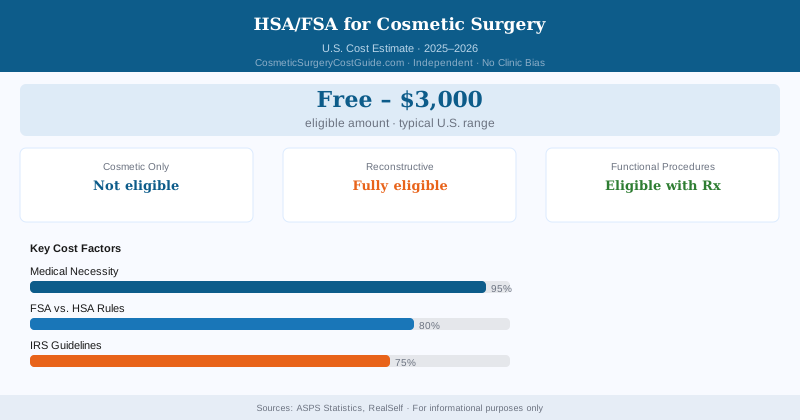
Here’s a myth worth busting right away: HSA and FSA funds are completely off-limits for plastic surgery.
That’s not actually true. The more accurate version is that purely cosmetic procedures don’t qualify — but a meaningful number of procedures that fall under the “plastic surgery” umbrella have legitimate medical components that absolutely do. And even for fully cosmetic procedures, the surrounding expenses (prescriptions, pre-op testing, post-op follow-up) often qualify. If you’ve been assuming your HSA is irrelevant to your surgery budget, you may be leaving real money on the table.
Here’s exactly where the line is and how to use what’s available to you.
What Qualifies vs. What Doesn’t
| Treatment/Component | HSA/FSA Eligible? | Notes |
|---|---|---|
| Functional rhinoplasty (septoplasty) | Yes | Treating breathing obstruction |
| Cosmetic rhinoplasty component | No | Purely aesthetic improvement |
| Breast reduction (medical indication) | Yes | With insurance pre-auth documentation |
| Breast augmentation | No | Cosmetic |
| Upper eyelid surgery (functional ptosis) | Yes | With visual field documentation |
| Lower eyelid (cosmetic) | No | No functional impairment |
| Breast reconstruction post-mastectomy | Yes | Covered under WHCRA |
| Liposuction | No | Purely cosmetic |
| Botox for hyperhidrosis | Yes | FDA-approved indication |
| Botox for wrinkles | No | Cosmetic |
| Scar revision (functional impairment) | Possible | Documented functional limitation |
| Laser hair removal (medical necessity) | Possible | Hirsutism treatment, with documentation |
| Acne treatment | Yes | Topical and some procedural treatments |
| Sunscreen (SPF 15+, broad spectrum) | Yes | Added by Congress (2020) |
| Compression garments (post-surgical) | Yes | When medically prescribed |
The IRS Rule: What Makes a Procedure “Medical”
IRS Publication 502 governs HSA/FSA eligibility. The core rule is simple:
Eligible: Procedures that “alleviate or prevent a physical or mental defect or illness” — medical necessity, essentially.
Not eligible: Procedures “of a cosmetic nature, such as face lifts, hair transplants, hair removal, and liposuction.”
The gray zone: A lot of real-world procedures fall somewhere in between. Rhinoplasty is the classic example — the septoplasty component that fixes a breathing obstruction is eligible; the cosmetic reshaping of the nose tip isn’t. Those two things can happen in the same OR on the same day, but they’re treated differently by the IRS.
For procedures with both medical and cosmetic components, proper documentation allows you to use HSA/FSA funds for the medical portion:
- Get your surgeon to provide an itemized invoice showing separate fees for the medical vs. cosmetic components
- Keep documentation of the medical necessity (physician letters, test results)
- Use HSA/FSA funds only for the documented medical portion
- Retain all documentation in case of HSA/FSA audit
The HSA administrator or FSA plan administrator may require documentation. Keep everything. Claiming cosmetic components as medical is considered tax fraud — a serious risk not worth the marginal savings.
HSA vs. FSA: Key Differences for Surgery Planning
FSA (Flexible Spending Account):
- Employer-sponsored; funded with pre-tax payroll deductions
- “Use it or lose it” — funds must typically be used by year-end (with 2.5-month grace period or $610 carryover allowed under current rules)
- Maximum contribution: $3,050/year (2025)
- Can be used as soon as contributed to (full-year election available from day 1)
- No investment options
HSA (Health Savings Account):
- Available only to those with a High Deductible Health Plan (HDHP)
- Funds roll over indefinitely — no “use it or lose it”
- Maximum contribution (2025): $4,150 individual, $8,300 family
- Can be invested for tax-free growth
- Can be used at any age for qualified medical expenses, or at 65 for any purpose (taxed like an IRA)
For surgery planning, HSA is far more flexible. You can save over multiple years, invest the balance so it grows, and deploy it when your procedure date arrives.
Botox for Hyperhidrosis: A Clear HSA/FSA Win
This is one of the more straightforward eligible situations. Botox injected for medically diagnosed primary axillary hyperhidrosis is FDA-approved specifically for that condition — it’s not cosmetic. With documented diagnosis and appropriate treatment:
- The physician consultation: eligible
- The Botox treatment for hyperhidrosis: eligible
- Compression undergarments prescribed post-treatment: eligible
Botox for hyperhidrosis runs $1,000–$1,500 per session. Using pre-tax HSA/FSA funds saves 22–37% depending on your marginal tax bracket. That’s $220–$555 back on a $1,000 treatment, just from using the account you already have.
Post-Surgical Expenses That Qualify
Even when the surgery itself is purely cosmetic, the surrounding expenses often aren’t:
Eligible:
- Prescription medications: eligible
- Compression garments if medically prescribed: eligible
- Follow-up medical appointments: eligible
- Bandages and wound care supplies: eligible
- Anesthesia for a medically necessary procedure: eligible
Not eligible:
- Compression garments without a prescription: possibly not (check with your administrator)
- Massage for post-surgical lymphatic drainage: not medical (unless specifically prescribed)
- Recovery nutrition supplements: not eligible
The Accountable Care Strategy: Save Pre-Tax for Surgery
If you’re planning a procedure 12–36 months out, a proactive HSA strategy cuts the real cost:
- Maximize HSA contributions ($4,150/year individual, $8,300 family)
- Invest the HSA in index funds while leaving it alone
- When surgery arrives, pay all eligible components — functional portions, pre-op testing, prescriptions — with HSA funds
Example: Over 2 years, you contribute $8,300 to an HSA. Invested at 7%, it grows to roughly $9,000. At a 25% marginal tax rate, the tax savings on that $8,300 contribution was $2,075. Your real cost dropped by $2,075 in taxes, plus any growth. That’s not nothing.
Never use HSA or FSA funds for cosmetic procedures and claim them as medically necessary. The IRS can audit HSA transactions; employers can audit FSA transactions. Fraudulent use carries significant penalties (income tax plus a 20% penalty). Administrators increasingly require documentation for larger claims. The legitimate savings available are real and worth pursuing — the fraudulent path isn’t.
Bottom Line
HSA and FSA funds can’t be used for purely cosmetic plastic surgery — that part of the myth is true. But they absolutely can cover medically necessary components (septoplasty, functional ptosis correction, breast reduction with medical indication, hyperhidrosis treatment), post-surgical prescriptions, and pre-op testing. If your procedure has any medical component, document it carefully and use pre-tax funds for that portion. And even if you’re having a purely cosmetic procedure, maximize HSA contributions beforehand — the eligible expenses around surgery add up.