Picture this: you’ve got a big event in five days — a wedding, a reunion, job photos — and your skin looks tired, congested, and dull. You’re not looking for a peel that will leave you peeling for a week. You need something that makes you look better by tomorrow.
That’s the scenario where HydraFacial was basically invented for. The brand claims a HydraFacial is performed somewhere in the world every 15 seconds, and the reason isn’t marketing hype — it’s that almost everyone who gets one walks out with visibly better skin and zero downtime. For a specific set of goals, it delivers.
Whether it’s the smartest use of your aesthetic budget overall is a different question.
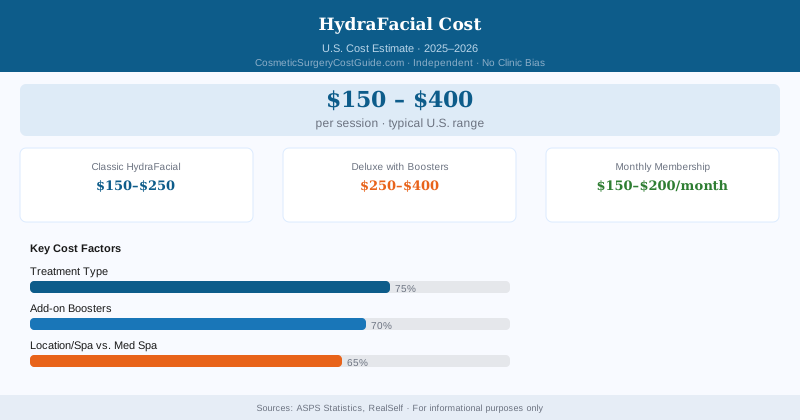
HydraFacial Cost in 2025
| Tier | What’s Included | Cost |
|---|---|---|
| Basic HydraFacial (Signature) | 3-step core treatment | $150–$250 |
| Deluxe HydraFacial | Core + booster serum | $200–$350 |
| Platinum HydraFacial | Core + booster + lymphatic drainage | $250–$450 |
| Perk Add-On (lip or eye) | Specialized add-on treatment | $50–$100 extra |
| HydraFacial package (6 sessions) | Monthly series | $750–$1,500 |
What Happens During a HydraFacial
The HydraFacial uses the proprietary Vortex-Fusion device and runs through three steps:
Step 1 — Cleanse and Exfoliate: A gentle peel solution loosens dead skin cells and sebum.
Step 2 — Acid Peel: A mild glycolic and salicylic acid solution is applied and removed — without the visible peeling you’d get from a standard chemical peel.
Step 3 — Extract and Hydrate: A vacuum tip pulls out blackheads and congestion while simultaneously pushing hyaluronic acid, peptides, and antioxidants into the skin.
That simultaneous extraction-and-infusion is what makes it feel different from anything else. There’s no trade-off between clearing out your pores and irritating your skin — both happen at once.
Add-Ons and Boosters: Where Upselling Happens
The core HydraFacial is a complete treatment on its own. Add-ons are genuinely optional:
Boosters: Specific serums tailored to your skin concern (anti-aging, brightening, clarifying) added during the infusion step. Examples: CTGF, Britenol, Dermabuilder. Cost: $50–$100 each.
LED light therapy: Red (collagen stimulation) or blue (acne bacteria) light added after treatment. $50–$75.
Perk treatments: Lip or eye-specific treatments using smaller tips. $50–$100.
Lymphatic drainage: A massage technique before treatment to improve circulation. $50–$75.
Growth factors or PRP: Premium add-ons for specific concerns. $100–$300.
One targeted booster is often worth it. A full suite of add-ons on every visit inflates the price significantly without proportional benefit. Know what you’re there for.
A monthly HydraFacial at $200 runs $2,400/year. A physician-recommended at-home skincare routine (retinoid, vitamin C serum, SPF, moisturizer) costs $200–$500/year and likely produces more cumulative skin improvement for most people.
The smarter approach: HydraFacial quarterly or every 2 months for deep cleansing and a visible reset, paired with a consistent at-home routine that does the heavy lifting between visits. Monthly HydraFacials are enjoyable and produce genuinely good skin — they’re just not a substitute for prescription retinoids or daily SPF.
Who Benefits Most from HydraFacial
Great for:
- Congested skin, large pores, blackheads
- Dull, dehydrated skin that needs a quick boost
- Pre-event prep — results are immediate and last 5–7 days
- Sensitive skin that can’t tolerate more aggressive treatments
- People new to medical aesthetics who want a gentle starting point
Not ideal for:
- Active severe acne (manual extraction can spread bacteria)
- Deep wrinkles or significant sun damage (laser and peels do more work here)
- Patients looking for the highest impact per dollar spent
HydraFacial vs. Traditional Facial vs. Chemical Peel
| Treatment | Cost | Downtime | Results |
|---|---|---|---|
| Standard spa facial | $80–$150 | None | Minimal, temporary |
| HydraFacial | $150–$300 | None | Immediate glow, congestion clearing |
| Glycolic acid peel | $100–$250 | 1–2 days light flaking | Better for texture/pigment |
| VI Peel (medium) | $300–$450 | 5–7 days | More significant long-term results |
HydraFacial sits in a useful middle ground — meaningfully better than a spa facial, with far less recovery than even a medium-depth peel. If you need to look good at an event in 48 hours, it’s probably your best option.
HydraFacial is a proprietary system — the device costs practices $20,000–$40,000, which shows up in the per-session price. You’re paying for the equipment, the single-use consumables, and the treatment itself. At $200–$300 for a 30–45 minute appointment, it’s not the most cost-efficient treatment per result. But for immediate, visible, zero-downtime skin improvement, it does what it says — and that’s worth something.
Package Savings
Most practices offer package pricing:
- 6-session package: 10–20% off single-session price
- Monthly membership: Some practices offer monthly treatments for $130–$200 vs. $200–$300 single session
If you’re planning quarterly or monthly treatments, the package math is usually worth running. Memberships especially can cut per-session cost meaningfully over a year.
Bottom Line
A standard (Signature) HydraFacial: $150–$250 per session at most medical spas. Add one targeted booster: $50–$100 extra. A quarterly schedule runs $600–$1,200/year. For zero-downtime immediate skin improvement, it’s one of the most reliable treatments available — just don’t expect it to replace what prescription retinoids or laser resurfacing can do for persistent texture or pigment concerns.